Thune Gets Senate History Wrong
Mike Lee isn't asking Thune to do something extraordinary. He’s only asking to use the Senate’s rules as senators used them in the past.
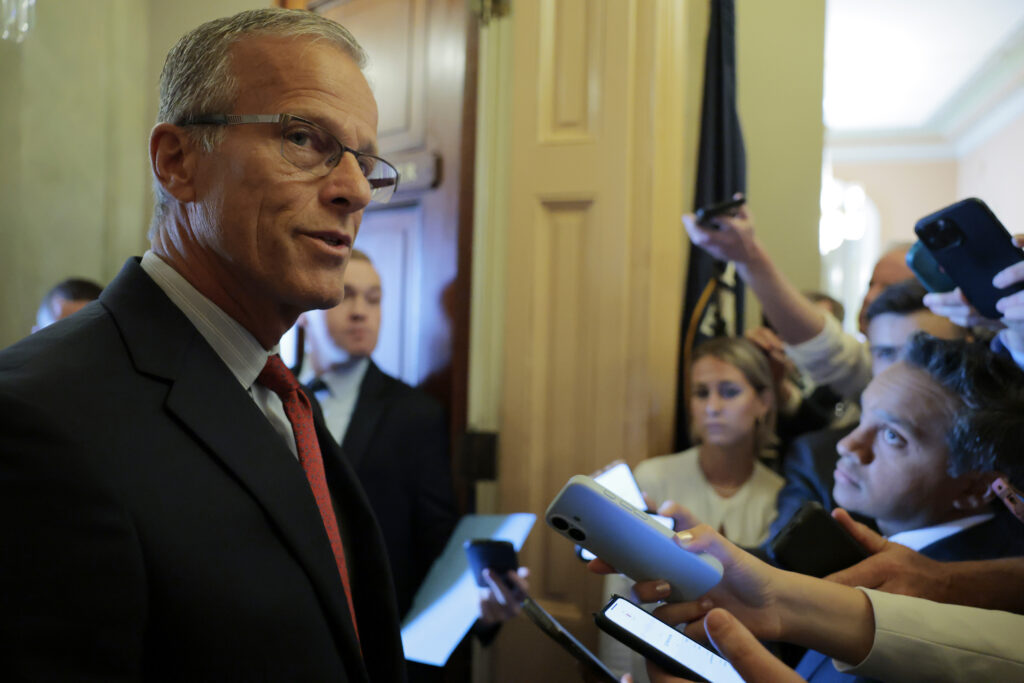
Democrats are blocking the SAVE America Act, and President Trump wants Senate Republicans to make them do it the hard way. He attended the Senate Republicans’ lunch to renew that demand, as Senators Mike Lee, R-Utah, and Rick Scott, R-Fla., press their colleagues — including Senate Majority Leader John Thune, R-S.D. — to use the Senate’s existing rules to overcome Democratic obstruction and pass the bill.
Lee made the case to Thune on X. “As I’ve been asking you to do for months, please bring it up now and announce that we will debate it until it passes.”
But Thune dismissed the idea, again. “Sometimes when something hasn’t been done in 100 years,” he replied, “there’s a reason for that.”
Thune’s quip sounds clever. But his contention that the Senate has relied on cloture to end debate for the last 100 years is wrong. The Senate’s present dependence on cloture to end debate and pass legislation is not a century-old tradition. It is a relatively recent habit. For most of the Senate’s history — even after it adopted the cloture rule — senators debated legislation until debate ended. Then they voted.
Cloture empowers a super-majority of senators to end debate over a senator’s objection and proceed to a final up-or-down vote on the underlying question. The Senate adopted the rule in 1917. Before that, the Senate had no formal procedure by which a supermajority could force an end to debate. Nevertheless, senators still managed to pass tariffs, charter national banks and regulate them, approve appropriations bills, and vote on other landmark legislation.
And the Senate rarely invoked cloture to end debate after adopting the rule in 1917. Senators turned to cloture just five times between 1917 and 1962. Five times in forty-three years. During that span, the Senate passed Social Security, the Wagner Act, and the Marshall Plan. It did so without leaning on Rule XXII, because cloture required a two-thirds vote that majorities rarely commanded. When the Senate wanted to act, it held the floor, wore down the opposition, and voted.
The Senate’s 1964 Civil Rights Act debate proves the point. It was the first time the Senate broke a filibuster of a major civil rights bill by invoking cloture. However, it took a sustained and exhausting floor fight to do it. It was a big deal when the Senate finally invoked cloture precisely because senators had rarely used the tool up to then.
The practice Thune refers to is a recent change in how the Senate ends debate and votes on bills. In the early 1970s, the Senate began using a “two-track” system that allowed leaders to set a bill under filibuster aside and move on to other business. The new practice removed the physical cost of obstruction for senators opposed to legislation. In 1975, the Senate lowered the cloture threshold from two-thirds of those voting to three-fifths of senators duly chosen and sworn (typically 60). That decision made invoking cloture easier.
The resulting shift in Senate practice is evident in the data — a chamber that invoked cloture five times in four decades now files hundreds of cloture motions every two years.
That is not an iron law of Senate procedure. It is a leadership — and senator — choice.
Lee is not asking Thune to do something extraordinary. He’s only asking his colleagues to use the Senate’s rules as senators used them in the past — bring up a bill, keep it on the floor, make its opponents hold the floor and talk, and vote when they can no longer talk.
Thune’s clever quip confuses today’s habits with the Senate’s rules and its history.