The Numbers No One on the Right Is Talking About
Democrats have flipped 30 state legislative seats since January. Republicans have flipped zero.
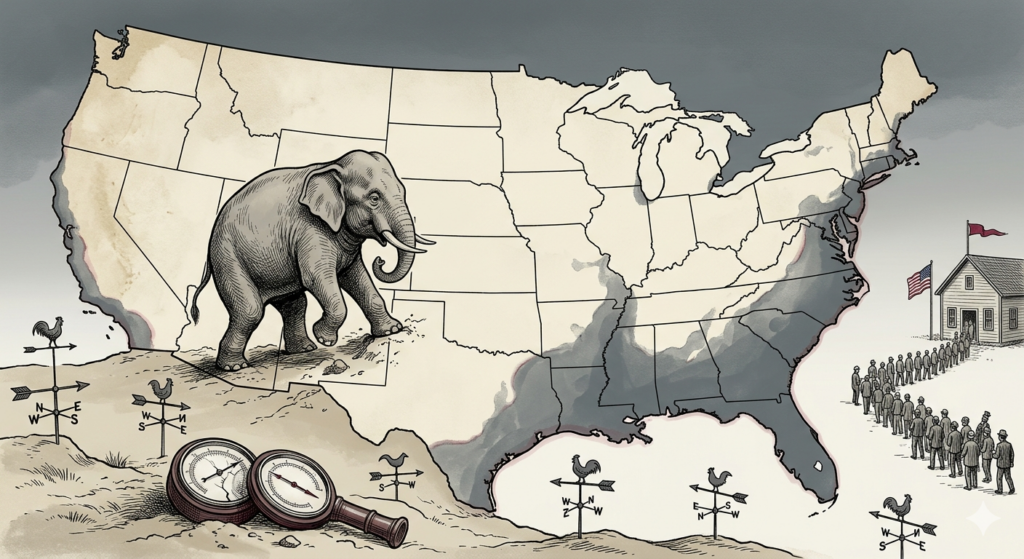
Clay Fuller won. That is the headline Republican operatives will circulate from Tuesday night’s special election in Georgia’s 14th Congressional District, the deep-red seat vacated by Marjorie Taylor Greene. Fuller, a Trump-endorsed district attorney, defeated Democrat Shawn Harris 56% to 44% in a district the president carried by 37 points in 2024. Mission accomplished. Seat held. Move along.
Do not move along. Harris, a retired Army brigadier general and cattle rancher who lost to Greene in the 2024 general election, overperformed the 2024 Democratic presidential baseline by 25 points. Every one of the district’s ten counties shifted toward the Democrat by double digits compared to November 2024. That is not a fluke attributable to a weak Republican field or a charismatic one-off. It is a data point in a trend line that should keep every Republican strategist awake at night.
The same evening, 700 miles north, liberal candidate Chris Taylor defeated conservative Maria Lazar by 20 points in the Wisconsin Supreme Court race, expanding the liberal majority to 5–2 in a state Trump carried by less than a single percentage point. It was the fourth consecutive victory for Democratic-backed judicial candidates in Wisconsin, and Taylor’s margin exceeded the liberal wins in both 2023 and 2025. The conservative bench in the nation’s premier swing state is now locked out of relevance until at least 2030.
These results did not emerge in isolation. According to The Downballot’s analysis, Democrats have improved upon their 2024 presidential margins by an average of 11 points in special elections so far this year, and roughly 13 points since January 2025. Ballotpedia’s data tells a similar story: of 96 state legislative special elections since Trump’s return to office, Democrats won 67 and Republicans 29, with an average margin shift of 5.6 points toward the Democratic candidate. Democrats have flipped 30 state legislative seats since January 2025. Republicans have flipped zero.
The pattern extends well beyond special elections. Virginia Democrats flipped 13 House of Delegates seats in November 2025, capturing the trifecta. In Florida, Democrats won special elections in Republican strongholds, including a state House seat overlapping with Mar-a-Lago. Primary turnout numbers tell the same story: Texas saw a record 2.3 million Democratic primary votes last month. More Democrats than Republicans voted in North Carolina’s statewide primary. Mississippi’s Democratic Senate primary turnout surged nearly 80% over 2018 levels.
The structural explanation is not complicated. Pollster Scott Rasmussen, operating through the Napolitan News Service, has been sounding the alarm since mid-March. His data shows only 24% of registered voters say their personal finances are improving, a five-point drop in two weeks, while 39% say their finances have worsened, an eight-point spike over the same period. Rasmussen called these “the worst numbers we have seen since Trump was elected” and warned that if current conditions hold through November, “Democrats would not only win the House, they would almost certainly win control of the Senate.” Republican seats in Maine, North Carolina, Alaska, and Ohio would all be at risk. The president’s job approval sits at a record-low average of 39%.
Rasmussen identifies the Iran war and its downstream effect on gas prices as the primary accelerant, but the underlying dynamic is older than February’s first airstrikes. The erosion began during the government shutdown last fall, paused briefly when the government reopened, and then accelerated again when fuel costs spiked. The pollster estimates that even if gas prices returned to pre-war levels tomorrow, it would take six months for consumer confidence to recover to its prior baseline. Six months from today is mid-October. The midterm is November 3.
The prediction markets have noticed even if conservative media has not. On Polymarket, the world’s largest prediction market, traders currently price a Democratic House takeover at 87% and a Democratic Senate majority at 53%, with a full Democratic sweep of both chambers at 52%. These are not polls of registered voters or likely voter screens; they are bets placed with real money by people with a financial stake in being right. The market’s assessment reflects a convergence of generic ballot leads averaging D+5 to D+7 in recent polling, a record 36 Republican House retirements signaling incumbent vulnerability, and the sustained drag of gas prices and the Iran war on the president’s 39% approval rating. Prediction markets are not infallible, but they were considerably more accurate than the polling averages in 2024. Republicans who dismiss them do so at their own risk.
None of this is destiny. Special elections attract atypical electorates, and the nationalized midterm battlefield will impose different dynamics. But the argument that special elections are meaningless was wrong in 2017, when Democratic overperformances foreshadowed the 2018 blue wave, and the current data is considerably more emphatic than anything from that cycle. The Right’s media infrastructure has largely ignored the trend, preferring to celebrate individual Republican wins rather than examine the margins. That is a choice. It is also how political parties lose majorities they thought were safe.
The Republican window for course correction is not closed, but as Rasmussen put it, it is “rapidly closing.” The ceasefire with Iran may buy time. But a ceasefire is not a resolution, and a pause in escalation is not a decline in gas prices. The voters who showed up for Shawn Harris in northwest Georgia and Chris Taylor in Wisconsin are telling Republicans something specific. The question is whether anyone on the Right is listening.