He Who Rewrites the Story — Rules
Two reports expose how a narrow elite is rewriting America's monuments and overriding the public they're meant to serve.
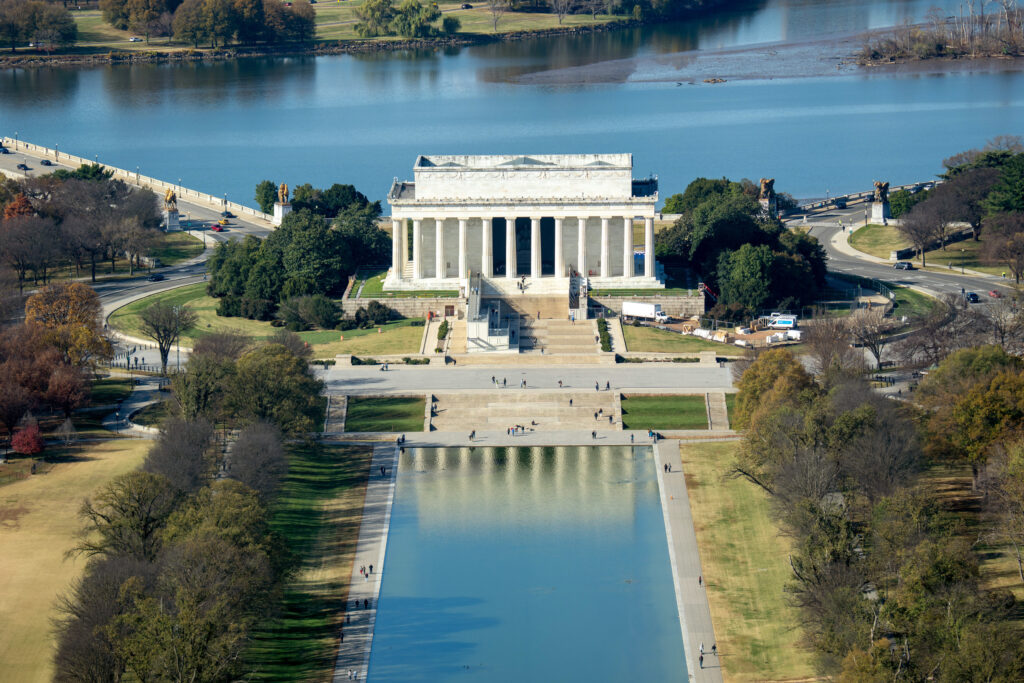
Regimes, at least during their beginnings, are in the business of mythmaking. And one mark of a successful, enduring regime is the longevity of its founding-era stories, songs, historical accounts, and even constitutions. Rome had a good run. America, so far, is not doing so bad herself.
But two recent white papers expose a sinister attempt to methodically transform the American story, and with it the stability of the country. The first, by Jeffrey H. Anderson and John Fonte, investigates how the National Park Service has quite literally recast the founders of the American republic at the very monuments built to honor them. Great statesmen like George Washington are called “deplorable” and branded primarily as slaveholders. Twenty-five of thirty signs at the President’s House Site focus on slavery. This is no longer subtle.
The second paper, from Scott Rasmussen and the Napolitan Institute, provides the survey data that explains why: the people who control America’s institutions hold views so far removed from the citizens they ostensibly serve that the gap can no longer be described as mere disagreement. It is a difference of premise.
Read them together and you get the why and the how. Put another way, you have the left’s blueprint. And once you have the blueprint, you know how to fight back.
The Rewriting Begins at the Monuments
Begin where Americans have always begun: at the monuments. Anderson and Fonte document with careful evidentiary rigor what has happened to the sacred civic spaces where the nation narrates its founding. At Independence Park in Philadelphia, twenty-five of thirty interpretive signs at the President’s House site now center on slavery. Washington’s actions are described as “deplorable,” “profoundly disturbing,” and as having “mocked the nation’s pretense to be a beacon of liberty.” He stands accused, along with other Founders, of “injustice” and “immorality.” The site, opened in 2010 during the Obama presidency, almost entirely ignores the watershed events of the first two presidencies in favor of a myopic prosecution. No mention of Washington’s navigation of early constitutional controversies, his charting of American neutrality in European wars, or his voluntary surrender of power after two terms. At the birthplace of America, the Father of His Country is presented as a hypocrite for the ages.
The assault extends beyond the President’s House. At the Liberty Bell Center, one block away, the famous bell is depicted as having little connection to the Founding at all. It is presented mostly as a symbol of the abolitionist movement and subsequent campaigns for women’s suffrage and gay rights. American freedom, won by beating the British, is downplayed. The sacrifices of hundreds of thousands who died in the Civil War to end slavery, the statesmanship of Lincoln, and the passage of the Thirteenth Amendment are either ignored or mentioned in passing. Visitors to this shrine of American independence would conclude that the Liberty Bell is largely disconnected from the Revolution.
At the Jefferson Memorial, the Park Service was nearing completion of a project to transform the basement museum into a woke condemnation of Jefferson himself. The overarching heading for the redesigned exhibit was “DEMOCRACY: A WORK IN PROGRESS.” Coming-soon signs posed questions like “Do Our Heroes Change?” and “Why a Jefferson Memorial?” The NPS signage declared that the memorial’s original designers had merely sought “to convey their mid-1900s version of US democracy” and that “studying these choices reveals their motives.” Anderson and Fonte alerted the White House Domestic Policy Council and wrote the public case for City Journal. The woke signage was subsequently removed. But the previous exemplary museum, which featured Jefferson’s own words and ideas, has not been restored. And just down the Tidal Basin path, a NPS sign at the George Mason Memorial falsely labels the author of the Virginia Declaration of Rights an “enslaver”: a weaponized term deliberately chosen, as Fonte observes, to collapse the moral distinction between inheriting slaves and seizing free men, thereby slandering the Founders and delegitimizing the civilization they built.
The Money and the Museums
Underwriting much of this effort is the Andrew W. Mellon Foundation, which has committed $500 million to what it calls “transforming the nation’s commemorative landscape.” Mellon’s president, Elizabeth Alexander, has declared it “a social justice foundation” in which “equity infuses absolutely everything we do.” The foundation’s National Monument Audit laments that “there are no US-born Latinx, Asian, Pacific Islander, or self-identified LGBTQ+ people” among the fifty most memorialized Americans. In other words, Mellon wants the portrayal of American history to prioritize demographic representation over the achievements that built the civilization those memorials adorn.
The Mellon Foundation is funding sixteen postdoctoral fellowships at NPS sites, described as “a signature element” of the Park Service’s commemoration of America’s 250th anniversary. The projects tell you everything about the priorities. At Fort McHenry, birthplace of the National Anthem, the fellowship researches enslaved people who joined the British Colonial Marines during the War of 1812. At Keweenaw National Historical Park, the project studies “gender-nonconformity” in Michigan’s copper mining range. At Saratoga, the fellowship aims to “revolutionize the narratives” at Philip Schuyler’s estate through the “intersectional” lens of “ethnicity, race, gender, and class.” At the Thomas Edison National Historical Park, the project bypasses the man who invented the light bulb and the phonograph in favor of studying “the lives of six generations of domestic workers.” None of this is enriched scholarship. It is narrative replacement conducted through curatorial authority.
Meanwhile, the Smithsonian, which draws sixty-two percent of its operating revenue from federal taxpayers, has become the institutional center of gravity for this transformation. Secretary Lonnie Bunch, whose avuncular personality masks his radical designs, has stated plainly: “People trust museums. If you don’t talk about social justice, then you’re not a museum.” He has spoken of wanting museums to “inspire new generations of activists” and of making “diversity and inclusion so central that it’s no longer talked about.” A 2019 Smithsonian Magazine article noted Bunch’s “insistence that the Smithsonian support the New York Times’ 1619 Project,” adding that he “took pains to ensure the Smithsonian’s name would be publicly associated with it.” This is not a custodian of the national inheritance. It is an activist with a budget.
A Near-Perfect Inversion
Now consider the sociology, because the data reveals the class interest behind the project.
Rasmussen’s Napolitan Institute research identifies what it terms the “Elite 1%”: Americans holding postgraduate degrees, earning above $150,000, and residing in dense urban zip codes. They constitute roughly one percent of the population. Their institutional influence is vastly disproportionate. And their convictions represent a near-perfect inversion of mainstream American belief.
The figures are bracing. Forty-seven percent of the Elite 1% maintain that Americans enjoy too much individual freedom. Among the subset Rasmussen calls Politically Active Elites, those who discuss politics daily, that number rises to sixty-nine percent. Seventy percent of the Elite 1% express trust in the federal government to do the right thing most of the time, against twenty-two percent of voters nationally. Among the Politically Active Elites, trust in the federal government reaches eighty-nine percent. More than three-quarters of the Elite 1% favor banning private gun ownership. Seventy-seven percent favor strict rationing of gas, meat, and electricity to fight climate change. Majorities favor banning gas-powered cars, gas stoves, SUVs, non-essential air travel, and private air conditioning.
The gap on education is revealing. Sixty-two percent of voters say parents have too little control over their children’s education. Among the Politically Active Elites, fifty percent say parents have too much. Half of the Elite 1% believe that people without a college degree should not be allowed to vote. Among the Politically Active Elites, sixty-nine percent hold that view. And yet sixty-three percent of those same Politically Active Elites simultaneously believe that Congress would be more representative if it had more members without college degrees. The implication is not subtle: they want a less representative government, and they know it.
Perhaps most alarming is what Rasmussen calls the “delusions” of the Elite 1%. Two-thirds of them believe that most voters agree with them on important issues. They do not. Sixty-five percent believe most voters trust the federal government. In reality, just twenty-two percent do, and it has been more than half a century since a majority of Americans expressed such trust. Fifty-nine percent of elites believe most voters want to live in communities where guns are outlawed. Most voters prefer the opposite. The elites have constructed a mirror that reflects only themselves and mistaken it for a window onto the country.
This self-delusion has operational consequences. Asked what they would do if their preferred candidate lost a close election and their campaign team thought it could get away with cheating to win, seven percent of voters said they would want their team to cheat. Among the Elite 1%, that figure rises to thirty-five percent. Among the Politically Active Elites, sixty-nine percent would rather cheat than accept the voters’ decision.
The Permanent Government’s Own Consensus
And then there is the administrative state. A separate Napolitan Institute survey of federal government managers living in the Washington, D.C., area found that they align more closely with the Elite 1% than with the public whose laws they execute. Fifty-one percent of federal government managers believe there is too much individual freedom in America. Fifty-four percent say that if their research concludes a regulation is needed but voters overwhelmingly oppose it, they should issue the regulation anyway. Seventy-four percent of Republican government managers and seventy-nine percent of Democrats favor banning private gun ownership. The partisan divide, in other words, barely exists among those who run the machinery. The permanent government has its own consensus, and it is not the country’s.
Not Coincidence, but Structure
What Anderson and Fonte document at the ground level, the patient, methodical revision of the American story at its most consecrated sites, Rasmussen quantifies at the population level. The relationship between the two is not coincidental. It is structural. The same narrow stratum that regards your liberty as excessive is the stratum staffing the agencies, endowing the foundations, and curating the exhibits that shape how the next generation understands its inheritance.
The Mellon Foundation did not consult the American public before committing half a billion dollars to reimagine the nation’s monuments. The National Park Service did not seek the consent of the governed before redesigning the Jefferson Memorial around the moral vocabulary of his critics. They did not need to. They occupy the commanding heights of institutional life, they share a coherent worldview, and they assumed, not unreasonably, that the public lacked the vocabulary and the venue to object.
That assumption is now being tested. These two reports, read side by side, supply both the vocabulary and the evidence. They demonstrate that the rewriting of America’s public memory is not the work of disinterested scholars pursuing uncomfortable truths. It is the product of a discrete class, identifiable by education, income, and geography, imposing its own ambivalent relationship with the American founding on a nation that does not share it.
Daniel Webster, reflecting on the creation of the republic in an 1802 Fourth of July address, observed that “miracles do not cluster. That which has happened but once in six thousand years cannot be expected to happen often.” The men now curating America’s monuments and staffing its administrative agencies do not believe a miracle occurred. They believe a crime did. And they have spent decades building the institutional architecture to make that conviction the national inheritance. The question before the country is not whether these institutions will be reformed. It is whether the Americans who still recognize the miracle will reclaim them before the story is told without them.