The Creed Holds
A new American ideals poll: voters affirm the founding creed at 91% to 98%, but only 44% say the country still honors it. The argument is the verdict.
Ninety-eight percent of registered voters say the law should apply equally to everyone, no matter who they are. Ninety-one percent say our rights to life, liberty, and the pursuit of happiness come from the Creator and lie beyond the reach of government. Forty-four percent say America today is a land of liberty and justice for all.
A new Napolitan News Service survey of 1,000 registered voters, conducted April 22–23, 2026, by Scott Rasmussen and RMG Research, finds the consensus on the country’s first principles running across nearly every line that usually divides it. Eighty-four percent rate the equal application of the law as very important. Eighty-three percent say the same of being judged by the content of one’s character rather than the color of one’s skin. Seventy-one percent place the Creator-endowed unalienable rights of the Declaration in the very-important column. The numbers hold across party, sex, age, and region.
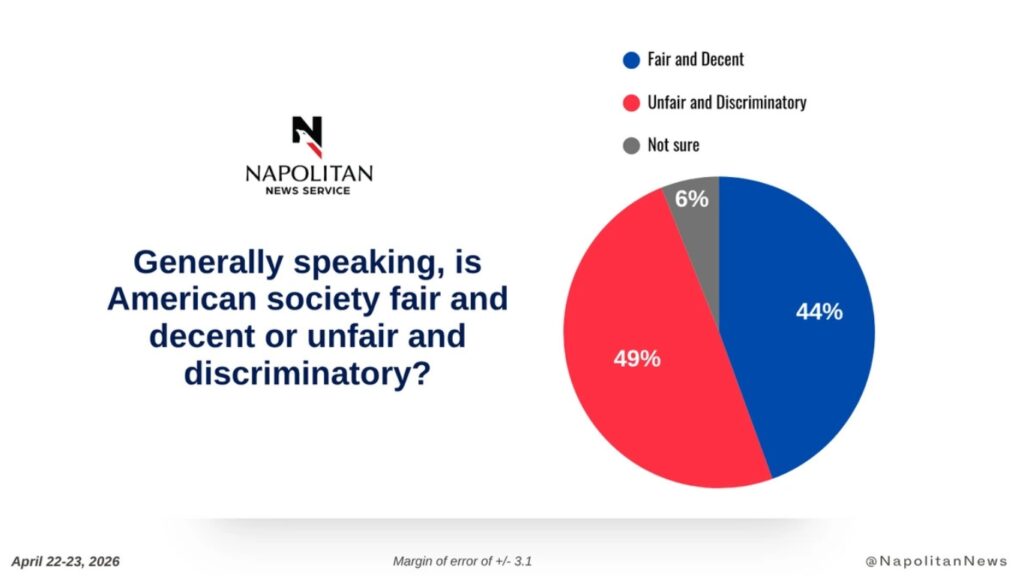
The contrast appears when the same voters are asked about the country they actually live in. The companion release shows 44% calling America today a land of liberty and justice for all, with 49% saying it is not. Forty-four percent describe American society as fair and decent; 49% call it unfair and discriminatory, a figure that has climbed nine points in three weeks. Only the older promise of opportunity still holds a clear majority: 59% say America remains the land of opportunity, with 27% disagreeing. Even there, the country splits by sex, with 70% of men and 49% of women saying so.
Pause on the gap. It is not the gap between believers and skeptics. The same sample that affirms the creed at 91% to 98% splits roughly evenly on whether the country lives up to it. The disagreement is not about the founding. It is about the verdict.
The partisan distribution looks like the partisan distribution of almost everything else. Republicans call American society fair and decent, 66% to 27%. Democrats reverse it, 70% to 25%. Republicans call America a land of liberty and justice for all, 69% yes; Democrats say no by the same margin. Read those numbers without reading the first set, and one would conclude America is split over its first principles. Read them together, and a different picture emerges. Both parties, in overwhelming numbers, accept the same premises. They render different verdicts about whether the country currently honors them.
This is the argument Abraham Lincoln returned to throughout his career: that the Declaration set a standard maxim for free society, one to be “constantly looked to, constantly labored for, and even though never perfectly attained, constantly approximated.” The question for Lincoln was never whether the principles were true. The question was whether the Republic continued to honor them.
Rasmussen’s earlier Napolitan Institute work established the same point from the other side. The country’s Elite 1%, voters with postgraduate degrees, household incomes above $150,000, and residences in dense urban zip codes, holds views on liberty and federal authority that diverge sharply from the broader public on every major axis. The April survey now establishes the public’s position with unusual clarity. The creed has not moved. The consensus from which the country draws its moral vocabulary is not eroding among the public. It is being abandoned, where it is being abandoned, by a discrete and identifiable elite.
The most striking finding closes the survey. Asked whether America would be stronger or weaker if it lived out its ideals about rights, liberty, freedom, and equality, 88% of voters said stronger. Sixty-five percent said much stronger. Eight percent said weaker. There is no meaningful party gap on the answer.
That number is the one to keep. The American public is not, by anything visible in this data, asking the country to abandon its creed. They are asking it to honor the creed it already has. The verdict on America’s institutions is contested. The verdict on America’s first principles is not.