The Court Loses Both Sides
In six weeks, SCOTUS has bled 20 net points of approval. The defection is bipartisan.
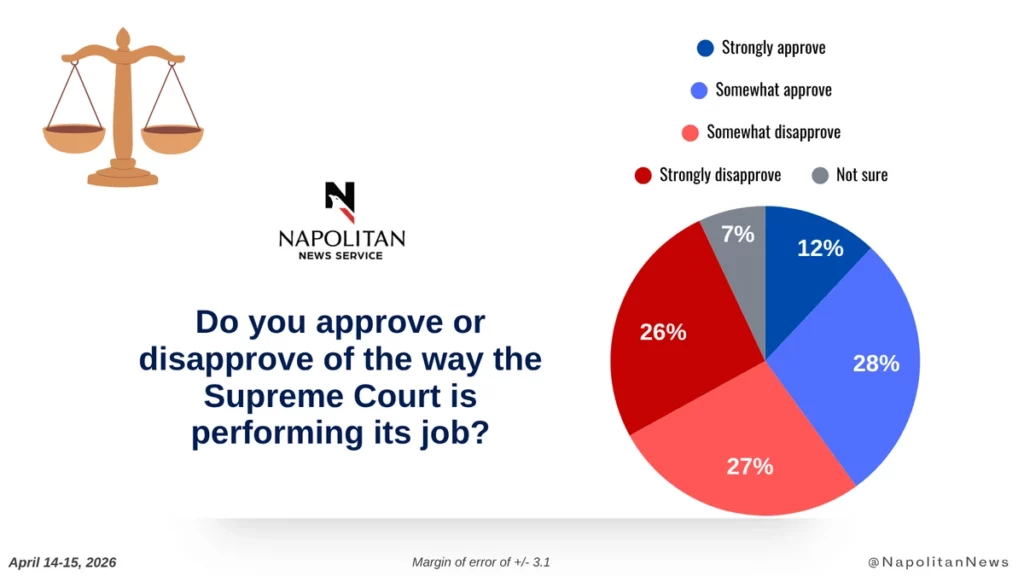
Forty percent of registered voters approve of how the Supreme Court is performing its job. Fifty-three percent disapprove. A new Napolitan News Service survey, conducted April 14–15 by Scott Rasmussen’s team, finds the Court underwater by 13 points, a 20-point net collapse from the +7 reading recorded just six weeks earlier in early March.
Numbers like these are sometimes the product of a single ruling or a single news cycle. This one is not. Strip away the topline and a more troubling pattern emerges: the Court is bleeding support from constituencies that should have no shared reason to abandon it.
Consider the ideological balance. Thirty-seven percent of voters now say the Court is too conservative; 23% say it is too liberal. That tilt is unsurprising given the bench’s composition. What is surprising is who supplies the “too liberal” reading. Among Republican voters, 37% say the balance is “about right,” another 37% say it is “too liberal,” and only 15% call the Court too conservative. A 6–3 conservative majority appointed in living memory has somehow failed to satisfy the base whose presidents put it there.
Democrats, predictably, have moved in the opposite direction. Sixty percent of them say the Court is too conservative; 74% disapprove of its performance overall. The disapproval, however, is no longer a partisan minority. It is the country.
The structural finding is starker still. Asked whether the Court generally favors individual freedom or government regulation when the two collide, 43% of voters say it sides with regulation. Just 15% say it sides with the individual. That ratio has held above 40% for nine consecutive months, after registering in the mid-30s through the first half of 2025. Whatever Americans believe the Court is doing, a near-majority believe it is doing it on the side of the state.
This is the perception problem the conservative legal movement has spent decades trying to fix. The argument for textualism, originalism, and the dismantling of administrative-state deference was always that the federal judiciary had drifted from its proper role as a guardian of liberty against government overreach. Three Trump appointees and a 6–3 majority later, only one in seven voters believes the Court is performing that role.
Some of the recent erosion has identifiable causes. On April 1, the Court heard oral arguments on the constitutionality of the executive order limiting birthright citizenship, a case that has generated saturation coverage and predictably partisan framing. The Washington Post published a feature on April 9 declaring the Trump-remade Court the first since the 1950s to reject a majority of civil rights claims involving women and minorities. Such pieces are not data; they are narrative. But they shape the environment in which polling occurs.
The deeper context is institutional. Approval of every federal entity has been crashing for a decade, and the Court, long insulated by its perceived independence, has finally caught up with the rest. When 53% of registered voters disapprove of the highest court in the land and only 12% strongly approve, the institution is operating without the reservoir of legitimacy it has historically drawn upon. Decisions handed down under those conditions land harder, are contested longer, and erode the bench further.
Whether that erosion accelerates depends in part on how the Court rules in the cases now before it. A decision on birthright citizenship is expected by early summer. So are decisions in any number of pending administrative-state cases that will test whether the conservative majority is willing to follow its stated principles where they lead. If the answer is no, the Republican defection visible in this poll will harden. If the answer is yes, the Democratic disapproval will deepen.
There may be no ruling that satisfies both sides. That is the position of every institution that has lost the country. The Court has now joined them.