The Compact Nobody Expects to Be Honored
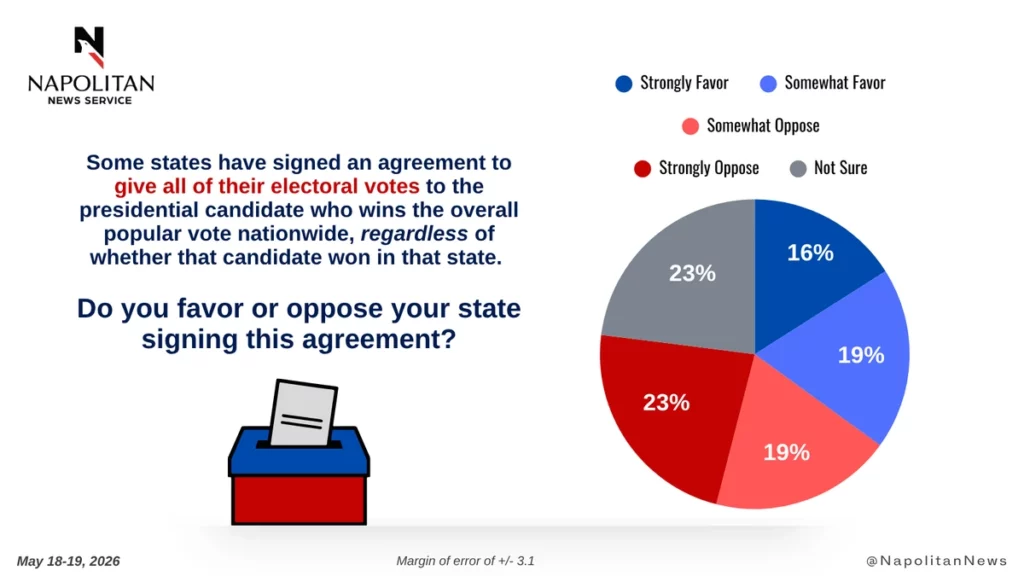
The National Popular Vote Interstate Compact is the long campaign to retire the Electoral College without the inconvenience of amending the Constitution. States pledge their electors to the winner of the national popular vote, and once enough states join to control 270 votes, the compact takes effect. Seventeen states and the District of Columbia have signed on so far. A new Napolitan News Service survey finds the public still unpersuaded: 35% favor the agreement and 42% oppose it, a net deficit of seven points. The number who favored it has not budged since August 2022. Opposition has merely softened, from a net of eleven points then to seven now.
The more revealing finding is the one the compact’s architects would prefer you skip.
Voters do not believe the thing would survive contact with a close election. Suppose a Democrat carried California in a landslide while a Republican won the national popular vote. Would California actually hand its electors to the Republican, as the pledge requires? Just 29% think so. Forty-three percent say California would keep its votes for the Democrat and break the compact. When the stakes were spelled out, with the presidency itself turning on whether the pledge held, the figure did not move: again, only 29% expected California to honor it.
The partisan split underneath is its own small confession. Forty-four percent of Republicans expect California would keep the bargain. Fifty-five percent of Democrats say it would not. The voters most sympathetic to the project are the ones most confident it would be abandoned the moment it cost their side.
This is the intuition the compact was designed to obscure. Sold as a tribute to majority rule, it functions in the public mind as a one-way ratchet: binding when it advances a preferred outcome, discarded when it does not. Americans have watched enough institutions discover convenient exceptions to grasp the pattern without a civics lecture. They suspect, correctly, that a pledge enforceable only by the good faith of the state legislature that signed it is no pledge at all. The Constitution’s framers built the Electoral College precisely to keep the selection of a president from collapsing into a single national plebiscite that a few populous states could dominate. The public seems to understand the stakes better than the reformers assume.
Scott Rasmussen’s polling keeps surfacing the same gap. The people drafting the workaround believe the public is ready to be governed by national majorities. The public, asked plainly, expects the workaround to be honored only when it suits the people who wrote it.