The Censor Frightens More Than the Lie
Sixty-three percent of voters worry more about federal information control than about disinformation. The gap has widened since January, and the bipartisan consensus against censorship has held for half a decade.
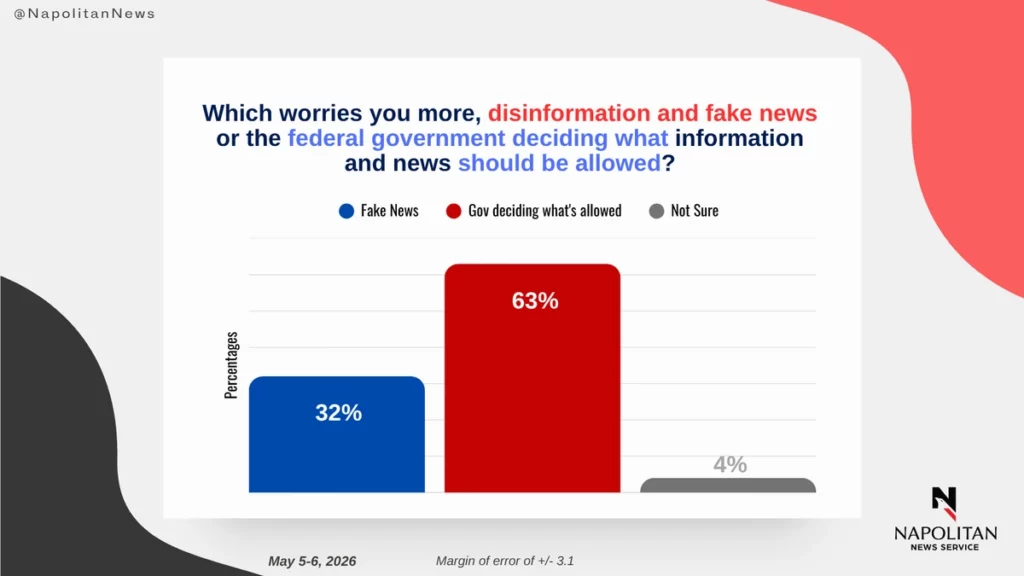
By a 31-point margin, registered voters worry more about the federal government deciding what news is allowed than about disinformation and fake news themselves, 63 to 32. The gap has widened six points since January.
That is the central finding of the latest Napolitan News Service survey, conducted April 29–30 by Scott Rasmussen and RMG Research among 1,000 registered voters. The result is not a one-month spike. The same question produced a 31-point gap in April 2022, and a 32-point gap in July 2025. The verdict is durable: voters trust the censor less than they trust the liar.
Seventy-two percent of Democrats worry more about federal information control than about disinformation; 23 percent worry more about fake news. Republicans split closer: 52 percent against 45. The party out of power has historically been the party more afraid of state speech control. The Democratic numbers reflect a base that has spent a year watching a Republican administration inherit the censorship machinery its own administration built. The Republican split is harder to read: it is the shape a coalition takes when its voters cannot decide whether they fear the apparatus or want to use it.
Voters are not naive about the information environment. Eighty-three percent say they worry about free speech being used to spread disinformation, up four points since January, with 45 percent very worried. Seventy-six percent worry about government efforts to restrict speech, and 46 percent are very worried about that. They can hold both concerns. They simply prefer a noisy public square to a managed one.
This is the finding the censorship coalition has spent five years refusing to accept. From the Global Engagement Center to the short-lived Disinformation Governance Board, from the Election Integrity Partnership to the FBI-Twitter back channels disclosed in the Twitter Files, the operating premise was that an educated administrative class could identify falsehood at scale and quarantine it before voters were exposed. The list of stories the apparatus successfully suppressed includes the 2020 Hunter Biden laptop reporting, sustained skepticism of pandemic-era lockdown policy, and the lab-leak hypothesis later endorsed by the FBI and the Department of Energy. In each case, the censor was wrong and the dissenters were right. In Murthy v. Missouri (2024), the federal government won on standing while losing on the merits in the court of public opinion. The polling has been telling the same story since 2022.
The Napolitan crosstabs also surface a quieter shift. Asked which party twists data more to serve its own ends, voters split 38 percent Republican to 35 percent Democratic, with 25 percent saying both equally. That three-point Republican edge has narrowed sharply from an 11-point gap six months ago. The partisan information war is now a contest the public scores roughly even, which is a problem for any party that has built its message around the dishonesty of the other.
The American public has now spent half a decade hearing the same argument from the censorship architects: trust us to draw the line. The public has, in poll after poll, declined the offer. The request from voters is simpler than the architects assumed: the freedom to judge for themselves, without an intermediary. The censor frightens them more than the lie because they know which one carries the badge.