The Arsenal of Energy
Five presidential determinations, one industrial logic, and the return of Hamiltonian statecraft.
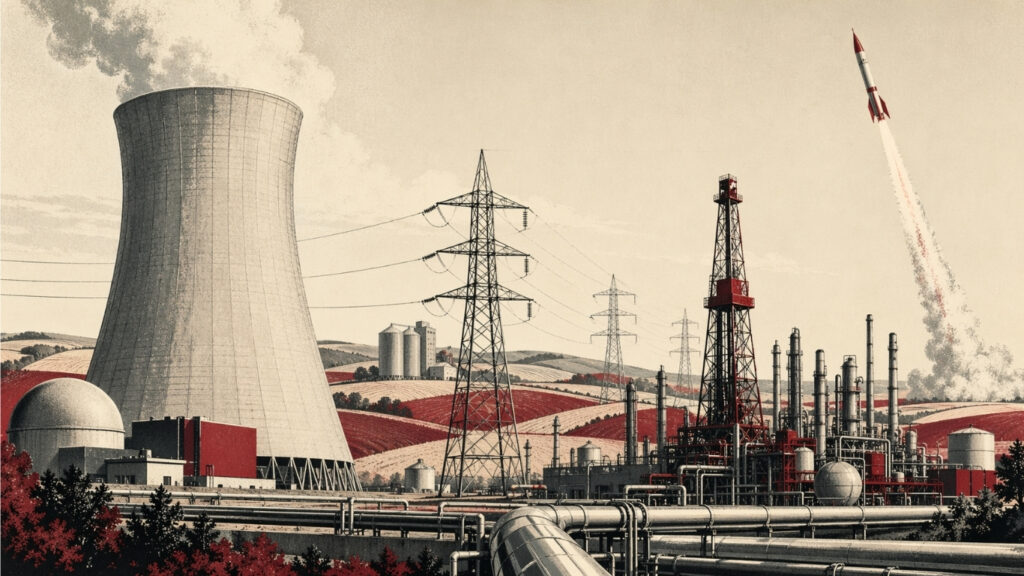
Five times on April 20, the president of the United States executed five separate memoranda to the Secretary of Energy, each underscoring the same principal point: the American energy sector is essential to national defense. Thus began a formal shift in American energy policy. What was once an emphasis on commodity concerns now turned to national-defense capacity.
The Arsenal of Energy
Under Section 303 of the Defense Production Act, the federal government has the mandate to create, maintain, and expand the domestic industrial base when the president determines that a given capacity is essential to national defense. Today, America’s inadequate energy production, transportation, refining, and generation constitutes an unusual and extraordinary threat to our economy, national security, and foreign policy. Hostile foreign actors have weaponized America’s reliance on foreign energy to destabilize international commodity markets and leave the United States and its allies dangerously exposed.
These are not new concerns. Famously, Alexander Hamilton, in his Report on the Subject of Manufactures (1791), argued that a nation dependent on foreign sources for essential goods is a nation whose independence is conditional. “Not only the wealth, but the independence and security of a Country, appear to be materially connected with the prosperity of manufactures,” he wrote. Instead of iron and sailcloth our concerns now center on pipelines, refineries, LNG terminals, grid transformers, and baseload generating stations. The strategic question is also existential. Hamilton himself challenged the First Congress to build the physical capacity to sustain America’s sovereignty. A dependence on supply chains, he contended, was tantamount to another form of slavery.
The administration has already demonstrated its willingness to use the Defense Production Act for energy. On March 13, Secretary of Energy Chris Wright issued a DPA order to Sable Offshore directing the company to immediately resume pipeline transportation of crude oil from the Santa Ynez Unit in California. That order invoked the DPA’s priorities and allocations authority. Sable began oil sales on March 29 at a gross rate exceeding 50,000 barrels per day, increasing California’s domestic crude supply by approximately 17%, according to the company. The five April 20 determinations escalate the same industrial logic from a single pipeline to the entire energy sector, and from the DPA’s allocation powers to Section 303’s capacity-building authority.
Exporting the Logic
The administration’s industrial framework is not confined to the domestic grid. Next week, the Three Seas Initiative summit in Croatia (April 28 and 29) will tackle similar concerns with our friends in Europe. The Three Seas Initiative, launched in 2016 to promote energy, infrastructure, and digital connectivity among thirteen E.U. member states between the Baltic, Black, and Adriatic seas, has become the most significant platform for U.S. commercial diplomacy on the continent. The strategic premise is identical to the one animating the DPA determinations: energy infrastructure is not a commodity market to be optimized but a security architecture to be built. American LNG terminals, pipeline interconnectors, and digital grid systems flowing into Central and Eastern Europe should displace Russian leverage, counter Chinese Belt and Road investment, and bind allied economies to a supply network the United States anchors.
The Industrial Ripple
The concern does not stop at the federal government. The same week the five determinations were issued, U.S. Steel announced the restart of its Gary Tin Mill at Gary Works in northwest Indiana, a facility idled since late 2022. The restart is expected to to produce tin mill products, mined, melted, and made in America, for food and beverage packaging, aerosol containers, and oil filtration goods, creating 225 jobs at an estimated cost of $15 to $20 million. CEO David Burritt described the move as a response to customers “increasingly focused on securing dependable domestic supply.” The language mirrors the White House determinations almost verbatim. When a steelmaker and the Oval Office independently reach for the same vocabulary, something structural has changed in the relationship between American industry and American statecraft.
In February, Illinois Governor J.B. Pritzker, not previously known as a champion of fission (he vetoed a nuclear construction bill in 2023) or a particular fan of the current White House, signed Executive Order 2026-01, directing the Illinois Power Agency and the Illinois Commerce Commission to solicit developers for new nuclear plants with a target of at least two gigawatts of new capacity and construction beginning by 2033. Illinois already leads the nation in nuclear power production, generating roughly one-eighth of the country’s nuclear output across six plants. The state had maintained a moratorium on new large-scale nuclear construction since the 1980s. That ban was partially lifted in 2023 for small modular reactors under 300 megawatts; the broader prohibition fell with Pritzker’s signature on the Clean and Reliable Grid Affordability Act. When the math of grid reliability, industrial demand, and data-center power consumption becomes inescapable, even governors who once vetoed nuclear legislation find themselves issuing executive orders to accelerate it.
The Foundation for American Innovation’s State Permitting Playbook: Nuclear Supplement, authored by Samuel Roland and Emmet Penney, documents the scale of the opportunity states like Illinois are now approaching. The report identifies approximately 5.6 gigawatts of theoretical uprate potential at existing nuclear stations nationwide, the equivalent of roughly six new reactors, achievable through modifications at plants that already possess transmission connections, cooling infrastructure, and trained personnel. It catalogs the patchwork of state moratoria and waste restrictions, many enacted decades ago on the assumption that permanent federal waste repositories would materialize, that now function as de facto bans on nuclear development. The report’s recommendation is unequivocal: full repeal. Half-measures, Roland and Penney write, are “insufficient and unjustified.” Wisconsin, Kentucky, Montana, and West Virginia have already demonstrated that moratorium repeal is politically viable.
The Hamiltonian Question
The through-line connecting all of these developments, the DPA determinations, the Three Seas summit, the Gary Tin Mill, Pritzker’s nuclear pivot, and the FAI permitting playbook, is a single proposition: energy abundance is the precondition for every other national project. Full stop. You cannot reshore manufacturing without reliable baseload power. You cannot deter adversaries with an electrical grid that cannot sustain surge demand. You cannot export democratic leverage to Central Europe if you lack the LNG terminals, pipeline capacity, and trade infrastructure to back the commitment. You cannot even feed a population if the tin for food packaging is sourced from supply chains a hostile power can interrupt.
For a generation, American energy policy oscillated between two poles: commodity management on one side and climate moralism on the other. Neither treated energy as what Hamilton and the founders understood it to be: the physical foundation of national strength. Energy is now, by executive determination and statutory authority, a component of national defense. The federal government is no longer merely regulating the energy sector. It is mobilizing it.
Hamilton’s question to the First Congress remains the operative one: will a self-governing republic build the capacity to sustain itself, or will it outsource the foundations of its independence to powers that do not share its interests? The current administration has answered. Whether the next one will sustain the commitment is the question that matters now.