The American Earth Opened
The painting belongs to a century that increasingly found beauty in the machinery of progress, though the machinery is, here, out of sight.
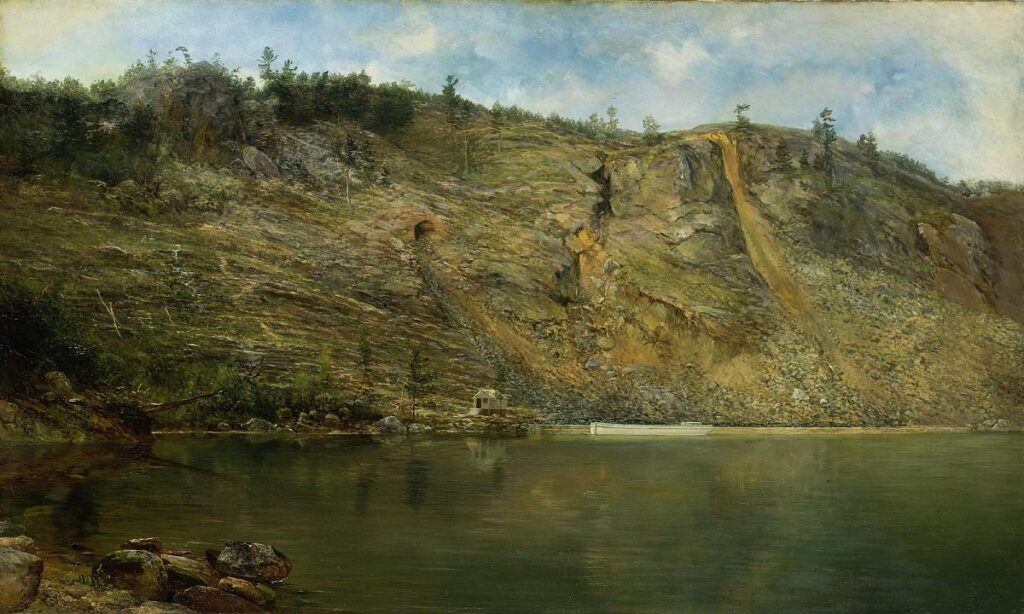
Homer Dodge Martin, The Iron Mine, Port Henry, New York, c. 1862. Oil on canvas mounted on fiberboard. Smithsonian American Art Museum.
America was once a country that regarded the earth as an inexhaustible promise. Its mountains contained iron, its forests timber, its rivers the power to set a thousand machines in motion. In Homer Dodge Martin’s The Iron Mine, Port Henry, New York (c. 1862), that promise has become something altogether stranger. A great wound has opened in the side of a mountain overlooking the water, its exposed yellow earth spilling down toward the shore. The trees remain standing, the sky is an innocent blue, and the whole scene possesses the peculiar stillness of a landscape that has suffered some tremendous violence without quite realizing it.
Martin painted the iron mines of Port Henry during the Civil War, when the industrial might of the North was becoming inseparable from the fate of the American republic. The region’s iron deposits helped feed the furnaces that supplied the nation’s expanding railroads, which in turn carried the materials of further industrial expansion. Here was the great American enterprise in miniature: the conversion of wilderness into wealth, raw matter into civilization, geography into destiny. The painting belongs to a century that increasingly found beauty in the machinery of progress, though Martin allows the machinery itself to remain almost entirely out of sight.
There is something unsettling in this absence. The mine is the unmistakable subject of the painting, yet the human beings responsible for it have nearly vanished. Nature appears to have opened itself for extraction, revealing its innards to an invisible civilization. The resulting landscape is neither triumphant nor ruined. It retains a kind of battered grandeur, as if the American wilderness possessed sufficient dignity to survive even its own exploitation. Martin leaves us with the central ambiguity of the industrial republic: a civilization whose extraordinary abundance depended upon tearing open the very landscape that first inspired its sense of providential destiny.