Post-Election Day
His republic is populated by fools and opportunists, sincere patriots and shameless hustlers, all crowded together beneath the same afternoon sun.
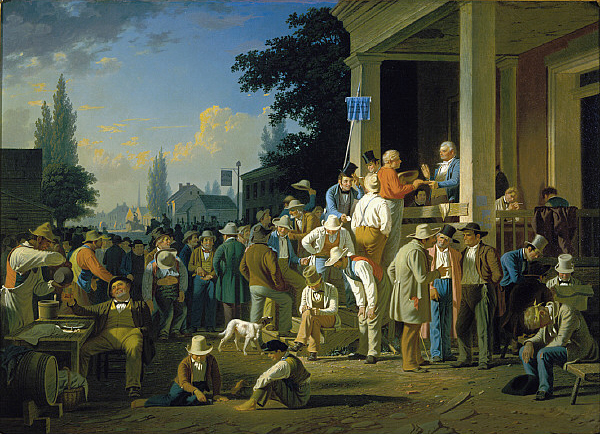
George Caleb Bingham, The County Election (1852). Oil on canvas. Saint Louis Art Museum, Missouri.
Election Day in America has always been a somewhat disorderly affair. In George Caleb Bingham’s The County Election, the great machinery of popular sovereignty has descended upon a dusty Missouri town, where it immediately dissolves into a spectacle of drinking, arguing, bargaining, and general misbehavior. A politician presses his ticket upon a prospective voter. A drunkard is hauled toward the polls, apparently determined to exercise his constitutional privileges even if he can no longer stand upright. Two boys play a dangerous game with a knife in the foreground, blissfully indifferent to the business of self-government taking place behind them. It is a wonderfully unflattering portrait of the American electorate, and perhaps for that reason, an unusually affectionate one.
Bingham painted the scene in 1852, drawing upon his own experience in Missouri politics, where he had suffered a bitter electoral defeat. The painting belongs to the great age of Jacksonian democracy, when political participation had expanded dramatically among white men, bringing laborers, immigrants, and prosperous gentlemen into the same noisy public square. The spectacle had its obvious limitations: women and Black Americans were largely excluded from the franchise. Yet Bingham understood something essential about the democratic experiment. Its participants were ordinary human beings, vulnerable to vanity, stupidity, greed, and the occasional glass too many. The miracle was that a political order could emerge from such material at all. Saint Louis Art Museum+2
There is a temptation, particularly during an election, to imagine that democracy might be improved if only the electorate were a little more enlightened, the candidates more virtuous, and the public less susceptible to manipulation. Bingham offers little encouragement for this fantasy. His republic is populated by fools and opportunists, sincere patriots and shameless hustlers, all crowded together beneath the same afternoon sun. Nearly two centuries later, the costumes have changed, the franchise has expanded, and much of the shouting has migrated onto the internet. The underlying human comedy remains remarkably familiar. Democracy has always involved trusting the judgment of people who are, in countless ways, no better than ourselves.