Capital Is Not a Hostage
A new Napolitan poll finds bipartisan majorities endorse a corporation's right to walk away. The voters have ratified federalism.
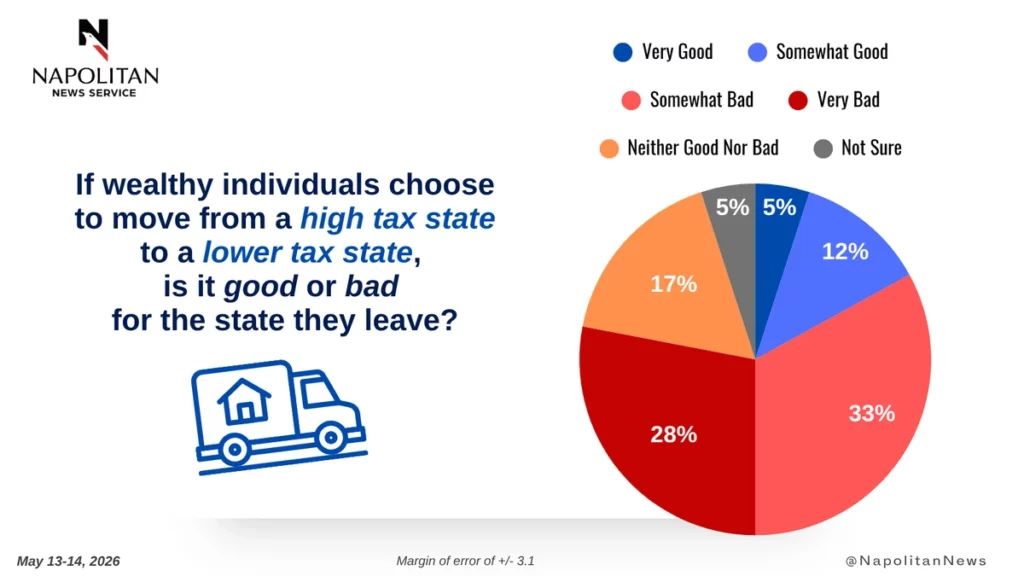
The political class spent the better part of a decade insisting that capital flight was a manufactured grievance, a fiction peddled by right-wing think tanks. Their own voters disagree. A new Napolitan News Service survey, conducted by RMG Research on May 13 and 14, finds 73% of registered voters endorse the right of a corporation to leave a state because taxes are too high. The cross-partisan structure is the story: 79% of Republicans, 67% of Democrats.
Sixty-nine percent say it is appropriate for a corporation to relocate in pursuit of a lower cost of living. A solid 59% endorse the right to leave when a company disagrees with state leaders on matters of business policy. Even on the most contested question, whether a corporation may leave over disagreements unrelated to its core operations, 48% say yes and 40% say no, with 53% of Republicans in favor and a 46% plurality of Democrats opposed.
The numbers describe a country that has internalized a basic federalist principle: exit is a legitimate form of accountability. Charles Tiebout sketched the theory in 1956. He argued that competition among local jurisdictions for capital and residents would discipline poor governance more effectively than any rule handed down from above. The voters in this survey arrived at the same conclusion without the journal article. They do not need an economist to tell them that a corporation paying taxes in Austin or Nashville is not paying them in Sacramento or Albany, and that the difference is not an accident.
What makes the result striking is the cross-partisan structure. The political class might have expected Democrats to want corporations held in place, taxed harder, regulated more. Two-thirds of them do not. They endorse the same freedom to walk away their Republican neighbors endorse, with a smaller but durable majority. The U-Haul rental data has been telling this story for years. Now the polling says it too.
The implication for state policy is sharper than most statehouses will care to admit. Legislatures that have raised marginal tax rates and regulatory burdens on the theory that capital has nowhere else to go are operating against the express judgment of their own voters. So are governors who treat corporate residency as a hostage to political loyalty. The voters know capital can move. The corporations have already begun moving.
Lyceum has documented how that movement is hollowing the revenue base of America’s largest cities, from Seattle’s Starbucks exit to New York’s $5.4 billion budget gap. The Napolitan numbers are the political theory underneath the migration map. Americans treat mobility not as a betrayal but as a verdict, and one they consider their own to render. A state that wants to keep its employers will have to earn the privilege. Public sentiment has settled the principle. What remains is whether the statehouses will read the result.