American Pride at a Three-Year Low
Pride in country is down nineteen points from its 2024 peak. Among Democrats and AOC-aligned voters, the floor is dropping faster.
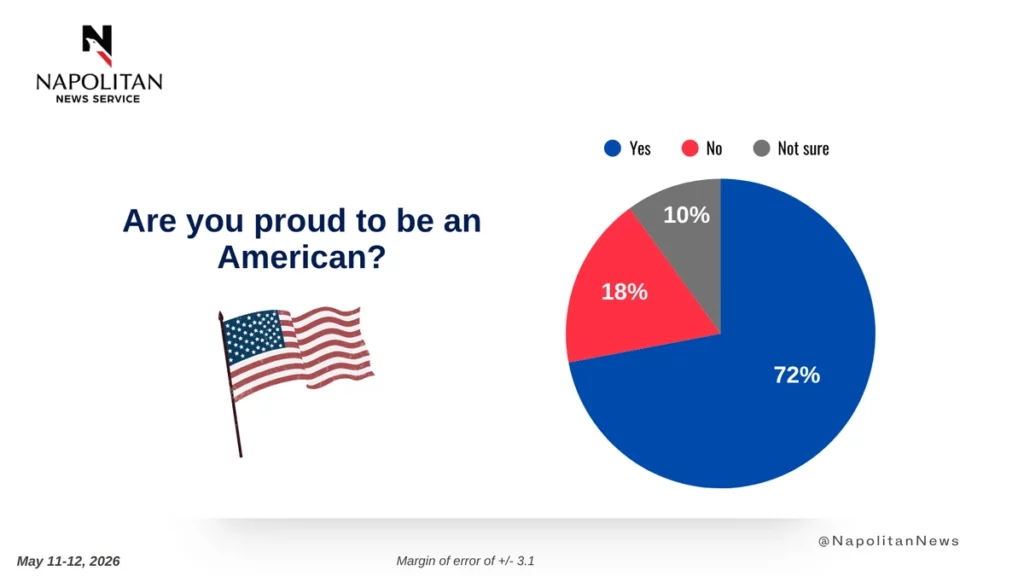
In June 2024, 91% of registered voters told the Napolitan News Service they were proud to be American, and 4% said they were not. In the latest survey, conducted May 11 and 12 and released this week, 72% say they are proud and 18% say they are not. The share who will not affirm pride in their country has more than quadrupled in twenty-three months. It is the lowest reading Scott Rasmussen has recorded since he began asking the question in 2023.
Month by month, the descent is steeper than the headline number suggests. November 2025 stood at 85% proud and 7% not. February: 81 and 8. April: 79 and 11. May: 72 and 18. Seven points have come off the affirmative side in a single month; ten have been added to the negative side since February.
Ninety percent of Republicans still say they are proud to be American. Among Democrats, the figure is 55%, and among voters who say they prefer policies in the style of Representative Alexandria Ocasio-Cortez, it falls to 39%. The country is not losing pride in itself uniformly. It is losing the portion of the electorate that has been instructed, in school and on screens, that the Founding was a fraud and the present a hierarchy of grievances.
Asked whether America is the last best hope of mankind, 42% of voters say yes and 35% say no. Last October the answer was 50 to 28. In June 2024 it was 52 to 21. Republicans say yes by 64 to 17; Democrats say no by 53 to 25. A nation will not make hard sacrifices for a country it does not believe is exceptional, and half the country no longer does.
A thinner majority survives on the question of whether America’s best days are still to come: 49% say yes, 31% say they are gone. Republicans answer ahead by 65 to 22. A plurality of Democrats now say the country is past its peak.
None of this is a polling artifact. It is the visible surface of a long campaign to teach a generation of voters that their own country is a problem to be managed, not a project to be sustained. The schools, the curricula, the museums, the media, and the platforms have spent more than a decade telling that story, and the data is now beginning to reflect it.