The American Working Man
What makes the painting so compelling is its refusal to resolve the contradictions of American progress.
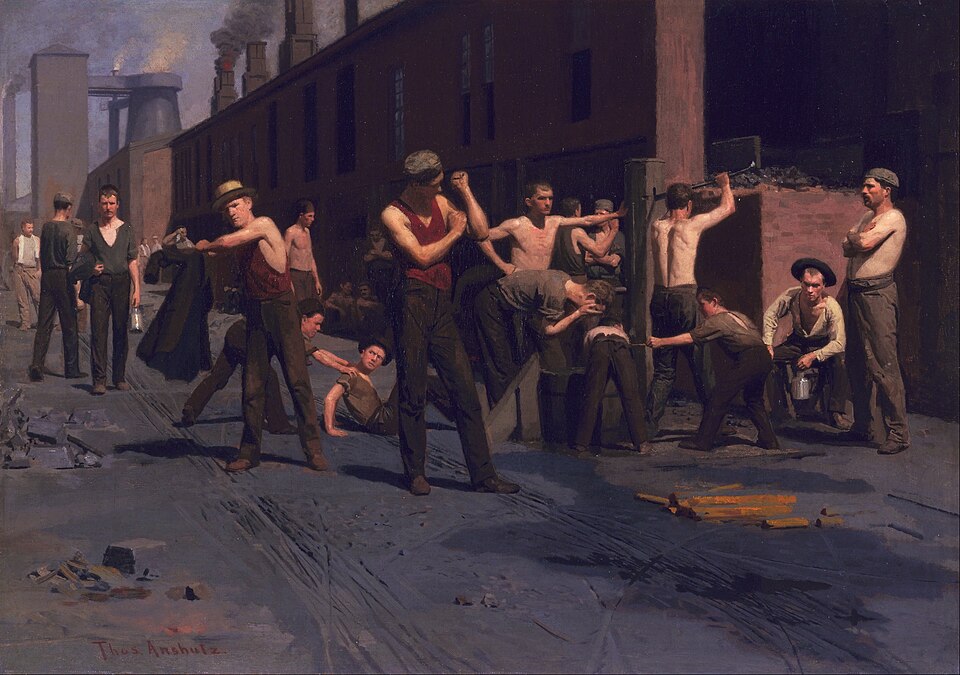
Thomas Pollock Anshutz, The Ironworkers’ Noontime (1880). Oil on canvas. Fine Arts Museums of San Francisco.
America was built by men like these, although its official histories have generally preferred to remember the men who owned the factories. In Thomas Anshutz’s The Ironworkers’ Noontime, a group of laborers gathers in the yard of a West Virginia ironworks, stretching their aching limbs, drinking water, and enjoying a few minutes of freedom from the machinery. Their bodies are powerful and exhausted, their clothing filthy, their surroundings almost aggressively ugly. Yet Anshutz has arranged them with the dignity of classical sculpture. The muscular figures might belong to some ancient heroic frieze, except that their battlefield is an industrial courtyard and their great victory is a lunch break.
Painted in 1880, the work belongs to an America undergoing a profound transformation. Industrialization was producing enormous wealth while steadily dismantling the older world of skilled manual labor. Anshutz had observed the ironworkers of Wheeling, West Virginia, where men known as puddlers performed the punishing work of refining iron. Their physical strength was indispensable to an industry that would soon find ways to dispense with much of their labor. There is a peculiar tenderness in the painting’s attention to these men, whose bodies have become instruments of production but whose humanity remains irreducibly their own. Google Arts & Culture+1
What makes the painting so compelling is its refusal to resolve the contradictions of American progress. There is no sentimental pastoral refuge, no benevolent industrialist looking on, no obvious promise that tomorrow will be better. The men have built the modern world, and for a few minutes that world has stopped demanding something of them. Anshutz leaves us with the uncomfortable possibility that civilization’s greatest achievements may depend upon people whose names civilization will never bother to remember.