Virginia’s New Religion of Reproductive Freedom
The essential question is who gets to decide when the freedom of one human being collides with the life, welfare, or legitimate claims of another.
It is one of the more peculiar features of modern American life that nobody can quite explain what freedom is anymore, although everyone is terribly certain that we need more of it. Freedom means being left alone, except when it means having the government provide you with something. It means liberation from institutions, except when institutions are required to enforce it. It means the right to make your own decisions, unless those decisions happen to be sufficiently disagreeable, in which case the problem is that you have not yet been properly educated. The word has swollen to accommodate so many contradictory meanings that it has become a sort of political blancmange, trembling magnificently beneath the weight of every demand that anyone cares to place upon it.
Virginia is about to discover what happens when one of these demands gets written into a constitution.
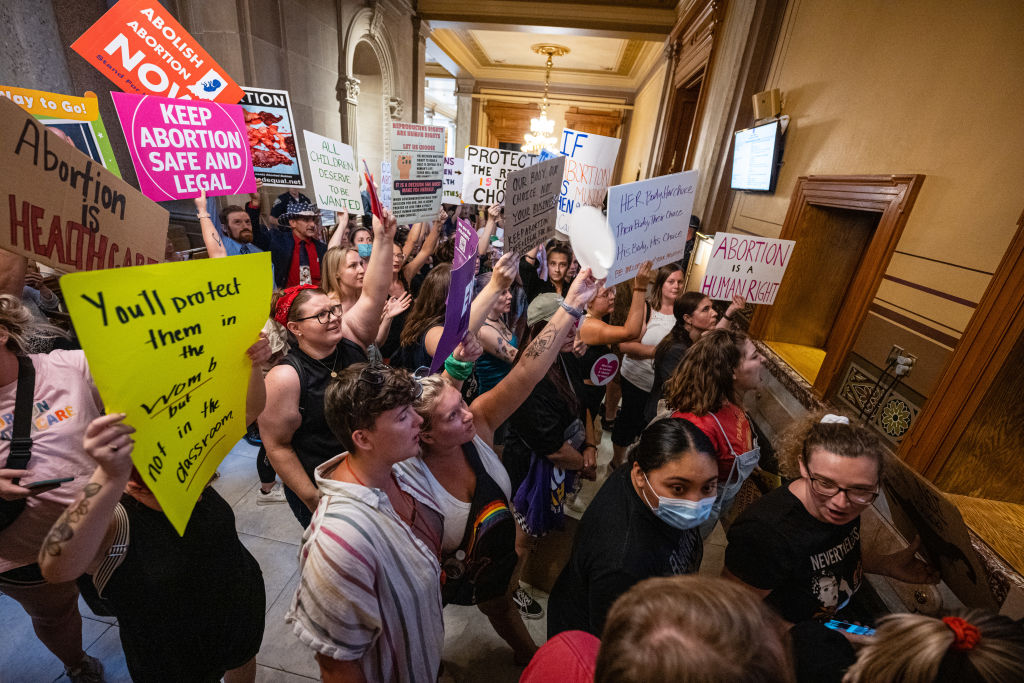
On November 3, voters will decide whether to amend the state’s Bill of Rights to establish a fundamental right to reproductive freedom. The proposal covers abortion, contraception, fertility treatment, miscarriage management, childbirth, and prenatal care, an impressive assortment of activities that have been bundled together under the agreeable proposition that people should be allowed to make decisions about their own bodies. The official ballot question promises protection for patients and medical professionals, along with continued permission to regulate abortions in the third trimester. It is difficult to imagine a more carefully upholstered piece of political language.
But constitutional amendments have the unfortunate property of continuing to exist after their campaign advertisements have been forgotten. Their words become law, which is to say that they become weapons in the hands of lawyers, instructions for judges, and eventually the architecture of ordinary people’s lives. What matters is not merely the reassuring thing the authors say they mean, but the range of things the text permits them, or their successors, to mean.
Virginia’s amendment is unusually interesting in this respect because it attempts to settle a very old moral argument by redefining the circumstances under which the state is permitted to have one.
Under the proposed language, an individual’s reproductive freedom cannot be infringed without a compelling state interest pursued through the least restrictive means. This is familiar constitutional machinery, the sort of language that sounds reassuringly technical until someone discovers what has been placed inside it. The amendment then defines a compelling state interest in extraordinarily narrow terms: the maintenance or improvement of the patient’s health, consistent with accepted clinical standards, without infringing upon that person’s autonomous decision-making.
Consider what has happened here. A government that has traditionally been expected to weigh a number of competing interests—the rights of patients, the welfare of children, the claims of parents, the protection of unborn life, the regulation of medical practice—is being instructed to approach reproductive freedom from a rather more restricted angle. The state may still regulate, but when it seeks to restrict the fundamental right, the amendment severely limits the interests it can invoke in justification. The patient and the medical profession occupy the center of the constitutional universe, while everyone else is left orbiting at an uncertain distance.
There is something almost theological about it. The modern state, having spent the better part of two centuries emancipating itself from the old religious authorities, has developed an extraordinary fondness for manufacturing new ones. Where once a priest might pronounce upon matters of life, death, and morality, now we have the physician, furnished with clinical standards, professional judgment, and a constitutional presumption that his decisions should prevail over those of the vulgar democratic masses. It is a curious arrangement for a political movement that otherwise regards concentrations of unaccountable institutional power with such elaborate suspicion.
None of this would be particularly remarkable if the amendment simply protected abortion access under Virginia’s existing framework. But the framework itself stands to change.
Virginia currently permits abortions during the third trimester only under specified circumstances. The procedure must take place in a qualifying hospital, and the attending physician and two consulting physicians must certify that continuing the pregnancy is likely to cause the woman’s death or substantially and irremediably impair her physical or mental health. The law also requires life-support measures to be available and used if there is clearly visible evidence of viability.
The new amendment preserves the state’s ability to regulate third-trimester abortion, but forbids prohibition when a physician judges the procedure medically indicated to protect the patient’s life or physical or mental health, or determines that the fetus is not viable. The existing requirement for three physicians is absent from the constitutional standard, as is the requirement that the threatened impairment be substantial and irremediable.
This is a real difference, and it would be rather strange to pretend otherwise. One can make a serious case that the existing law is too restrictive, that medical emergencies do not lend themselves to committee meetings, and that physicians should be able to treat patients without worrying about whether a prosecutor will approve of their judgment afterward. But one ought then to defend those propositions openly, instead of folding a significant change in medical authority into a campaign about preserving freedoms that Virginians already possess.
The question is not simply whether abortion should be legal. It is whether a decision involving at least two morally significant human lives should be removed further from the supervision of the political community and placed under the authority of an individual medical judgment. The amendment’s supporters may consider this an improvement, but they cannot quite escape the fact that the authority is being transferred somewhere. Power never vanishes merely because we have decided to call its exercise freedom.
This becomes still more complicated when children enter the picture, as they have a habit of doing in questions concerning reproduction.
Virginia currently requires parental consent for most abortions involving unemancipated minors, while providing a judicial alternative for girls who cannot or will not obtain it. There are exceptions for medical emergencies and certain circumstances involving suspected abuse or neglect. The law is an attempt, however imperfect, to accommodate several competing realities: that parents generally have responsibilities toward their children, that children are not always capable of making difficult medical decisions alone, and that some parents are themselves dangerous.
The proposed amendment contains no explicit provision abolishing parental consent. It would be inaccurate to claim that its adoption would automatically do so. Yet it establishes a broad individual right and prohibits direct or indirect burdens upon that right unless the government satisfies a demanding constitutional test. Existing parental involvement requirements could therefore face new challenges, leaving the courts to determine whether they can survive the new standard.
That uncertainty matters because it exposes a contradiction in the peculiar modern conception of childhood. The child is too immature to consent to almost anything that adults consider dangerous, from signing contracts to buying alcohol, but in certain ideologically charged contexts she is imagined as a perfectly self-contained sovereign individual, capable of exercising rights with which the state must not interfere. This sovereign individual is, of course, still dependent on adults for food, shelter, transportation, money, and almost every other material condition of her existence. Her autonomy is therefore frequently exercised through other people, who are not necessarily disinterested and whose influence does not disappear merely because the law refuses to acknowledge it.
The problem becomes especially ugly in cases involving sexual abuse. A pregnant minor may be the victim of an adult who controls much of her life. Her pregnancy may be evidence of a crime, and her decision to seek an abortion may take place under pressures that have little resemblance to the cheerful liberal fiction of an independent person making an informed choice in a quiet consultation room. In such circumstances, medical providers can play a vital role in identifying abuse and protecting the child. They may also possess records relevant to a criminal investigation.
Virginia’s amendment would prohibit the state from penalizing, prosecuting, or taking other adverse action against someone for assisting another person in exercising reproductive freedom with that person’s voluntary consent. There is a perfectly intelligible reason for such a provision. If reproductive freedom is to be a meaningful right, the government should not be able to circumvent it simply by prosecuting the physicians or others who help people exercise it.
But the breadth of the protection raises questions about its boundaries. Could a clinic argue that certain investigative demands amount to adverse action connected to its assistance? Would a court distinguish between punishing a provider for facilitating lawful care and requiring that provider to cooperate with an investigation into an unrelated crime? Almost certainly that distinction would be central to any such dispute. The amendment does not expressly repeal mandatory reporting laws or make medical records immune from subpoenas, and there is no sound basis for declaring that child-abuse investigations would simply become impossible.
Still, it would be useful to know how these obligations are supposed to coexist before a constitutional guarantee is put in place. The patient has a legitimate interest in privacy. The provider has a legitimate interest in being protected from politically motivated prosecution. The child has an interest in not being returned to the custody of someone who has abused her. A serious legal order must account for all three, even when the interests are inconveniently opposed.
This is the trouble with the modern habit of treating autonomy as the supreme political good. It is a wonderfully attractive principle when the autonomous individual happens to be an intelligent, articulate adult with a stable income, supportive friends, and the ability to leave an unpleasant situation whenever she pleases. It becomes rather less satisfactory when applied to a frightened child, or a person under coercion, or anyone whose capacity to choose is constrained by circumstances that no declaration of rights can magically abolish.
We have become very good at describing human beings as independent units of desire, each surrounded by an invisible constitutional force field. We have become rather worse at describing the relationships through which human beings actually live. Children belong to families, families to communities, patients depend upon physicians, physicians upon institutions, and all of these relationships involve obligations that cannot be reduced to the right of one person to be left alone. Sometimes the most important thing a society can do for an individual is to respect her decision. Sometimes it is to recognize that the apparent decision is being made under conditions that make freedom a rather complicated word.
There is a reason that laws governing children, medicine, and criminal investigations tend to be untidy. They are dealing with an untidy species. Real people do not arrange their lives into the neat moral categories preferred by campaign consultants, and difficult situations generally involve several legitimate interests, none of which can be made to disappear merely by declaring another one fundamental.
The defenders of the Virginia amendment will argue that precisely this uncertainty makes stronger constitutional protections necessary. They point to the removal of federal abortion protections under Dobbs, the possibility of future legislative restrictions, and the dangers of allowing medical care to depend on whichever political coalition happens to control Richmond. These concerns are not imaginary. Constitutional rights exist in part because majorities can be arbitrary and because certain intimate decisions should not be subject to every passing political enthusiasm.
But constitutionalizing a decision does not resolve the moral disagreement surrounding it. It changes the institution empowered to settle that disagreement. Legislatures lose some authority, courts gain it, medical standards acquire constitutional significance, and the question of what the public may legitimately regulate becomes a question for judges to answer. In the American political imagination, this process is frequently described as the removal of politics from medicine, as though politics were some unpleasant contaminant that could be filtered out and disposed of. In practice, the politics simply moves into a different room, where the participants wear robes instead of campaign buttons.
Virginia is not merely being asked whether women should have access to abortions. The amendment would establish constitutional rules governing when and how the state can restrict a broad category of reproductive decisions, rules that may reach existing laws concerning later abortions and parental involvement. Some consequences are visible in the text itself. Others will depend on judicial interpretation. The distinction matters, and voters are entitled to understand both.
The question is particularly pressing because the amendment declares itself self-executing. Its protections would not depend on the legislature passing some future implementing statute. Once adopted, they would form part of the state’s supreme law, available to be invoked in litigation against laws and government actions alleged to violate them.
There is an almost touching confidence in the belief that this process will produce a settled and harmonious arrangement. Americans have been arguing over abortion for decades, employing every available instrument of politics, philosophy, medicine, religion, and law, and the proposed solution is to write the word freedom into the constitution with sufficient emphasis that the argument will presumably conclude itself. The result may instead be a new series of legal disputes over precisely the competing interests that the amendment leaves uncertain.
A society that wishes to protect women facing dangerous pregnancies, children vulnerable to abuse, parents attempting to fulfill their responsibilities, and physicians practicing legitimate medicine will have to do something more difficult than announce its allegiance to autonomy. It will have to make distinctions. It will have to acknowledge that freedom is not the only good, that medical judgment is not infallible, that parental authority is neither absolute nor meaningless, and that the state’s obligation to protect human beings sometimes requires it to ask questions that somebody would prefer it did not ask.
These considerations need not settle the entire abortion debate, and they certainly cannot be compressed into the familiar contest between people who claim to defend women and people who claim to defend babies. But they are exactly the sort of considerations that constitutional law is supposed to take seriously.
Perhaps Virginia’s voters will decide that the new arrangement is preferable to the old one. They are entitled to make that judgment. What they should not be asked to believe is that the amendment merely preserves the status quo, or that every concern about its language can be dismissed as hostility to reproductive freedom.
A constitution is supposed to establish the terms on which a people govern themselves, including the circumstances in which their government may intervene to protect those who cannot protect themselves. It is a strange thing to amend such a document in the name of freedom while leaving so much uncertainty about what the public will still be allowed to do.
The essential question is who gets to decide when the freedom of one human being collides with the life, welfare, or legitimate claims of another. Virginia’s amendment offers an answer, or at least the beginnings of one. It would place considerably greater weight on individual reproductive autonomy and medical judgment, and correspondingly restrict the government’s authority to impose competing considerations.
That is a substantial political and moral choice. It deserves to be treated as one, rather than wrapped up in the comforting language of rights and handed to voters as though there were nothing left to argue about.