Think More: Friday, June 5, 2026
The SPLC fraud indictment, $186B in federal waste, the CBS News purge, Chinese money at Stanford, and more.
Lead · Follow the Money
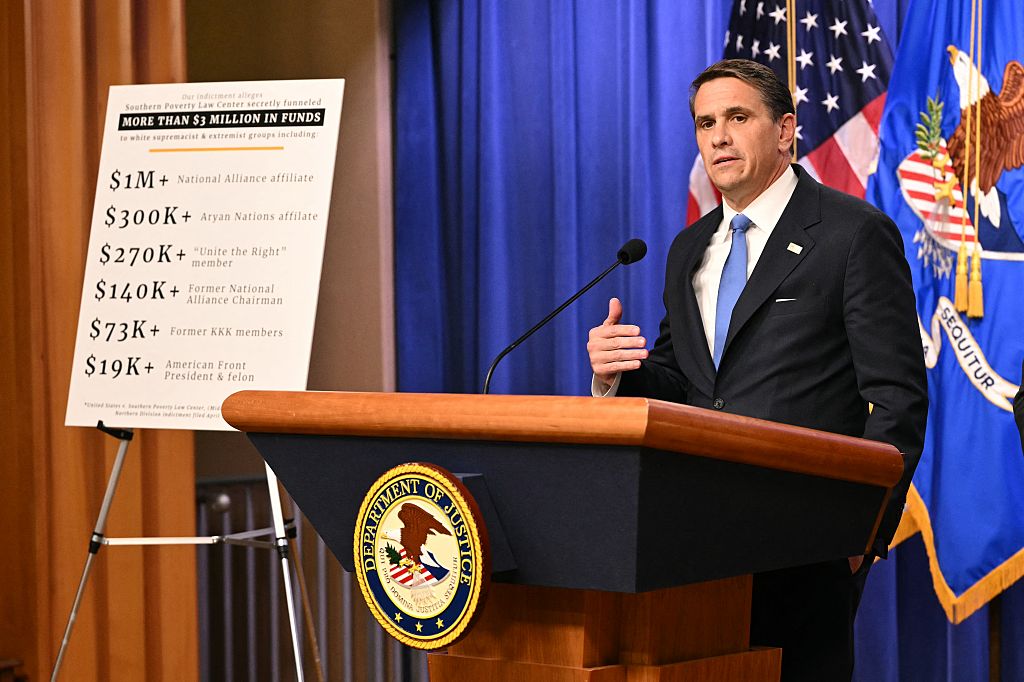
The SPLC Stands Accused of Funding the Hate It Fundraised Against
A superseding federal indictment charges the Southern Poverty Law Center with 11 counts of fraud and money laundering, alleging the self-styled hate watchdog paid Klansmen and neo-Nazis to stay in their groups rather than leave, routing about $4.1 million in donor money through shell companies. The group, which holds nearly $790 million in net assets, denies wrongdoing; its interim president testifies before House Judiciary on Friday.
Follow the Money
The Feds Lost $186 Billion to ‘Improper Payments’ in One Year
The Government Accountability Office reports the federal government made $186 billion in improper payments in fiscal 2025, with Medicare and Medicaid alone accounting for roughly half. The total has topped $3 trillion since 2003 and rose about $24 billion last year, despite DOGE; because some programs never report, even $186 billion is a floor.
A Third of Seniors Doubt They Will Collect All Their Social Security
A Napolitan News Service survey finds just 33% of seniors think it “very likely” they will receive all their Social Security benefits, even as 72% call protecting the program very important. Confidence falls with age: only 55% of voters aged 55 to 64 expect to collect in full. The poll surveyed 1,000 registered voters.
Federal ‘improper payments’ in fiscal 2025, by the GAO’s count
$186B
Total improper payments
$57B
Medicare alone
$37B
Medicaid alone
The University on Trial
Justice Opens Race-Bias Probes at 15 More Medical Schools
U.S. Department of Justice | justice.gov
The Justice Department’s Civil Rights Division opened 15 new investigations into alleged race discrimination in medical-school admissions, after finding that UCLA and Yale illegally weighed race. Assistant Attorney General Harmeet Dhillon framed the probes around Title VI and the Supreme Court’s Students for Fair Admissions ruling, arguing training should outrank demographics in medicine. No conclusions have been reached.
Harvard’s Legal Bill Hits a Record $126 Million
Harvard’s legal expenses surpassed $126 million in fiscal 2025, a record, as the university battled the Trump administration over federal funding, immigration, and antisemitism allegations, according to figures reported by The Harvard Crimson. The bill has climbed fast: roughly $20 million in 2022 and about $80 million in 2024. Harvard also spent nearly $1 million lobbying on immigration.
A $3 Million Stanford Gift Traces to a Chinese Military-Linked Donor
Steve Postal | The American Spectator
A Stanford Review investigation traces at least $3 million in “restricted gifts” to a donor matching Chen Yuan, chairman of a Chinese group tied to the People’s Liberation Army’s political-warfare apparatus, with funds steered to Hoover Institution researchers. Stanford ranks third among U.S. schools for combined China and Hong Kong money, at $446.2 million; nationwide, Chinese sources total $6.8 billion.
The Press Changes Hands
Bari Weiss Remakes CBS News, and the Old Guard Is Out
Since Skydance’s David Ellison bought Paramount for $8 billion and installed Bari Weiss atop CBS News, the network has shed its old guard: Anderson Cooper left “60 Minutes,” producers were dismissed, and Scott Pelley, who accused Weiss of trying to “murder” the program, was fired this week. Josh Hammer reads the upheaval as the legacy press reorganizing under collapsing public trust.
The Times Stokes a Vaccine Panic the Data Does Not Support
Ira Stoll | Washington Free Beacon
Ira Stoll argues a New York Times front-page story on unvaccinated children stoked alarm while burying the CDC’s own data: reported whooping-cough cases fell from 43,321 in 2024 to 28,783 in 2025, lower still in 2026. He notes three of the six doctors the paper quoted are undisclosed Democratic donors. The causes of recent pertussis swings remain contested.
The Golden State Comes Undone
In MacArthur Park, Police Defy the Voters Who Want Them Gone
Chris Bray | Tell Me How This Ends
Chris Bray watches the DEA and LAPD stage yet another drug raid on Los Angeles’s MacArthur Park, a district whose council member and mayor campaign against policing and post signs warning federal agents to stay out. The officers are defying the city’s own leaders, and its voters, to clear a neighborhood the ballot box keeps choosing to leave in ruin.
California Still Has Not Finished Counting Its Primary
Days after California’s June 2 primary, the editors note, barely 56% of ballots had been counted, with official results not due for more than a month. Republican Steve Hilton looked headed for the governor’s runoff and reality-TV figure Spencer Pratt for a Los Angeles mayoral race against Karen Bass, before prediction markets showed Pratt sliding behind Bass and socialist Nithya Raman.
Essayli Says Federal Election-Fraud Probes Are Underway in California
As California’s primary count crawls, First Assistant U.S. Attorney Bill Essayli said his office and the FBI have multiple election-fraud probes underway and are auditing the state’s voter rolls with Assistant Attorney General Harmeet Dhillon. He cited last month’s guilty plea by a woman who paid Skid Row residents to register to vote, sometimes at her own address.
The Law as Weapon and Shield
Arizona’s AG Revives Her Fake-Electors Case After a Court Defeat
After the Arizona Supreme Court refused to revive her 2020 “fake electors” case, thrown out over a biased grand-jury presentation, Attorney General Kris Mayes said she will simply convene a new grand jury. Her 2024 indictment named 18 people, including Mark Meadows, John Eastman, and Rudy Giuliani, with President Trump an unindicted co-conspirator. A court separately found she unlawfully withheld records.
A Model Bill Would Make Organized Road-Blocking a Felony
Tal Fortgang | Manhattan Institute
Tal Fortgang’s model legislation, the “Combatting Civil Terrorism Act,” would let states elevate coordinated low-level offenses, such as groups blocking roads or barring others from a house of worship, into felonies, attach a private right of action for victims, and fold the conduct into racketeering law. The premise: misdemeanor penalties cannot deter disruption that is organized, funded, and deliberate.
The Sinews of a Serious Country
The Service Academies Forgot How to Make Honorable Officers
Peter Mitchell | The American Mind
Writing as a serving Army officer, Peter Mitchell argues the service academies once stamped honor into cadets through swift, public expulsion witnessed by the whole corps, but have since become credentialing machines wrapped in due-process review. Drawing on Alasdair MacIntyre, he contends honor dies when shame loses its audience, citing VMI’s 2021 choice to stop naming the cadets it expels.
Millions of Prime-Age American Men Still Are Not Working
Comson Cao | Center for Immigration Studies
Comson Cao marshals the long trend: the share of native-born men aged 25 to 54 outside the labor force has risen from about 4% in 1960 to 11.1% today, and from 4.2% to 14.6% among those without a bachelor’s degree. A recent dip may reflect tighter immigration enforcement, he allows, but imported labor mostly lets institutions ignore the men already here.
America’s Cyber Defenders Need Faster Access to Frontier AI
Daniel King | Foundation for American Innovation
Daniel King examines a Trump executive order, pulled in May and signed in narrower form on June 2, giving trusted federal agencies and critical-infrastructure defenders early access to frontier AI models, but shrinking the pre-release window from 90 days to 30. He wants a durable, secure “fast lane” so American defenders can wield the best models before adversaries turn them against U.S. systems.