The Future Has Been Vetoed
The data-center backlash reveals a country that wants technological supremacy without the inconvenience of building anything.
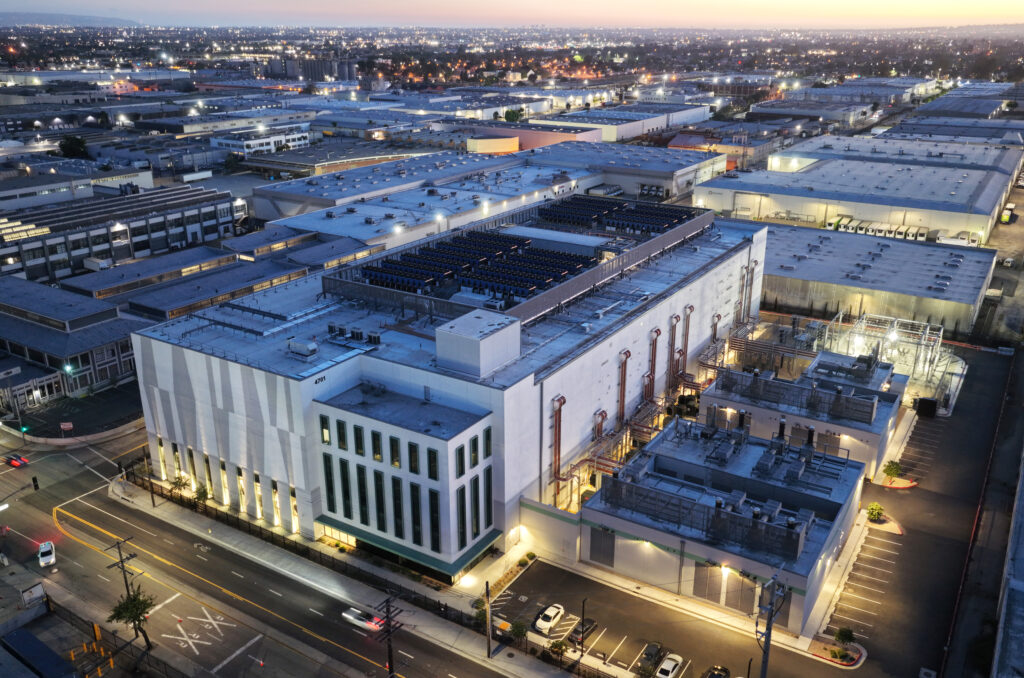
For the better part of a century, American politicians have promised to build the future. The future would be electrified, mechanized, automated, digitized, and eventually inhabited by a race of benevolent machines, tirelessly attending to humanity’s every need. It would be a place of unimaginable prosperity, provided that nobody had to look directly at the machinery responsible for producing it. Americans have always liked the idea of progress. They are rather less enthusiastic about its physical manifestations, particularly when these happen to be built near their houses.
The latest object of this peculiar national hostility is the data center, an enormous, windowless building containing thousands of humming computers and the infrastructure required to keep them alive. Its purpose is to house the computational machinery upon which artificial intelligence increasingly depends. It is the factory of the future, and it has all the aesthetic appeal of an oversized refrigerator. Unlike the mills and foundries of the nineteenth century, it produces nothing that can be held in the hand. Its product is intelligence, or at least a remarkable approximation of it, delivered to the consumer in the form of a cheerful little box on a screen.
On Tuesday, voters across America made their feelings about these buildings abundantly clear. According to Ballotpedia, 46 of the 47 data-center-related ballot measures decided by November 4 produced outcomes favoring greater restrictions on development. Alhambra, California, voted to prohibit data centers outright. Edgewater, Florida, did the same. Bloomington, Illinois, overwhelmingly supported an advisory measure urging a moratorium on large facilities. The American people had discovered the physical location of the cloud, and they wanted it somewhere else.
The backlash had become remarkably swift. As Christian Britschgi observed in Reason, data centers went from a political nonissue to what he called a “high-salience moral panic” in scarcely a year. But the interesting question is what happens when a country begins treating the infrastructure of its own prosperity as an intolerable intrusion. For all the talk of artificial intelligence as the next great revolution in human productivity, the American political system seems increasingly determined to ensure that the revolution takes place somewhere beyond the view of its constituents.
Meanwhile, Democrats have won control of both houses of Congress, bringing an end to unified Republican government and raising the prospect of a more adversarial federal approach to the AI industry. The incoming majority will have considerable opportunities to investigate, regulate, and complicate the construction of data centers, although President Trump’s veto and the Senate’s legislative rules will limit what it can accomplish unilaterally. The politics are almost irresistible: who would dare defend a trillion-dollar technology company against a grandmother struggling to pay her heating bill?
And there is something to the complaint. A data center can consume enormous quantities of electricity, while its cooling systems may place additional demands on local water supplies. The companies building these facilities have hardly endeared themselves to ordinary Americans with their cheerful predictions that artificial intelligence will shortly eliminate large categories of human employment. It is a curious sales pitch: surrender your landscape, pay for our electricity, and enjoy the privilege of watching a machine learn to do your job.
For decades, the American public was encouraged to regard technological progress as a process of dematerialization. The old economy was made of coal mines, steel mills, factories, and smokestacks. The new economy would be clean, weightless, and infinitely scalable. Its entrepreneurs worked in fashionable offices, dressed like unemployed teenagers, and promised to liberate humanity from the grubby business of producing physical things. The computer would replace the filing cabinet, the internet would replace the shopping mall, and the cloud would replace the computer itself. Everything would disappear into an increasingly elegant abstraction.
But the abstraction has begun to acquire an alarming amount of mass. Artificial intelligence requires power plants, transmission lines, semiconductor factories, cooling systems, and vast warehouses full of computers. It requires copper, concrete, steel, and considerable quantities of land. The supposedly weightless economy has revealed itself to be one of the most physically demanding industrial enterprises in modern history. Americans are discovering, with something approaching horror, that the internet has a body.
This is where the politics become interesting. The Democrats’ victory has been widely interpreted as a rebuke to the Trump administration, but the electoral hostility toward data centers suggests a problem that will outlast any particular presidency. The American electorate has developed a formidable appetite for the benefits of technological progress while becoming increasingly unwilling to tolerate the conditions required to produce them. It wants cheaper goods without factories, abundant electricity without power plants, and artificial intelligence without data centers. The future must arrive fully formed, preferably through the mail.
The Democratic Party is particularly well equipped to administer this contradiction. Its coalition includes environmentalists who want a rapid transition to clean energy, technology workers whose livelihoods depend on the expansion of computing, organized labor seeking new construction projects, and affluent homeowners who have spent much of their political lives preventing construction projects of any kind. These interests coexist happily in the abstract. They become considerably less compatible when someone proposes building a new power station.
For Republicans, the difficulty is more embarrassing. The party has spent years lamenting the disappearance of America’s industrial base, the hollowing out of its productive capacity, and its growing dependence on China. Trump has promised a new era of American manufacturing and technological supremacy. Yet the infrastructure required to achieve these ambitions is increasingly unpopular with the very electorate whose support the administration needs. A country that has made an ideological commitment to building things may discover that it has lost the political capacity to build them.
China presents an uncomfortable comparison. Its government can direct industrial development, coordinate electricity infrastructure, and mobilize capital without requiring a series of local referendums on the aesthetic qualities of a transformer station. This is hardly an argument for importing Chinese authoritarianism. The ability of citizens to challenge unwanted development is one of the virtues of American government. But that virtue becomes a liability when every locality exercises an absolute veto over infrastructure whose benefits extend far beyond its borders. A republic must occasionally possess the capacity to accomplish things.
The question for the incoming Congress is whether it intends to govern the AI boom or merely preside over its gradual suffocation. There are perfectly legitimate reasons to regulate data centers. Residents should know how much electricity and water new facilities will consume, and utilities should be prevented from shifting the costs of industrial expansion onto ordinary households. But these concerns call for sensible rules, transparent pricing, and substantial investment in energy infrastructure. A moratorium on construction may satisfy an angry constituency without doing anything to resolve the underlying shortage of electrical capacity.
Indeed, the most absurd feature of the emerging backlash is that restricting new infrastructure could aggravate some of the very problems its opponents hope to solve. Electricity demand is growing, and the grid requires substantial expansion regardless of whether any particular locality welcomes a data center. Blocking a proposed facility may spare one community the immediate inconvenience of construction, but it does little to increase the supply of affordable power. It merely moves the problem elsewhere, where another group of residents will be invited to object.
A serious national strategy would begin by making it easier to produce and transmit electricity. Nuclear energy, natural gas, geothermal power, and other reliable sources should be expanded wherever economically and geographically appropriate. Large industrial customers should bear the costs of the infrastructure they require, and communities should receive a clear accounting of the economic benefits and burdens of development. Federal permitting reform could reduce the extraordinary delays that now accompany major energy projects. None of these measures requires turning American towns into unwilling company settlements. They require a government capable of distinguishing legitimate public concerns from the increasingly extravagant demands of organized obstruction.
But America has developed a peculiar genius for transforming political disagreement into administrative paralysis. Rather than openly deciding that a project should never be built, it subjects the proposal to an indefinitely expanding sequence of reviews, hearings, appeals, and procedural requirements. A data center must demonstrate that it will consume no additional water, increase no electricity prices, disturb no local ecosystem, offend no nearby resident, and contribute handsomely to the municipal tax base. Having satisfied these conditions, its developers may discover that the relevant permits have expired and the process must begin again.
The attraction of this arrangement is that nobody has to take responsibility for the result. Politicians can promise technological leadership while congratulating themselves for protecting local communities. Regulators can proclaim their commitment to innovation while inventing new conditions for its exercise. Voters can enjoy the benefits of artificial intelligence while opposing every attempt to build the machinery that makes it possible. The system allows everyone to be in favor of progress and against practically everything associated with it.
There is an older American tradition worth remembering. The country that built the transcontinental railroad, electrified its cities, and turned itself into the world’s greatest industrial power was frequently reckless, sometimes destructive, and certainly capable of making terrible mistakes. Its achievements came at real human and environmental costs. Yet it possessed an understanding that seems increasingly foreign to contemporary politics: prosperity is an activity. It must be produced, and production necessarily changes the physical world.
The election has made the consequences of forgetting this principle more immediate. The incoming Democratic Congress will face pressure to make an example of an industry that has become a convenient symbol of corporate excess. Republicans will be tempted to respond with another round of grand declarations about American greatness. Neither response will be particularly useful unless it addresses the country’s growing inability to construct the infrastructure upon which its ambitions depend.
For all the extraordinary promises of artificial intelligence, its immediate political lesson may be an embarrassingly ordinary one. A civilization cannot live entirely inside its own abstractions. The cloud requires a building. The building requires a power plant. The power plant requires a permit. And somewhere between the promises of unlimited abundance and the public hearing at which somebody complains about the view from his kitchen window, the future of American technological supremacy will be decided.