The American Promise of Religious Liberty
Along the bottom of the canvas, an inscription celebrates the treaty as a foundation of religious and civil liberty in America.
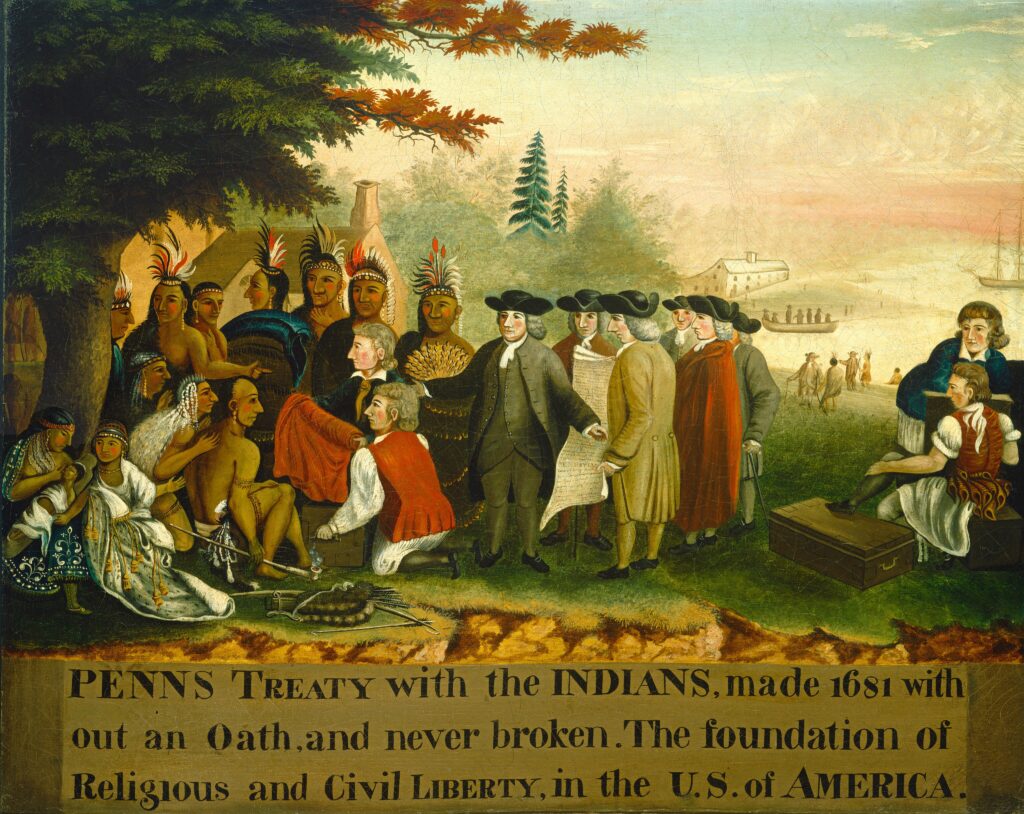
Penn’s Treaty with the Indians (c. 1840–1844), Edward Hicks. Oil on canvas. National Gallery of Art, Washington, D.C.
In the early years of Pennsylvania, William Penn sought to establish a colony in which religious conscience would enjoy protections rarely afforded in Europe. A Quaker who had himself suffered imprisonment for his beliefs, Penn envisioned a society in which freedom of worship and civil government could coexist. Edward Hicks, another Pennsylvania Quaker, returned to this founding vision in his painting Penn’s Treaty with the Indians, depicting the legendary meeting between Penn and the Lenape people. Painted more than a century after the event it commemorates, the scene presents an idealized vision of peaceful agreement, with European settlers and Native Americans gathered beneath the open sky.
Hicks devoted much of his artistic career to depicting the possibility of peace among people divided by competing interests and beliefs. His treatment of Penn’s treaty reflects the Quaker conviction that moral obligations precede political authority and that agreements should be governed by conscience as well as law. Along the bottom of the canvas, an inscription celebrates the treaty as a foundation of religious and civil liberty in America. The historical relationship between Pennsylvania’s settlers and its Native inhabitants proved considerably more troubled than this idealized scene suggests, but Hicks’s painting preserves the aspirations that animated Penn’s experiment in religious toleration.
The American commitment to religious freedom would eventually find constitutional expression in the First Amendment and statutory reinforcement in the Religious Freedom Restoration Act of 1993. Yet the distance between a principle established in law and its protection in practice remains a recurring feature of American political life. Religious employers challenging federal mandates today encounter a version of the same fundamental question that occupied Penn and his successors: how far may government authority extend into matters governed by religious conscience? Hicks’s painting recalls an American political inheritance in which liberty of belief was understood as an essential condition of a just and peaceful society.