Mamdani and the Politics of Compulsory Grief
The strange thing is the compulsion to make every act of mourning contain its opposite. Our public culture has become terrified of particular grief.
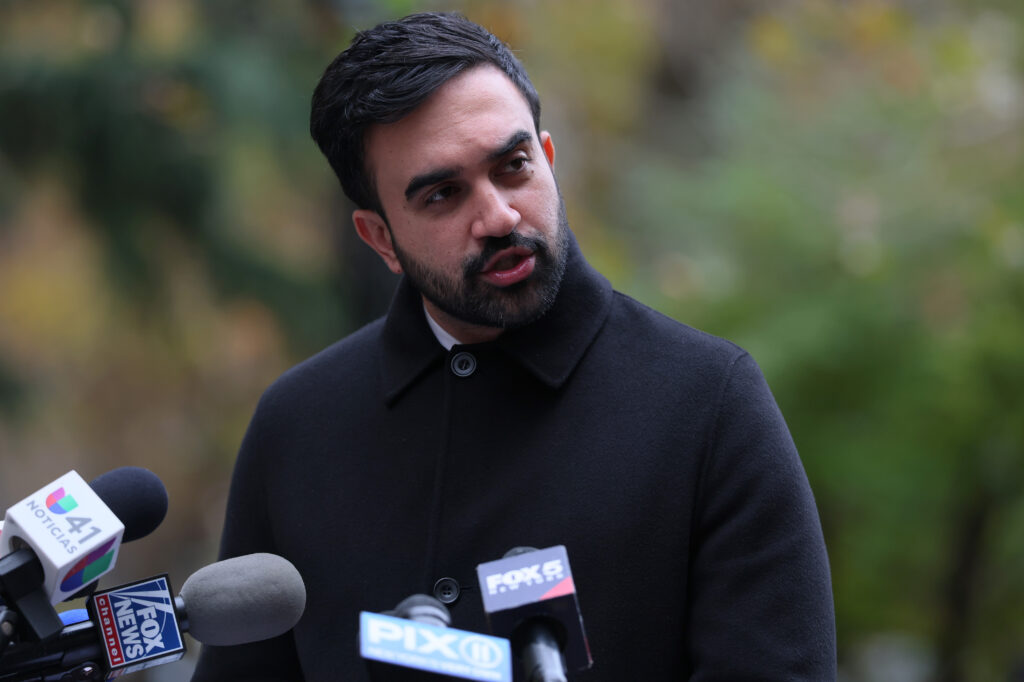
There is something almost too neat about the schedule. At seven o’clock, Zohran Mamdani will attend a vigil for the Israelis murdered on October 7. Two hours later, he will meet with Palestinian New Yorkers. The arrangement has the slightly unreal quality of a mayoral itinerary trying to solve the Middle East by calendar invite.
His statement for the anniversary has the same structure. Mamdani condemned Hamas for killing more than 1,100 Israelis and abducting 251 others, then turned to Gaza, where he accused the Israeli government of carrying out an “ongoing genocide” that has killed more than 74,000 Palestinians, including more than 21,000 children. New Yorkers, he added, were mourning “all while knowing that our tax dollars fund these war crimes.”
You can see what he is trying to do. He wants to condemn October 7 without surrendering his broader view of Israel and Gaza. Politically, that is perfectly legible. But there is something grim about the insistence that even an anniversary of mass murder has to carry the full weight of every subsequent argument.
This is one of the stranger habits of contemporary politics. Nothing can simply be mourned anymore. Every death arrives with context, every atrocity with a footnote, every memorial with a second moral claim waiting just offstage. We are apparently incapable of letting one horror remain, for a few hours, one horror.
Of course October 7 did not happen outside history. Nothing does. The attack had a political context, and so does the war that followed it. But anniversaries are not policy seminars. A funeral is not improved by someone standing up halfway through to explain the geopolitical conditions that produced the corpse.
That is what makes Mamdani’s schedule so urgently revealing. First the Israeli dead, then the Palestinian dead, one constituency after another, as though suffering can be balanced by municipal choreography. This is probably intended as inclusion. New York has large Jewish and Palestinian communities, and a mayor should be able to speak to both. But inclusion becomes strange when it starts to feel compulsory, when every expression of grief has to be immediately paired with another one so nobody is ever allowed to occupy the moral foreground for very long. The result here isn’t pluralism, but rather a kind of neurotic bookkeeping.
Israeli Consul General Ofir Akunis has invited Mamdani to watch footage from the October 7 attacks, apparently in the hope that seeing the violence more directly will change his politics. That feels like the inverse mistake. Mamdani does not lack information about what happened. He knows people were murdered. The disagreement is about what follows from that fact.
Still, his own response falls into the same trap. He wants to reject tribalism while speaking in the language of competing victimhood. The categories are familiar by now: victims, oppressors, war crimes, apartheid, genocide, complicity. Everyone must be placed somewhere. Everyone’s suffering must be interpreted before it can simply be felt.
There is a simpler way to handle this. October 7 can be the day Israelis and Jews mourn October 7. Palestinians can mourn Gaza. One grief does not have to cancel out the other, and neither needs to arrive with a disclaimer attached.
A city as large as New York ought to be able to tolerate that much particularity. It should be possible, at least occasionally, to let the dead belong to the people who are mourning them.