What Maine Democrats Chose to Ignore
The accusations gathered slowly, like ominous clouds over a harbor, and still the party sailed on.
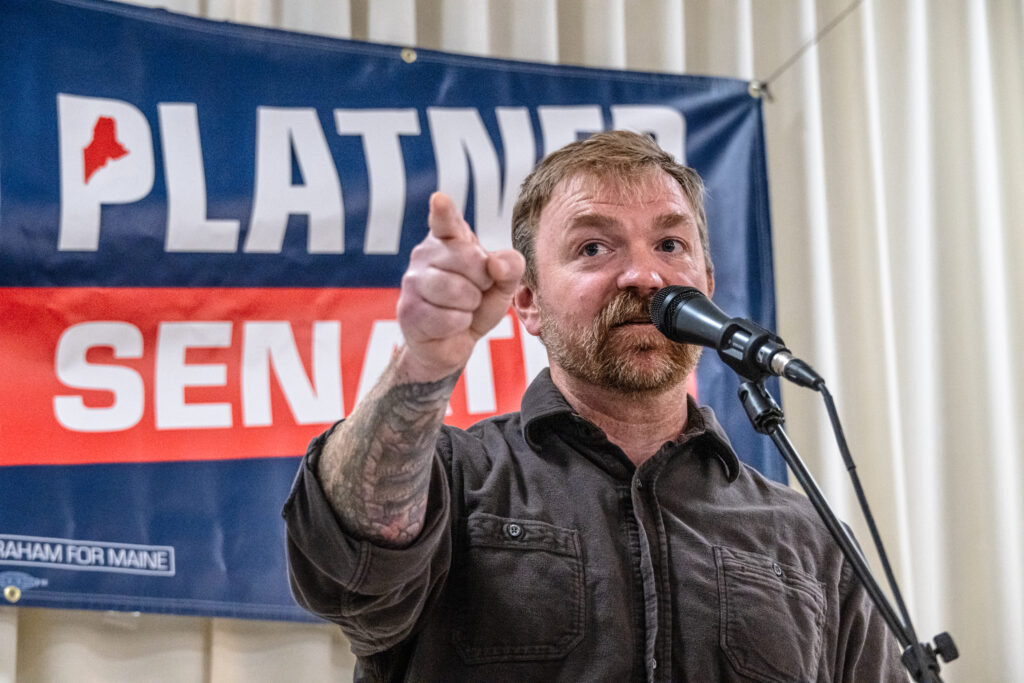
Maine Democrats are asking you to nod along as they explain their stance on the newly sloughed-off Graham Platner. They would like you, the public, to believe that his departure reflects a belated act of responsibility. It doesn’t, of course. If you’re a person with a thinking mind, you’ll know that it reflects merely the moment when political usefulness finally gave way to political danger.
Platner withdrew after a former girlfriend accused him of sexual assault, an allegation he denies. By then, however, Democratic voters had already given him 72 percent of the primary vote. Progressive leaders had endorsed him. Party activists had defended him through one revelation after another. And it may be hard for them to take a look in the mirror — but come on. They knew enough.
They knew about the offensive online writings, the contemptuous remarks about women, police officers, black Americans, gay people and rural whites. They knew he had called himself a communist. They knew about the tattoo resembling a Nazi symbol. They knew about the sexually explicit messages sent to women during the early years of his marriage. They knew former girlfriends had described troubling behavior. The accusations gathered slowly, like ominous clouds over a harbor, and still the party sailed on.
Platner’s supporters treated each disclosure as proof that he frightened the establishment. His crudeness was actually just authenticity. His radicalism, you see, was simply courage. Questions about his character became evidence of persecution. Nothing mattered as much as the promise that he might defeat Sen. Susan Collins.
That was the governing calculation. Collins’s seat represented power, and power made forgiveness easy. As long as Platner remained competitive, Democrats found reasons to excuse him. The contrast with Democrats’ treatment of Donald Trump is difficult to miss. For years, they insisted that Republicans had a moral duty to abandon him on the strength of allegations that, in many instances, were decades old, untested in court and supported by little contemporaneous evidence. They allowed no room for uncertainty and treated what should have been skepticism as complicity.
With Platner, they suddenly acquired a connoisseur’s appreciation for evidentiary nuance. One accuser’s Republican background became grounds for suspicion; earlier allegations were compartmentalized, minimized or dismissed. The party’s rigor depended largely on the identity of the accused—and on whether his continued candidacy still promised another Democratic seat.
The standard shifted only when the latest allegation threatened the party’s chances of capturing the seat. Then the endorsements vanished, the calls for withdrawal came, and the party discovered a limit it had not found before. Indeed, there is little honor in abandoning a candidate only after the cost of defending him becomes too high.
The sadness of the episode lies in what it reveals about political judgment. Parties will always contain ambitious people, damaged people and opportunists. Their character is measured by what they reward, what they excuse and what they ask voters to forget. Maine Democrats rewarded Platner after his record was already visible.
His fall also belongs to a larger pattern. Democrats have continued backing candidates after revelations that would once have ended public careers. Virginia Democrat Jay Jones survived the disclosure of messages imagining violence against a Republican colleague and still won election as attorney general. Other Democratic candidates have advanced after making excuses for terrorism, indulging revolutionary rhetoric or expressing contempt for the country they seek to govern.
The cases differ, but the habit is familiar. Conduct once considered disqualifying is recast as secondary when the candidate serves the larger political cause. Standards return only when the polling turns. Maine Democrats have governed much of the state for years; they control the governorship and have dominated the legislature. Maine still struggles with high taxes, expensive electricity, weak infrastructure and a difficult climate for business.
Those failures might have prompted reflection, but Democrats made defeating Collins their moral drama and embraced a candidate who reflected the anger of their activist base.
Collins has spent decades serving Maine, building influence and surviving in a region increasingly hostile to Republicans. Democrats answered her record with Platner and now hope a new name will erase the choice they made, but it won’t. The convention may produce a more presentable nominee, and the rhetoric may soften. The campaign signs may even change. Yet the primary remains, along with the knowledge that Democratic voters saw Graham Platner clearly enough and chose him anyway.