The Bill Comes Due for College-for-All
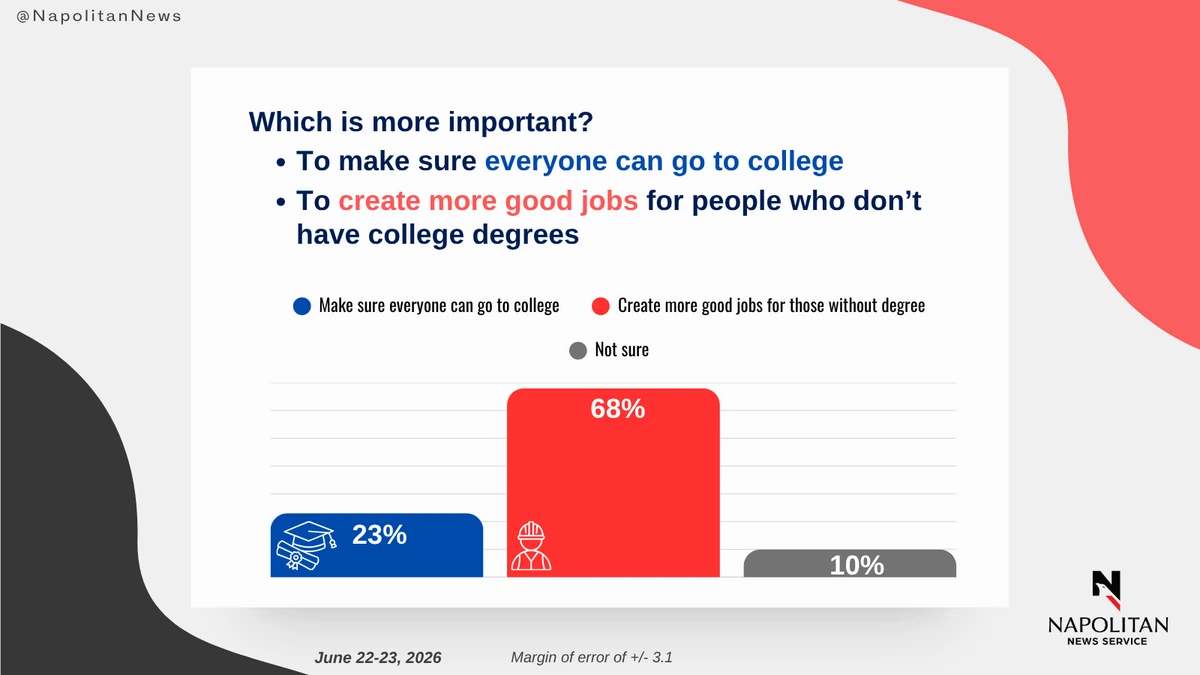
A new Napolitan News Service survey finds voters back good non-degree jobs over universal college access, 68% to 23%.
For a generation, the governing assumption of American education policy held that the diploma is the ladder, and that the only serious question was how to get more people onto it. Voters have stopped believing it.
By better than two to one, Americans now say the country’s priority should be creating good jobs for people without college degrees rather than guaranteeing that everyone can go to college. A late-June Napolitan News Service survey of 1,000 registered voters, conducted by Scott Rasmussen and RMG Research, puts the split at 68% to 23%. The finding is no mood swing. The same question has produced the same lopsided answer since 2023, never closer than a 43-point gap.
The instinct extends to the choices families actually face. Asked whether America would be better off with more high school graduates heading to college or straight into the workforce, a plurality chose work, 45% to 37%. Republicans were united behind it. So were rank-and-file Democrats, who favored an immediate job by 46% to 35%. Only the party’s activist wing dissented, with 56% of the voters who champion Alexandria Ocasio-Cortez preferring college.
The sharpest finding concerns money. Sixty percent of voters say college grew ruinously expensive because the federal government subsidized it with student loans and other funding. Only 17% credit an improvement in quality. This is the argument William Bennett, Ronald Reagan’s education secretary, made in 1987, when he charged that federal aid was licensing colleges to raise their prices rather than easing the burden on families. For decades the credentialing class treated the claim as a conservative superstition. The public has now ratified it.
The stakes here are not abstract. A country that no longer regards college as the universal ladder is a country with different politics around student-loan forgiveness, around the trades and apprenticeships, around the calculation every parent runs when a capable sixteen-year-old asks what comes next. On that last question voters proved cautious: given a mature teenager who has already met his graduation requirements, 41% would still have him finish high school the ordinary way, against 34% who would send him to college early and 12% who would put him to work.
The old faith survives in one place, among the young. Half of voters under 35 say more graduates should attend college, the only age group to think so, and nearly a third of them still believe rising tuition reflects rising quality, a view shared by just 8% of voters over 65. Experience is a stern tutor. The Americans who have actually paid the bills, or watched their children pay them, have reached the harder conclusion.
None of this demanded an ideological conversion. It demanded arithmetic. Voters weighed four decades of tuition inflation, thinning wage premiums on many degrees, and a labor market starved for skilled work that no seminar confers, and they returned the verdict the experts kept postponing. The consensus that built the modern university has lost the country it was meant to serve, and the people who run our politics are the last to know.