After Iran, the Wallet
Rasmussen's latest finds the Economy reclaiming voters' top issue spot for the second week running, and the GOP's traditional advantage on it is gone.
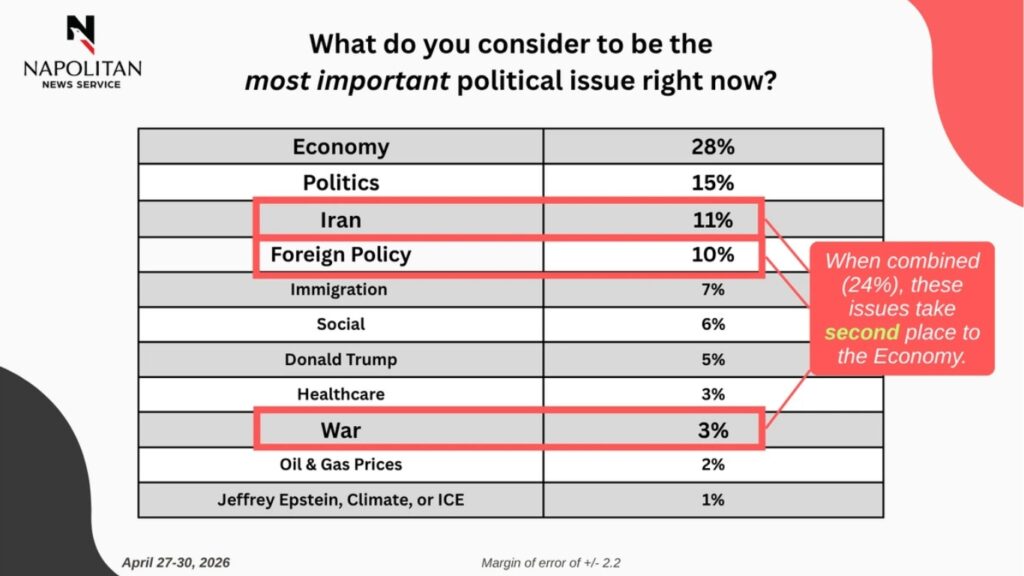
For a brief season, the war with Iran organized the country’s political mind. Casualty figures, strike packages, and the question of what would come next pushed past inflation and grocery bills as the issue most likely to be named, unprompted, when an American voter was asked to identify the most important political problem facing the country.
That season is over.
Scott Rasmussen’s latest Napolitan News Service survey, conducted April 27 through 30 among 2,000 registered voters, finds the Economy back in first place for the second consecutive week, named by 28% of respondents in an open-ended question categorized using Jigsaw’s Sensemaker tool. Iran, Foreign Policy, and War combined draw 24%. Politics follows at 15%, then Immigration at 7%. The poll carries a margin of error of plus or minus 2.2 percentage points.
The pattern holds across both parties. Republicans name the Economy first (30%), then the Iran complex (26%), then Politics and Immigration tied at 12%. Democrats name the Economy first as well (27%), with the Iran complex at 21% and Politics at 17%. The two coalitions disagree about almost everything in 2026. They agree about this.
The reason, on the underlying numbers, is not a mystery. In a companion Napolitan release, 44% of registered voters say all their income goes to living expenses. Just 26% rate the economy as good or excellent. Thirty-eight percent believe the country is already in a recession. These figures describe a public counting receipts at the kitchen table, not one preoccupied with grand strategy.
Here the data delivers a finding the governing party cannot afford to ignore. Asked which party they trust more on the Economy, an issue that has been a Republican stronghold across decades, 39% of voters now name the Democrats. The Republican advantage on its signature issue has eroded under a Republican administration and a Republican Congress. The voters who put the GOP back in power did so on the promise of cheaper groceries, lower energy costs, and an end to the inflation that defined the prior four years. They are not yet persuaded that promise has been kept.
The pattern is older than this administration. President George H. W. Bush concluded the Gulf War in 1991 with approval near 90%. Eighteen months later he lost the White House to a candidate whose campaign ran on a single standing instruction: “It’s the economy, stupid.” American voters reward decisive foreign-policy action, and then they return, with little ceremony, to the question of what is in the refrigerator.
President Trump’s Iran posture has produced one of the most consequential foreign-policy outcomes of the post-Cold War era. The Rasmussen data suggests the political dividend from it is already discounted in the public mind. Foreign policy concentrates voter attention for as long as the cameras hold the image; once the cameras move, the kitchen returns, and the bill on the counter resumes its quiet work of organizing political loyalty.
The window to translate strategic clarity into material relief is narrower than the headlines suggest. Tariff policy, energy permitting, the regulatory agenda at the FTC and SEC, the pace at which prices on the shelf actually move: these are now the variables on which the next election will turn. Voters have signaled, in their own words, what they want their representatives to discuss. The next election will be settled on whether anyone listens.