The Kingdom of Fraud and the Campaign It Will Define
California lost an estimated $180 billion to fraud on Gavin Newsom's watch.
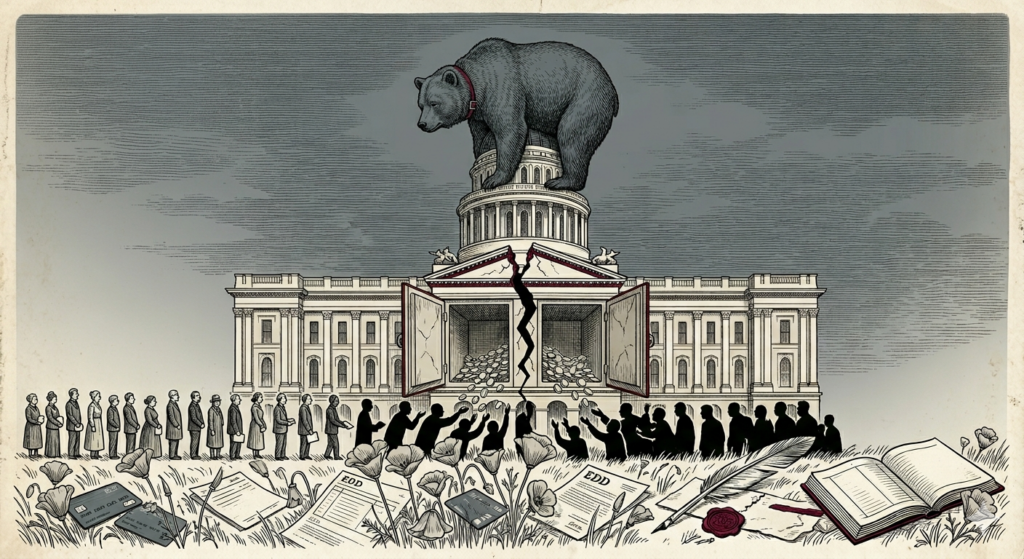
One hundred and eighty billion dollars. That is the figure at the center of a City Journal investigation by Christopher Rufo and his co-authors, representing their best estimate of the taxpayer money lost to fraud in California since Gavin Newsom took office in 2019. The number is almost too large to process. It rivals the entire annual GDP of Hungary. It could fund the Department of Veterans Affairs for a year. And it has been siphoned, dollar by dollar, from programs ostensibly designed to serve the state’s poorest and most vulnerable residents.
The anatomy of the theft is by now well documented. During the pandemic, California’s Employment Development Department paid out an estimated $32 billion in fraudulent unemployment claims. Recipients included inmates in state prisons, organized crime rings operating from Romania, and a Memphis rapper who posted a music video boasting about his exploits with EDD debit cards. The state’s Medi-Cal program, which Newsom expanded aggressively, now carries a fraud rate that federal officials at the Department of Health and Human Services estimate at 25%, translating to roughly $50 billion per year disappearing into phantom patients and fabricated billings. California’s homelessness spending, some $24 billion over five years, was so poorly tracked that the state auditor could not determine whether the money accomplished anything at all.
The pattern is not one of isolated failures. It is the predictable harvest of a political system that treats government spending as a virtue in itself and oversight as an inconvenience. One-party rule in Sacramento has produced an environment in which programs expand faster than anyone can monitor them, eligibility verification is treated as an obstacle to access, and a Democratic state senator last year introduced legislation to raise the felony threshold for welfare fraud from $950 to $25,000. As Republican Assemblyman Carl DeMaio told Just the News, the bill would effectively “legalize welfare fraud” in the nation’s largest state.
Enter Vice President J.D. Vance. In his capacity as the White House’s newly appointed fraud czar, Vance announced the arrest of eight alleged fraudsters in California, including nurses and a psychologist accused of billing Medicare for more than $50 million in fabricated hospice care. The sting was coordinated through the new White House fraud task force, and Vance made certain the public knew it. Newsom, predictably, called the operation “baseless” and politically motivated. His press office dismissed Rufo’s reporting as “unsourced slop.”
The governor’s defensiveness is instructive. Newsom’s administration rolled up 280 fraud cases across his entire tenure. The federal task force exceeded that pace in its first month. The disparity is less a commentary on competence than on incentives: a government that derives its political identity from expanding the welfare state has little institutional motivation to discover how much of that spending is stolen. The fraud is not a bug. It is the cost of doing business in a system designed to distribute money first and ask questions later, if ever.
None of this would matter as much if Newsom were simply a governor finishing his term. But he is, by every indication, running for president. The 2028 campaign will likely feature Vance on one side and Newsom on the other, and the fraud task force is already doing double duty as opposition research. Every arrest in California, every audit revealing phantom patients and ghost employees, will arrive in voters’ inboxes with the Vance imprimatur and the implicit question: if Newsom could not keep organized crime out of his own Medicaid program, what would he do with the rest of the federal government?
The $180 billion figure will follow Newsom through every primary debate and into every general election ad. It is the kind of number that does not require explanation, only repetition. Newsom will call it exaggerated. He will blame the pandemic, the federal government, the prior administration. But the structural truth beneath the number is simple and damning: California built an empire of spending with no serious mechanism for accountability, and the people who were supposed to benefit paid the price while criminals collected the checks. Vance does not need to embellish. He only needs to keep counting.