New Poll: Congress is Crooked
A new Napolitan poll finds 67% of voters across party lines say Congress is less ethical than ordinary Americans. The demands for accountability are concrete.
Republicans and Democrats, for all their problems appear to agree on one thing: Congress is crooked.
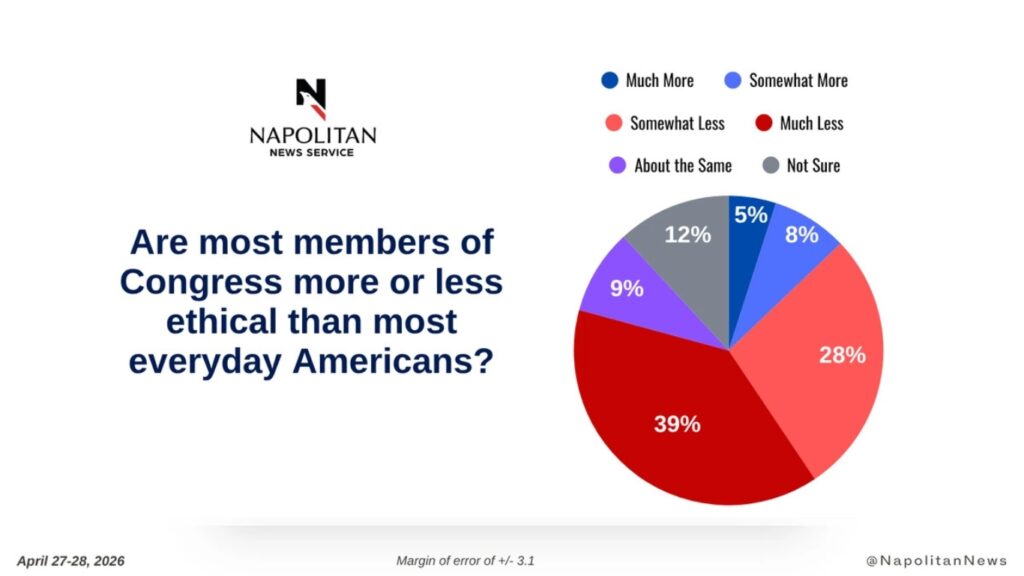
A Napolitan News Service survey of 1,000 registered voters conducted by Scott Rasmussen on April 27 and 28, 2026, finds that sixty-seven percent of voters now consider most members of Congress less ethical than most everyday Americans. Only thirteen percent say more ethical. The plurality, thirty-nine percent, registers the harshest available judgment: most members are much less ethical than the people they represent.
The striking feature is the symmetry across the partisan divide. Republicans agree at sixty-four percent. Democrats agree at seventy-one percent. Whatever else separates the two coalitions, the verdict on Capitol Hill does not.
A corollary question delivers the same finding in plainer language. Sixty-two percent of voters say most members of Congress act in ways that would be considered inappropriate or illegal for anyone else. Among the politically engaged, those who follow the news closely and talk politics most days, the margin balloons to seventy-five percent against nineteen percent. The voters who pay the closest attention are the most certain that Congress operates under a different set of rules.
It is worth considering that these low percentages would indeed be much lower if more Americans really understood how institutionalization of the corruption.
Since the 1990s, Congress has maintained a fund that pays settlements out of the U.S. Treasury when members and congressional offices are accused of sexual harassment, discrimination, and other misconduct. Between 1997 and 2019, more than $18 million flowed through what is now the Office of Congressional Workplace Rights, covering nearly 300 cases. Until reforms in 2018, the names of accused members were rarely disclosed and the members themselves were not personally liable. Seventy percent of voters say taxpayer money should never have been used this way. Seventy-five percent say the names and the amounts should be made public.
The settlement fund itself is the residue of an earlier reform. The Congressional Accountability Act of 1995 brought Congress under the same labor and civil-rights laws it had long imposed on every other American workplace. The Treasury fund was the enforcement mechanism. Three decades later, the public’s complaint is that the mechanism has inverted its purpose, covering the cost of member misconduct with the money of the citizens to whom the misconduct was done.
That is the question now formally before the House Oversight Committee, which last month approved Representative Nancy Mace’s motion to subpoena the Office of Congressional Workplace Rights for all awards and settlements paid for member misconduct prior to December 12, 2018. The records have been withheld for a generation. The voters whose money paid the settlements would now like to see them.