The Squeeze Nobody Voted For
A new Napolitan survey finds 64% of voters say they are spending more than a year ago. The squeeze crosses party lines, and Democrats now lead on the economy.
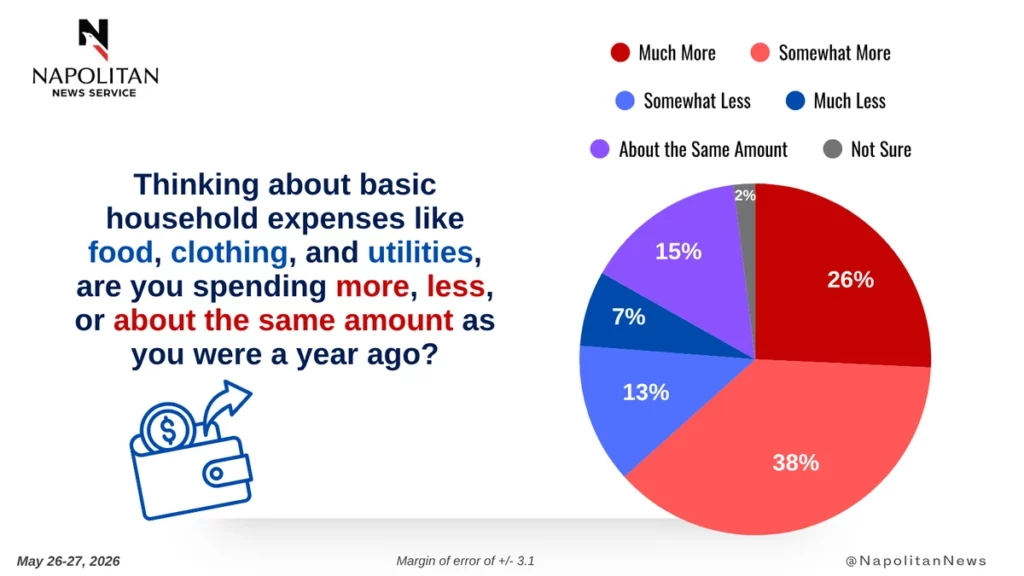
Ask Americans how the economy is treating them and the answer arrives without hesitation. In Scott Rasmussen’s latest Napolitan News survey, 64% of registered voters say they are spending more than they were a year ago. More than a quarter, 26%, say they are spending much more. Only 20% report spending less, and a slim 15% say their outlays have held steady.
The number itself matters less than its stubbornness. This figure has hovered between 57% and 64% since February 2025, a flat line of discontent that no headline GDP print or cooling inflation rate has managed to bend. Voters are not reacting to a single bad month. They are describing a condition.
What makes the finding politically lethal is its reach across every line that usually divides the electorate. Majorities of Democrats, Republicans, and Independents alike say their costs are climbing. The squeeze does not stop at the working class, either. Seventy percent of postgraduates, the cohort most insulated from economic shocks and most likely to be told the fundamentals are sound, say they are spending more. So do 81% of the voters who follow politics every single day. These are the people who read the reassuring data. They are not buying it, because they are the ones doing the buying.
The Rasmussen file fills in the rest of the picture, and it is bleak. A separate Napolitan poll found that 44% of voters say all of their money now goes toward living expenses. Thirty-eight percent believe the country is already in a recession. Just 25% rate the economy as good or excellent. For an electorate, these are not abstractions traded among economists. They are the arithmetic of a grocery run, a utility bill, a tank of gas.
History offers a warning about numbers like these. Jimmy Carter learned in 1980 that voters forgive almost anything before they forgive the sense that their dollar is shrinking and no one in charge has noticed. Ronald Reagan’s question, whether you were better off than four years ago, worked because it required no expertise to answer. The Napolitan data suggests a great many Americans would answer it the same way today.
The political consequence is already visible. For the second consecutive month, voters now trust Democrats more than Republicans on the economy, an issue that was a Republican stronghold for a generation. That trust does not transfer because the public has studied a tax plan. It transfers because the party perceived as defending the status quo pays the price when the status quo hurts.