One Bill From Trouble
A plurality of voters say the country is already in a recession. Beneath the argument over the label, the survey finds a nation split between those with a cushion and those without one.
The National Bureau of Economic Research, the body that officially dates American recessions, has declared nothing. The growth statistics still point upward. Yet ask the people who live inside the economy rather than chart it, and a harsher verdict emerges.
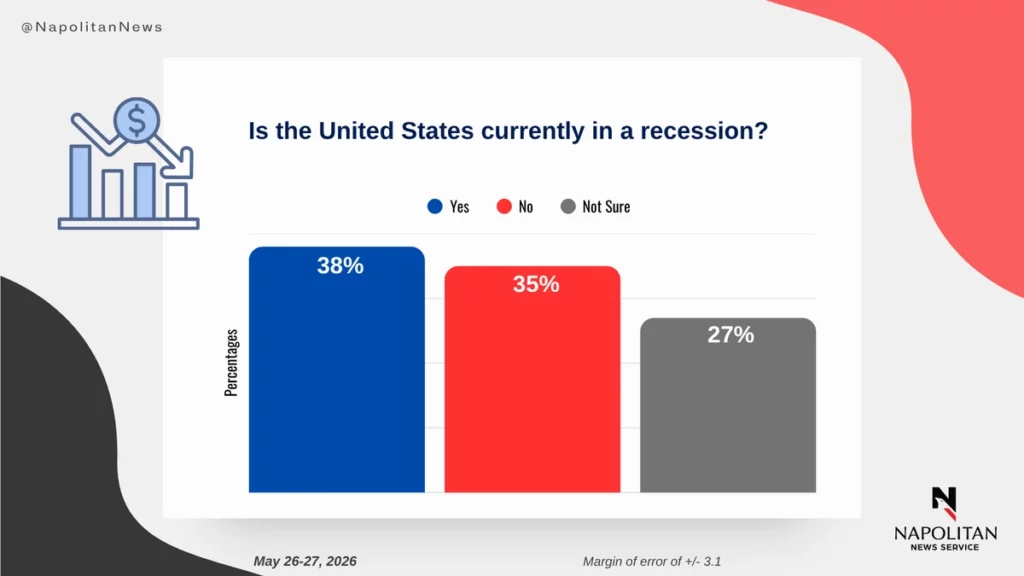
Thirty-eight percent of registered voters say the United States is already in a recession, against 35% who say it is not and 27% who are unsure. That is the finding from Scott Rasmussen’s latest Napolitan News Service survey, conducted May 26–27 by RMG Research among 1,000 registered voters. The share saying recession has climbed three points in two weeks.
Much of that judgment tracks party rather than economics. Forty-nine percent of Democrats say the country is in a recession; only 27% of Republicans agree. The party out of power sees a downturn, the party in power sees clear skies, and the truth presumably sits somewhere between them.
The broader readings are bleak across the board. Forty-two percent rate the national economy as poor, and 57% say it is getting worse. Sixty-four percent report spending more on basics like food, clothing, and utilities than they did a year ago, a net figure of plus 44 that has widened from plus 34 in March. The cost of ordinary life keeps climbing, and Americans feel it at the register.
Here the survey turns from opinion to arithmetic. Americans rate their own finances more kindly than the nation’s, with 40% calling them good or excellent. But the average conceals a fault line that runs straight through the country. Rasmussen separates what he calls Mainstreet voters from an elite and elite-adjacent class, and on the questions that measure resilience the two might as well inhabit different economies.
Consider the simplest test of security. Asked whether a surprise $1,000 expense would force them to cut back, 55% of Mainstreet voters said yes. Among the elite, only 33% said the same. More than half of Mainstreet households, 53%, report that every dollar of income goes to current living expenses, against 25% of the elite. On credit cards the gap holds: 46% of Mainstreet voters paid their balances in full last month, compared with 69% at the top.
This is the strain the headline statistics cannot capture. For the comfortable, the present economy is an inconvenience, a matter of higher grocery bills absorbed without much thought. For tens of millions of others, the distance between solvency and trouble has narrowed to a single unexpected expense.