The People Who Still Trust Washington
Voter confidence in the federal government slips to 24%, and the few believers cluster among the politically obsessed.
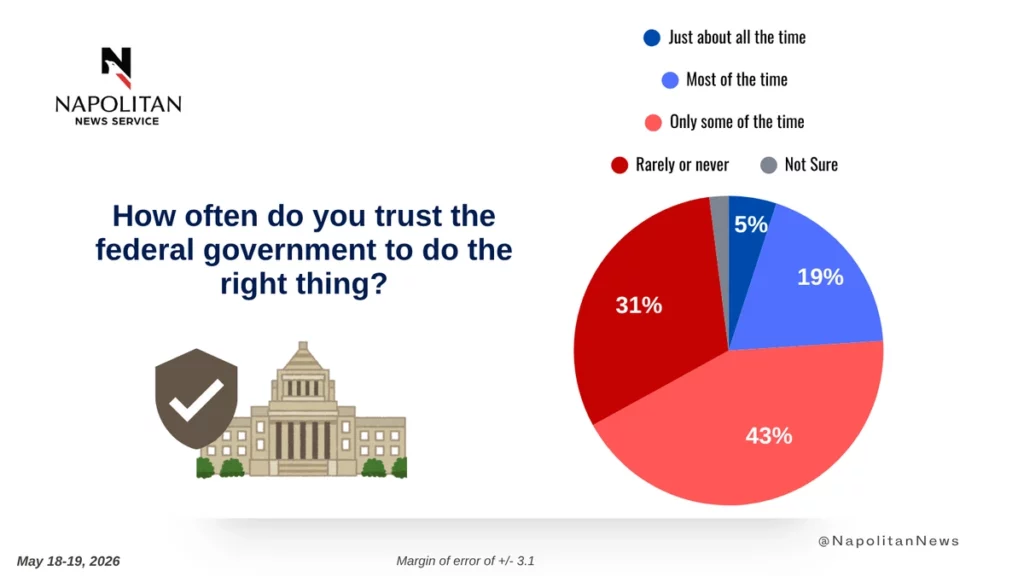
Twenty-four percent. That is the share of American voters who, as of this week, trust the federal government to do the right thing a majority of the time. The figure comes from the latest Napolitan News Service survey, down three points from April and tracing a line that has bent in one direction for half a century.
The rest of the country has settled somewhere between resignation and contempt. Forty-three percent of voters say they trust Washington only some of the time. Another 31% say rarely or never, a share that has itself fallen five points since April. Add it together and roughly three in four Americans decline to extend the government their confidence in any sustained way.
The trend runs deeper than any single administration. It has been more than 50 years since a majority of Americans trusted the federal government to do the right thing most of the time. Presidents have come and gone, the parties have traded the White House, and the line has held through all of it. The institution that taxes, regulates, and spends in the name of the public has steadily lost the public.
The most revealing number sits beneath the headline. Among voters who talk politics every day or nearly every day, 46% say they trust the federal government to do the right thing a majority of the time, almost double the rate of the country at large. The Americans closest to the machinery, the ones who follow every hearing and absorb every briefing, are also the ones most willing to believe in what it produces. Proximity breeds faith. Distance breeds the opposite.
Normal Americans, who meet the government mostly through the IRS, the permitting office, and the price of a tank of gas, have drawn the harder conclusion.
The partisan split confirms the pattern without softening it. Republicans, whose party holds the White House, post the highest trust of any group at 33%, and even that is down five points from April. Democrats sit at 18%. Trust ordinarily rises for the party in power, which makes the Republican slide worth marking: the voters whose side currently runs the machinery are losing faith in it anyway.
A republic runs on a kind of credit. Citizens consent to be governed on the expectation that the governing will be done, more or less, in good faith. That credit is now extended by a quarter of the population and withheld by the rest. Washington has drawn on the overdraft for two generations, and the political class, comfortable at 46%, has shown little curiosity about when the account comes due. The survey suggests that question is no longer hypothetical.