A Half-Century Without a Majority
Trust in the federal government has not held a majority since 1972. A new Napolitan poll shows the gap widening — and the political class standing apart.
In 1972, a national poll found that the majority of Americans trusted the federal government to do the right thing most or all of the time. Five decades and eleven presidents have since elapsed. Not once during any time in the intervening years has the federal government been able to replicate the pre-1972 numbers.
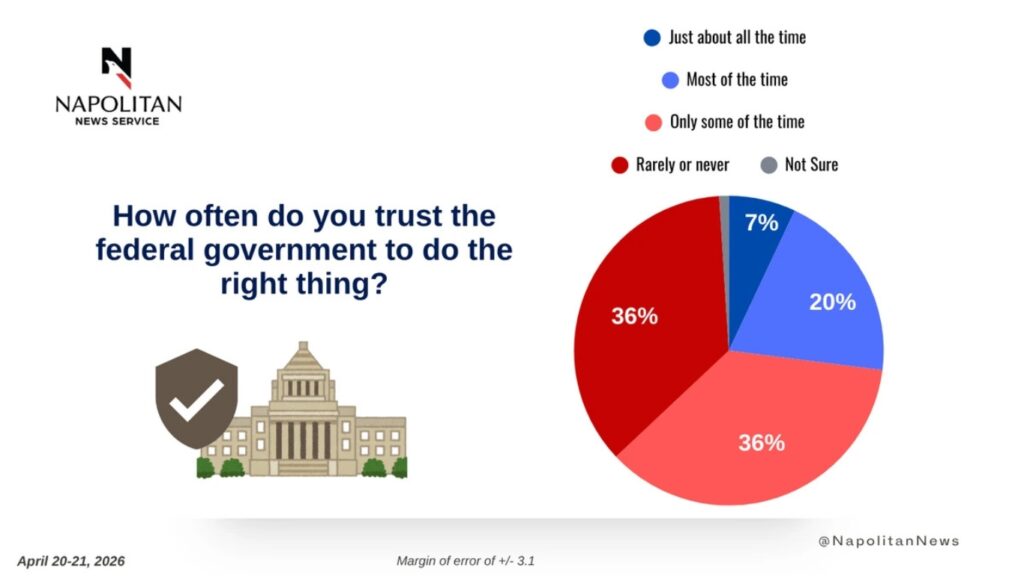
The latest Napolitan News Service survey, conducted April 20–21 by Scott Rasmussen and RMG Research discovered that among 1,000 registered polled voters, the trust gap was increasingly widening. Some 27% of voters now say they trust the federal government to do the right thing just about always or most of the time, down two points from March. The figure for those who say they rarely or never trust the government has climbed to 36%, an increase of five points in a single month. The “no trust” cohort now exceeds the “trust” cohort by nine points.
Stop and consider the structural fact. Trust in the federal government has not commanded a majority of the public since the year of the Munich Olympics. Whatever the federal government has done in that span, from wars won and wars lost to expansions and contractions of the welfare state to the prosecution and pardoning of presidents, the operative number has not moved into majority territory once.
That is not a polling artifact. That is a verdict on the regime.
The April crosstabs surface a quieter finding that deserves attention. Among voters Rasmussen classifies as “politically engaged,” 44% say they trust the federal government to do the right thing most of the time. Among the narrower set who report discussing politics every day or nearly every day, the figure climbs to 55%. A bare majority. The only stratum of the country where federal trust commands a majority is the stratum closest to federal power.
This inversion is the running theme of the Rasmussen project. The same polling operation has documented for years that the people most confident in the federal government’s competence and good intentions are the people whose careers, social standing, and intellectual identities depend on its expansion. The administrators trust the administration. The people who ride the train trust the schedule. Everyone standing on the platform watching it pass has long since concluded the schedule is fiction.
The partisan breakdown is worth noting if only because it confounds the usual expectation. Trust in the federal government typically rises among voters whose party holds the White House. Yet under a Republican administration in 2026, only 38% of Republicans say they trust the federal government to do the right thing most of the time, down a point from March. Democrats sit at 19%. The Republican number is the higher of the two, but it is not a vote of confidence. It is a grudging concession that the present occupant is preferable to the alternative on offer.
What does the public actually believe? It believes the federal government will not do the right thing most of the time. It believes this consistently across administrations, across decades, across nearly every demographic slice the pollsters have managed to isolate. The single durable exception is the political class itself, which trusts the institution it inhabits because it cannot afford to do otherwise.
The American public has been saying the same thing for fifty-three years. Whatever the regime has heard, it has not changed what it does. The next survey will be along in a month. The number will move a point in one direction or the other. The verdict will not.