An Indictment at Fauci’s Door
A five-count federal indictment of Fauci's longtime senior advisor reads less like a personnel matter than a roadmap.
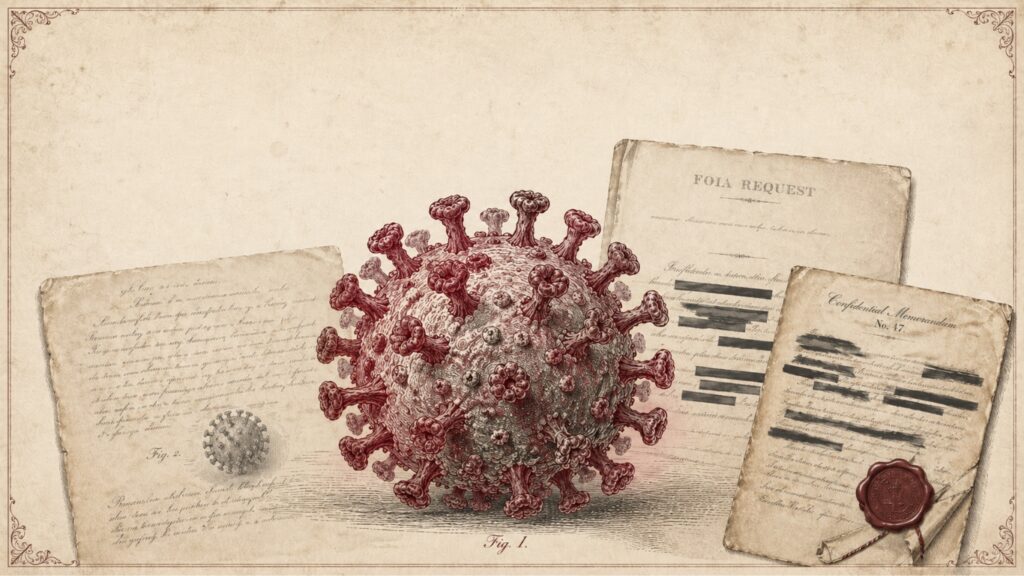
The five-count indictment unsealed Tuesday in the U.S. District Court for the District of Maryland is, on its face, the case of one man. David M. Morens, 78, a longtime senior advisor at the National Institute of Allergy and Infectious Diseases, is charged with conspiracy against the United States, two counts of destruction, alteration, or falsification of records in a federal investigation, and two counts of concealment, removal, or mutilation of records. He faces decades in prison if convicted.
Read the indictment, however, and the case grows several ranks in size.
From 2006 through December 2022, Morens served as Senior Advisor to the man the indictment refers to only as “Senior NIAID Official 1.” That official ran NIAID through the entirety of the Covid-19 pandemic. He briefed the president of the United States, the Congress, and the public about the origins of the virus. The indictment names him only by his title. No reader who paid attention to American public life over the past six years requires a name.
A Private Channel
What Morens is alleged to have done is straightforward. According to the grand jury, he and two co-conspirators routed federal business onto his personal Gmail account for the express purpose of placing it beyond the reach of the Freedom of Information Act. They moved discussions of the EcoHealth Alliance bat coronavirus grant that subawarded funds to the Wuhan Institute of Virology, of Covid-19’s origins, of Congressional inquiries, and of scientific commentaries onto a channel they believed FOIA could not penetrate.
In Their Own Words
This is not a leak or a partisan summary. The grand jury has the men quoting themselves.
“This is sent from my gmail account,” Morens wrote on April 25, 2020, to the figure the indictment calls Co-Conspirator 1: the longtime president and chief executive of a New York non-profit whose tenure (2009 to January 2025) and grant portfolio (NIH 1R01AI110964, “Understanding the Risk of Bat Coronavirus Emergence”) identify Peter Daszak of EcoHealth Alliance unmistakably. “Please send all replies here To gmail.”
A day later: “We’ll communicate with you via gmail from now on.”
A week after that, writing to officials at a prominent medical organization to enlist their support for Daszak: “I need to keep this correspondnce [sic] off of USG emails for obvious reasons, so am sending from gmail . . . I am under Multiple FOIAs already.”
Morens, the indictment alleges, then learned to do worse than route around the law. He learned to defeat it. “I learned from our foia lady here how to make emails disappear,” he wrote on February 24, 2021, “after I am foia’d but before the search starts.” He told a correspondent he had “deleted most of those earlier emails after sending them to gmail.” When confronted by the House Select Subcommittee on the Coronavirus Pandemic in May 2024 testimony, Morens called the line “black humor.” A grand jury has now disagreed.
What was Morens defending? The indictment is specific. He edited Daszak’s written response to the NIH Deputy Director for Extramural Research about EcoHealth’s compliance failures. He helped author a scientific commentary, submitted on July 3, 2020, that the indictment says “advocated COVID-19 emerged from nature and not from a lab” and “was intended to benefit” the New York non-profit and its president. He counseled his collaborators that “we are getting FOIA’d non stop, so its most important that [Senior NIAID Official 1] not have anything on the record that could come back to bite.”
The Gifts
For these efforts, the indictment alleges, Morens accepted things of value. On June 25, 2020, two bottles of Napa Valley red wine arrived at his Maryland home from Daszak, accompanied by a note thanking him for his “behind-the-scenes shenanigans in my battle against your bosses boss, his boss, and the ultimate boss on the hill.” Morens replied from his Gmail: “Now i am actually going to have to do something to deserve it. Let me think.” Eight days later he had submitted the natural-origin commentary. Daszak then promised “phase II” and “phase III” gifts, including meals at “the Michelin starred restaurants” in Paris, Washington, and New York. When the same non-profit was awarded a $7.5 million Emerging Infectious Disease Research Centers grant that August, Morens emailed: “Ahem . . . do I get a kickback????” Daszak replied: “of course there’s a kick-back. It starts with 5 more years of FoIA requests . . . I just hope it doesn’t culminate in 5 years in Federal jail.”
The Principal
The indictment also makes clear who all of this was for. Morens was not freelancing. He was, by the document’s account, the conduit. He back-channeled information to Senior NIAID Official 1. He prepared the briefings Senior NIAID Official 1 carried to the President of the United States, to Congress, and to the public. He warned his collaborators repeatedly, in writing, that Senior NIAID Official 1 needed to be kept off the record because everything written down might one day be FOIA’d. He told them that Senior NIAID Official 1 was aware.
A senior advisor of two decades’ standing did not invent a multi-year records-evasion scheme on his own initiative. He did not, on his own, prepare the briefings his principal would carry to the Oval Office, to the Senate, and to a frightened American public. He did it for someone. That someone is named in the indictment only by title. Anthony Fauci held that title.
What an indictment of a senior advisor reveals, in the end, is the principal that senior advisor served. Morens did not build his Gmail workaround to hide his own correspondence. He did not draft his briefings to bury his own files. He did not solicit kickbacks for the benefit of his own publications. He did all of it on behalf of someone whose name the indictment withholds and whose presence in the document is, even so, unmistakable.
Morens is entitled to the presumption of innocence, and so is the principal in whose service he is alleged to have acted. But the grand jury has now placed the operational record of how a senior figure of American public health spent the pandemic into the public domain. What follows from it is a matter the U.S. Attorney’s Office in Maryland will decide first, and the American public will judge afterward. Dr. Fauci has reasons of his own to read paragraph 47 of the indictment carefully.