The Third Bullet
Cole Allen signed his manifesto "Friendly Federal Assassin" before he opened fire at the Hilton Saturday night. The signature is the story.
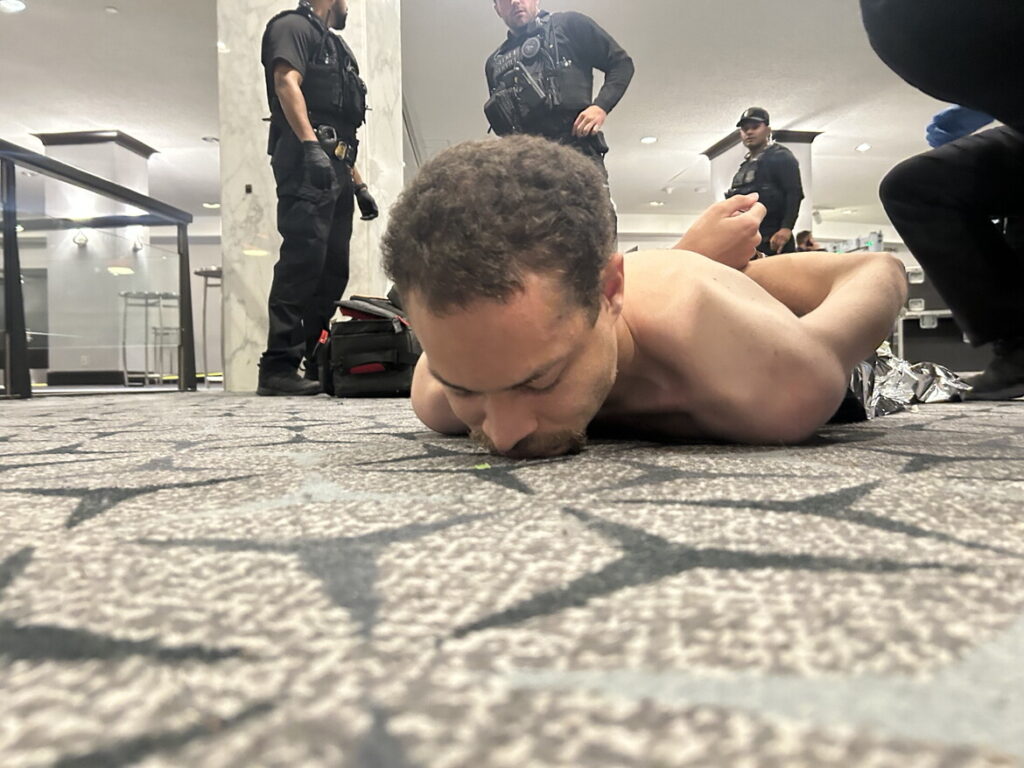
Saturday night at the Washington Hilton, a 31-year-old man from Torrance, California named Cole Tomas Allen rushed a Secret Service checkpoint outside the ballroom where President Donald Trump was about to speak. He carried a shotgun, a handgun, and multiple knives. He fired at least one round. An agent was struck and saved by his vest. Ten minutes earlier, Allen had emailed his family a 1,052-word document and signed it “Cole ‘coldForce’ ‘Friendly Federal Assassin’ Allen.”
It was the third attempt on the President’s life in twenty-one months.
The instinct will be to treat this as a security question. The perimeter held; the perimeter did not hold. The magnetometer was placed correctly; the agent moved fast enough. Those questions are not unimportant. They are also, at this point, beside the point. After Butler, after West Palm Beach, after the Hilton, the security frame has been tried and found wanting. Something is running underneath these attempts that no Secret Service field manual will reach.
It is a regime question.
There is a speech worth recalling this week. On January 27, 1838, a 28-year-old Springfield lawyer named Abraham Lincoln rose before the Young Men’s Lyceum to ask what could plausibly destroy the American republic. Not foreign armies, he answered. The danger was domestic. It was the breakdown of reverence for the laws and the institutions those laws produced. The remedy he prescribed: that reverence for the laws must “become the political religion of the nation.”
That phrase has fallen out of use, which is part of the problem, because we now live inside its inverse. The dominant register of opposition to the elected President of the United States, sustained for nearly a decade by the prestige outlets and the academic monographs and the campaign rhetoric of the opposing party, holds that the man holding the office is not merely wrong but illegitimate, lethal, and beyond the reach of argument. Allen’s manifesto, recovered minutes after he opened fire, named his target with three words: pedophile, rapist, traitor. Each has appeared in the prestige press thousands of times in reference to the same man. Allen did not invent the indictment. He accepted it as binding.
Then he signed his note “Friendly Federal Assassin,” and that signature deserves close reading. He understood himself to be acting in the manner of a federal agent, on the federal government’s behalf, against an existential threat to the republic. He believed the act was civic. He believed it was what reverence for the laws required of him. The inversion is total: the assassin understands himself as the instrument of legitimacy, and the elected President as the criminal whose removal his act will accomplish.
This is what rhetorical escalation produces when it produces anything at all. A century ago, the French sociologist Jacques Ellul observed that propaganda does its real work not by changing the views of its consumers but by removing their capacity to imagine that the targets of the propaganda are entitled to the protections civilized people normally extend to one another. Tell people the building is on fire long enough and someone will break a window. Tell them the President is a traitor long enough, and a “Friendly Federal Assassin” will sign his name and walk to the Hilton.
Lincoln, in 1838, saw the same pattern in the lynchings and mob killings of his own moment. He understood that the question was not how to better police the mob. The question was how a republic restores the political religion that makes the mob unthinkable in the first place. He addressed that question to a young men’s lyceum because he believed the literate and the well-positioned would have to do the work. The custodians of the discourse, he understood, would either rebuild the republic’s reverence for itself or, in his own phrase, watch it die by suicide.
The class that has spent nearly a decade constructing the vocabulary Cole Allen used to sign his manifesto will not, on its own, stop constructing it. It has invested too much in the proposition that the costs fall only on others. At the Hilton, the bill for that proposition came due once again, in the names: the Secret Service agent whose body armor took the round, and the President of the United States, alive because Allen, like Crooks at Butler and Routh in West Palm Beach, was a poor shot under duress.
Lincoln gave the architects of the discourse fair warning, 188 years ago, that the republic does not survive its own incitement. He was speaking, as it happens, to a Lyceum.