Mainstreet Goes Broke
A new Napolitan poll finds 44% of voters say all their income goes to living expenses. Mainstreet and Elite Adjacent voters now live in two different economies.
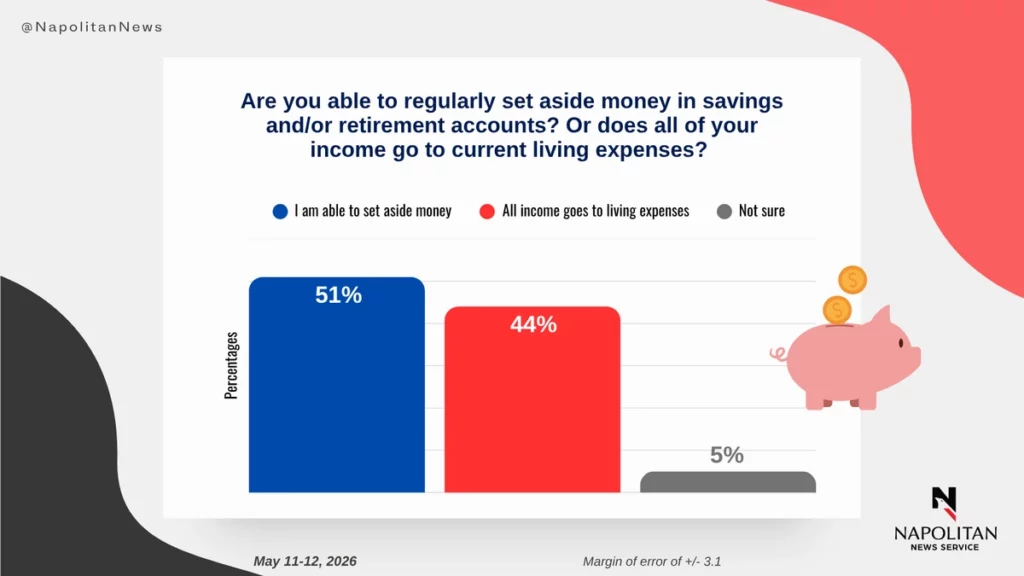
Forty-four percent of registered voters say all of their income goes to current living expenses. That is the latest finding from a Napolitan News Service survey of 1,000 voters conducted by Scott Rasmussen on May 11 and 12. The same figure was recorded two weeks ago, and one point off a month ago. The headline has not moved in five tracking releases. The story sits underneath it.
Among Mainstreet voters, the figure climbs to 55%. Among the Elite Adjacent, it falls to 22%. Seventy-nine percent of postgraduates report that they can regularly set aside money for savings or retirement; only 40% of Mainstreet voters can. Asked whether they could absorb a surprise $1,000 expense without cutting back on their lifestyle, 74% of the Elite Adjacent said yes, against 39% of Mainstreet voters. Asked whether they had paid off their credit cards in full last month, the corresponding figures were 71% and 43%. The spreads describe two economies coexisting beneath one national statistic.
The aggregate readings tell a sobering tale.
Twenty-eight percent now rate the economy as excellent or good, up two points from a month ago. Thirty-five percent say the country is currently in a recession, down three. Fifty-four percent say the economy is getting worse, against twenty-four percent who say it is improving. The topline has softened slightly at the edges. The composition beneath has held.
And it is the composition that matters. The American economy has, for years now, performed two jobs at once: producing strong topline indicators of growth and asset appreciation for those with capital, and producing concurrent erosion of disposable income for those without. The aggregate looks ambiguous. The household experience depends almost entirely on where one lives and how one earns.
The midterm electorate will not be persuaded by the topline, and spells trouble for the GOP. After all, it is bill at the kitchen table. The Republican coalition was assembled, and the Republican administration elected, on a promise to deliver relief to precisely the voters now reporting the deepest strain. Fifty-five percent of Mainstreet voters say every dollar they make is already spoken for. Thirty-nine percent say a $1,000 surprise would force them to cut back. Forty-three percent could only make partial payments on their credit cards last month.
Tariff policy, energy permitting, regulatory restraint, and the slow recovery of household purchasing power are the variables that will determine whether the headline moves before November 2026. Until they do, the 44% holds, and the country it describes splits cleanly along the line of who can still afford to look up from the bill.
Unless something changes, the GOP will soon be held to account.