The Swing-State Illusion
Two-thirds of voters say the same states have decided our elections for half a century. The record says otherwise.
Two-thirds of American voters believe the country’s swing states have remained essentially the same for half a century. The record says otherwise, and the gap between perception and reality has become the quiet premise of every campaign to abolish the Electoral College.
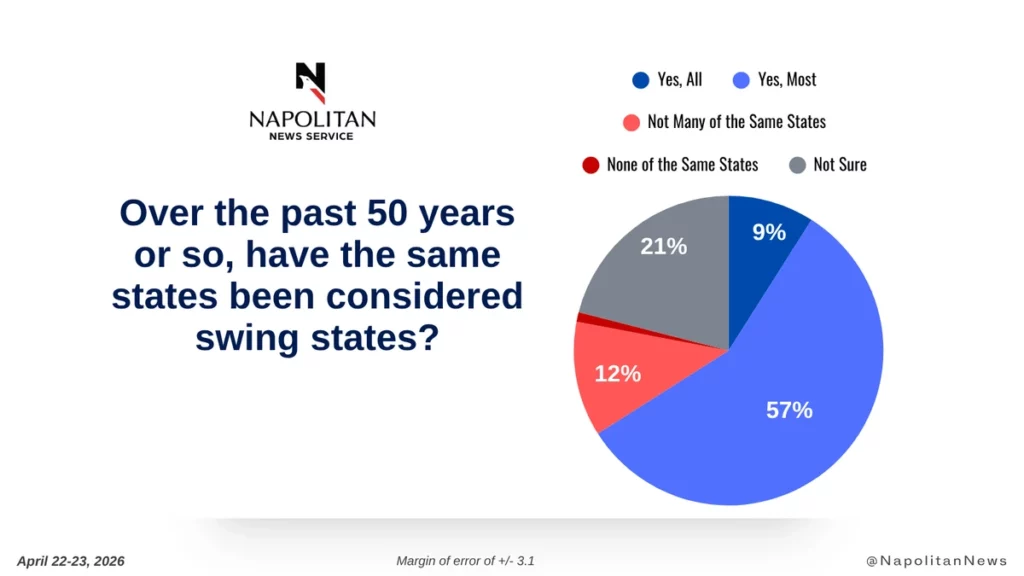
A new Napolitan News Service survey of 1,000 registered voters, conducted April 22–23, 2026, by Scott Rasmussen and RMG Research, finds that 66% of respondents say the same states have mostly served as swing states over the past 50 years. Fifty-seven percent answer “mostly the same”; another 9% insist all the same states. The consensus crosses party lines: 70% of Republicans and 64% of Democrats agree.
The historical ledger tells a different story. In 1976, Jimmy Carter secured the presidency by winning Oregon, Ohio, Maine, and Iowa by margins of less than a single percentage point. California, Illinois, and Virginia, each decided by less than two points, went Republican. Not one of those seven states appeared on either campaign’s battleground list in 2024.
This misperception matters because it fuels a constitutional campaign. Fifty-nine percent of voters told Rasmussen they favor replacing the Electoral College with a direct popular vote. That number survives only as long as voters are not asked to consider consequences. When the same respondents are informed that a popular-vote system could produce a president elected with 25% or 30% of the vote, support for the change collapses by 17 points, to 42%, with 44% opposed. The case against the Electoral College depends on keeping voters uninformed about what would replace it.
The survey also finds the Electoral College itself losing ground in public regard. Favorability has fallen from 57% in October 2024 to 48% today; unfavorability has risen from 35% to 41%. Among the 71% of voters who say they know what the Electoral College is, only half can describe its mechanics or core function in their own words.
The picture that emerges is familiar to anyone who has watched an institution come under sustained pressure. Civic knowledge erodes. A caricature substitutes for the real thing. The caricature proves vulnerable to the first polished attack. In this case, the attack line is that the Electoral College is a rigged relic that routes every election through the same handful of states. It is not. The 1976 map was not the 1988 map, which was not the 2000 map, which was not the map of 2024. The states that decide presidential elections shift with migration, demographic change, ideological realignment, and the quality of the candidates.
That is not a defect of the system. It is the system doing its work. The Electoral College forces presidential campaigns to assemble coalitions across geography and interest, and it redraws the battlefield as the country itself changes. A nation that has forgotten this is a nation persuadable by anyone offering a simpler story.
Is the cure a constitutional amendment? Or is it simply acquiring working knowledge of the Constitution we have?