The Slow Bleed
Republicans held a party ID lead every month from November 2024 through December 2025. Four months later, the lead is a deficit, and the leaners are gone.
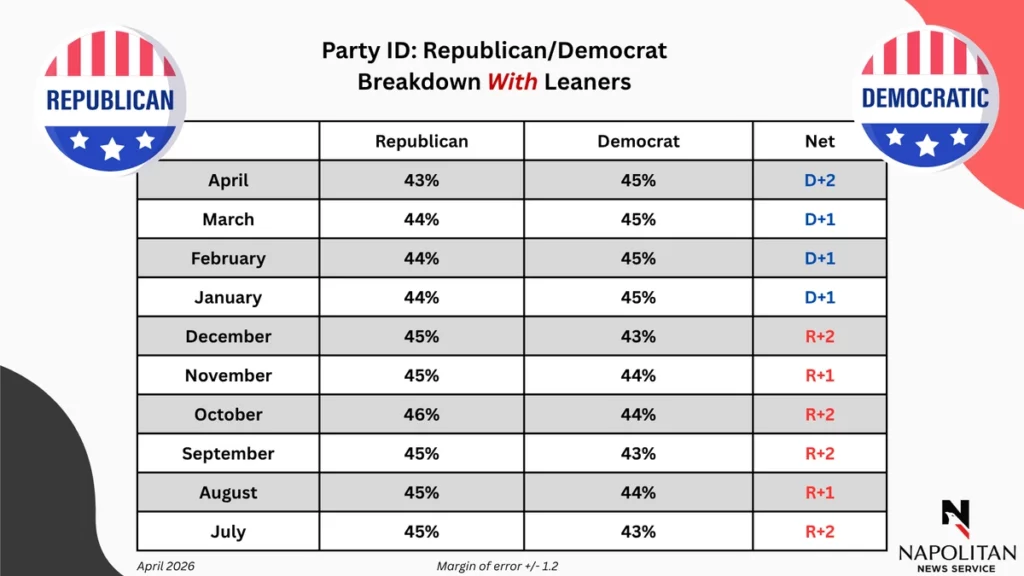
April closed with Democrats up two points on party identification, 45 to 43. Not exactly headline-grabbing stuff. Except for the fact that, from November 2024 through December 2025, Republicans held an edge in every monthly Napolitan News Service survey except one.
The decline has been a slow-motion car crash. Republicans hit 46 percent in January, February, and March of last year. Then the number drifted into the mid-40s and held through year-end. In January 2026 it dropped to 44. In April it dropped again, to 43. Democrats have not moved. They have been parked at 45 percent for the full year.
This tells us something important: the deficit Republicans now face is not built from a Democratic surge. It is built from Republican attrition.
For greater clarity, let’s take out the “leaners” within each party. With weakly attached voters set aside, Democrats and Republicans tie at 36 percent. The shift is happening in the soft middle: the voters who lean rather than commit, who give a pollster an answer when asked but do not show up at a convention or send a check. That is the cohort Republicans have been losing month by month since January.
This is also the cohort that decides elections.
Scott Rasmussen, the pollster behind the numbers, has been making the underlying argument since March. His mid-March reading found 39 percent of voters reporting their personal finances had worsened, an eight-point spike in two weeks. 24 percent said their finances had improved, a five-point drop. He called them the worst numbers he had seen since the president’s restoration. The Iran campaign and its drag on gas prices supplied the accelerant. The economic anxiety supplied the kindling.
To be clear, none of this is a forecast. Party ID is a snapshot, not a ballot test, and six months separate today from the midterm. The Republican apparatus has assets that do not appear in a monthly tracking poll: a sitting president, a fundraising advantage, and an opposition party whose generic appeal masks a leadership vacuum.
But a party that has lost its lead among leaners has lost the voters most exposed to persuasion. Those voters are not gone. They are listening to something other than what the party is saying. The Republican task between now and November is to give them a better account of why prices, war, and approval ratings should not move them where they appear to be moving. So far, the account has not arrived.