What the States Refuse to Show: An Examination of 60 Million Voter Records
Twenty-nine states are fighting in court to keep the Justice Department from looking at their voter rolls. The reason is now public knowledge.
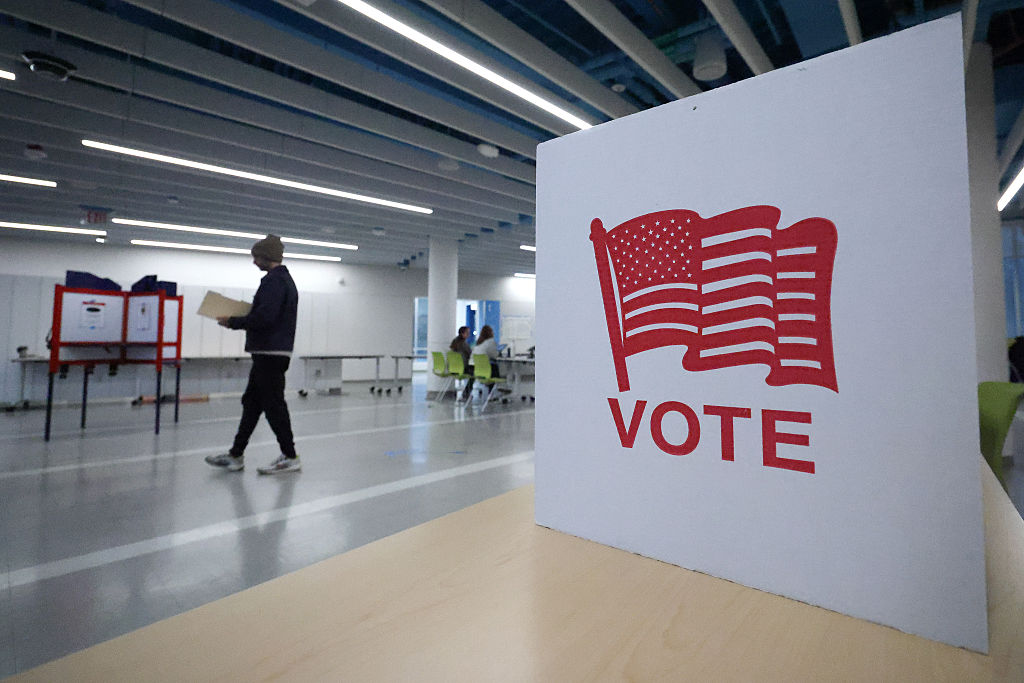
Here are some startling statistics to begin your day.
On Sunday Morning Futures, Assistant Attorney General Harmeet Dhillon released the findings of an examination of sixty million voter records. To date, three hundred and fifty thousand dead people remain eligible to cast a ballot; twenty-five thousand registrations have been referred to the Department of Homeland Security because the registrant could not be confirmed as a United States citizen.
And these are the figures drawn from the voter files of states that have cooperated with the Justice Department’s audit. The real numbers are much higher.
More than half — twenty-nine states and the District of Columbia — in the union have refused to provide this key data. The Department of Justice has now sued every one of them under Title III of the Civil Rights Act of 1960, which permits the United States attorney general to demand inspection of all records and papers relating to voter registration. Interestingly enough, the statute was passed at the height of the civil-rights era to ensure that the federal government could not be locked out of state election machinery by officials hostile to fair elections. It is now being invoked, with no little irony, to obtain the same access from a different set of state officials, hostile for different reasons.
Wisconsin has asked a federal judge to dismiss the suit outright. Oregon’s secretary of state, Tobias Read, refused to hand over the unredacted file. So did Maine’s Shenna Bellows. Both states, the Department’s complaints note, had previously provided the same data to a private organization. It is difficult to understand any current grounds of refusal to the Justice Department without cynically concluding this is a political strategy from the left. Indeed, the states fighting hardest to keep their rolls private are the states with the most reason to want them private.
And the left knows it can count on its legal allies. Federal judges in five states have ruled against the administration so far: California, Michigan, Oregon, Georgia, and Rhode Island, where the most recent decision came down last week. The reasoning, generally, is that a 1960 statute drafted before statewide computerized voter files existed cannot have anticipated them. The Department is expediting appeals to the Ninth and Sixth Circuits. Whatever the courts ultimately decide, the political question has already been settled in plain view.
But much more is at stake than political jostling. The Help America Vote Act of 2002 requires states to maintain accurate voter registration lists, and the National Voter Registration Act of 1993 specifies how ineligible registrants are to be removed. Both statutes presuppose that someone, somewhere, will check the work. The federal officer Congress designated to do the checking is the attorney general. If the attorney general cannot inspect the files, the statutes are unenforceable.
The practical effect on the citizen is straightforward. Every dead registrant left on a roll is a credential available to be voted. Every registrant whose citizenship cannot be verified represents either a clerical failure or a federal crime. Every illegitimate ballot cast in a federal election dilutes the lawful vote of an American citizen by precisely the same amount. Three hundred and fifty thousand dead names is not a rounding error. Joe Biden carried Arizona, Georgia, and Wisconsin in 2020 by a combined margin of fewer than 43,000 votes.
President Trump’s March 2025 executive order on election integrity has been partially blocked in federal court, the proof-of-citizenship provision permanently enjoined last fall by a judge who concluded that only Congress and the states may set the terms of federal voter registration. That ruling will be litigated for years. The voter-roll audit is a separate matter. It is governed by a separate statute, conducted by a federal officer with a clear statutory mandate.
The states resisting it are not defending federalism, they are in violation of our sacred democratic norms and processes. One would think the GOP would have learned the importance of cleaning up election impropriety. This is a good step, but without ensuring free and fair elections, America’s future remains hung in the balance.