The Justice Draws the Line
Clarence Thomas used his 250th-anniversary speech to name progressivism as the adversary of the Declaration. A verdict, not an argument, and overdue.
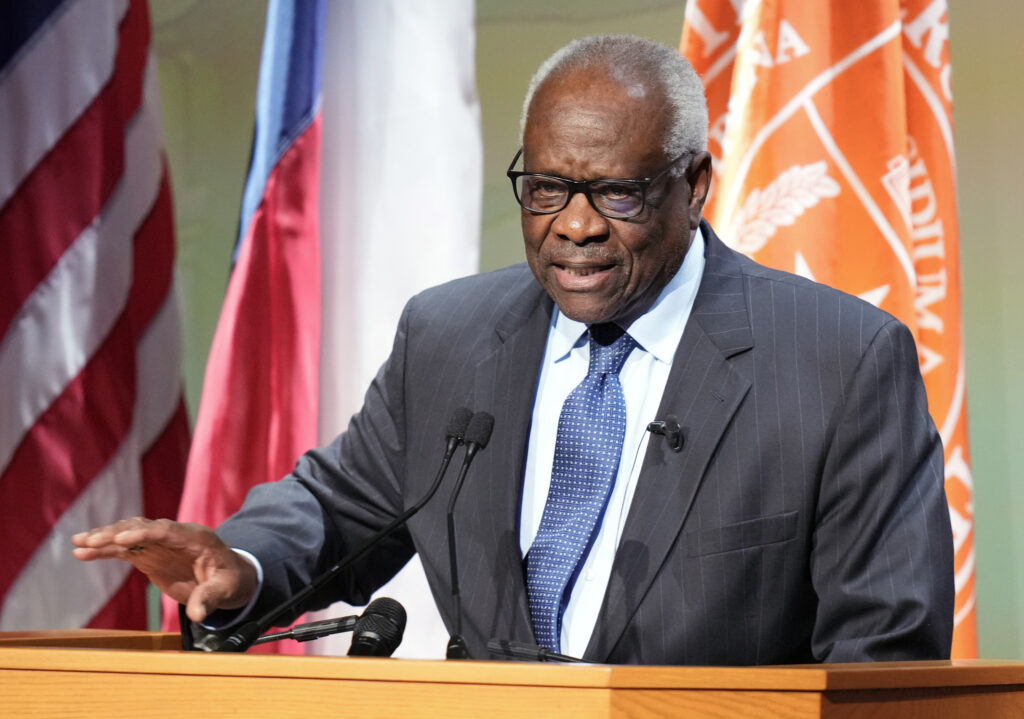
On Wednesday evening at the University of Texas at Austin, the longest-serving Justice on the Supreme Court stood before a law-school audience and delivered a speech that should be read for years. Clarence Thomas, speaking to mark the 250th anniversary of the Declaration of Independence, did what few sitting Justices have done in living memory. He named the adversary.
“Progressivism seeks to replace the basic premises of the Declaration of Independence, and hence our form of government,” Thomas said. “It holds that our rights and our dignities come not from God, but from government. It requires of the people a subservience and weakness incompatible with a Constitution premised on the transcendent origin of our rights.”
That is a verdict, not an argument. The Justice was not making a case. He was announcing one.
Thomas traced the ideology to Woodrow Wilson’s presidency, and this is where the speech moved from philosophy to indictment. Wilson admired the centralized administrative states of Europe and set out to transplant them here. His instruments were not only the civil service and the regulatory commission, but also the courts. The progressive political class supplied the intellectual defense for Plessy v. Ferguson (1896), resegregated the federal workforce under Wilson’s direct order in 1913, and, within a generation, gave the country Buck v. Bell (1927), in which Justice Oliver Wendell Holmes, Jr. declared that “three generations of imbeciles are enough” and upheld compulsory sterilization as a legitimate exercise of state expertise. The victims were American citizens judged unfit by the experts of the day. The legal reasoning was progressive to its core.
Thomas called this tradition “retrogressive,” and the word lands. A regime founded on natural rights, in which the individual precedes the state and the state exists to secure liberty, was exchanged in steady stages for a regime in which experts administer citizens for their own good. The substitution proceeded through commissions, executive orders, and Supreme Court opinions that treated the founding not as a settled inheritance but as an embarrassment to be corrected.
Here Thomas reached for two witnesses. The first was Alexis de Tocqueville, who concluded in Democracy in America that the American experiment owed its vitality to its rejection of centralized rule. The second was Calvin Coolidge, whose 150th-anniversary address on the Declaration rings truer at 250 than it did at 150. “If all men are created equal, that is final,” Coolidge said. “If they are endowed with inalienable rights, that is final. … If anyone wishes to deny their truth or their soundness, the only direction in which he can proceed historically is not forward, but backward.”
This is the argument the moment demands. Progress away from the Declaration is not progress. It is a return to the older, darker arrangement in which a small ruling class decides which lives are worthy, which speech is permissible, and which rights may be rescinded when the hour seems to require it. The administrative state, the campus speech code, the agency rule written by no one the citizen ever voted for: these are not novel forms. They are ancient ones, refitted for the 21st century and sold under a new label.
Thomas closed with a demand rather than a consolation. Americans, he said, must find in themselves the courage of the signers of the Declaration. “If we don’t stand up and take ownership of our country and take responsibility for it, we are slowly letting others control how we think and what we think.”
The next 250 years will not be secured by administrative refinement or clever institutional repair. They will be secured, if at all, by citizens who remember where their rights come from, and who are prepared to say so aloud. Thomas said so aloud. The question is who among us will follow.