Iran Blockade Sees Less Opposition Than War
Scott Rasmussen's latest finds the public frozen against the Iran campaign but nearly evenly split on stopping the bomb.
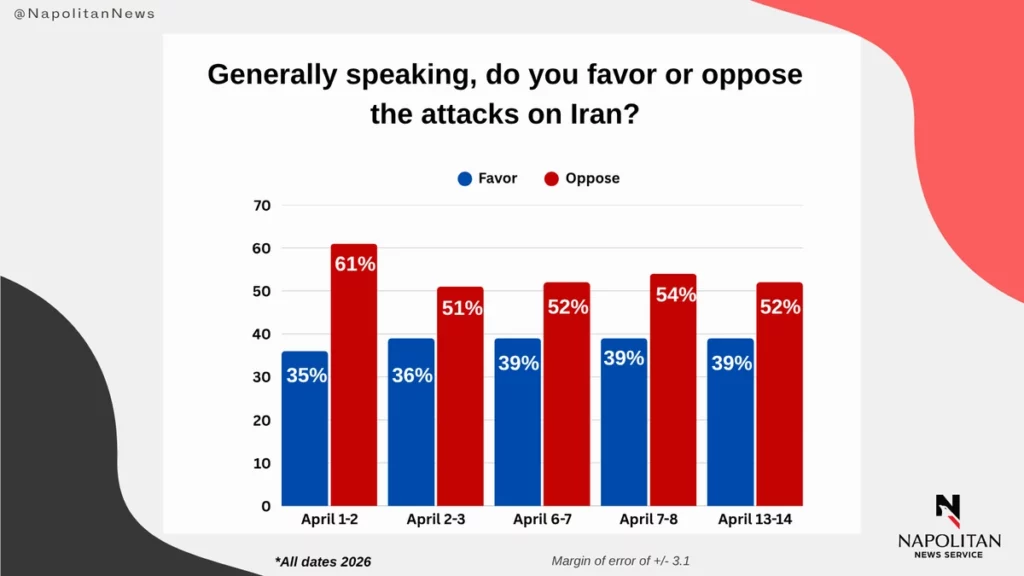
The latest Napolitan News Service survey, conducted by Scott Rasmussen April 13–14 among 1,000 registered voters, finds American opinion on the Iran campaign essentially frozen: 39% approve of President Trump’s handling of the situation, 56% disapprove, and 52% oppose the attacks outright. Those numbers have barely moved across fifteen successive surveys since late February. The war, whatever else it accomplishes, has not persuaded the country.
The blockade of the Strait of Hormuz is a different instrument and draws a different response. Voters split 42% in favor to 44% opposed, with 14% undecided. That is not an endorsement, but it is a meaningful departure from the settled opposition to the war itself, and it suggests the public distinguishes, as strategists always have, between the use of force and the use of pressure. One commits American lives; the other commits American leverage. Rasmussen’s fifth question sharpens the stakes: asked whether it is more important to end the war or to prevent Iran from acquiring nuclear weapons, the electorate divides almost evenly, 45% to 44%. That is the real argument beneath the polling, and it is the one the Administration has yet to win.
What the numbers will not tell you, but the pattern implies, is that the public is reasoning its way through this crisis rather than reacting to it. A country that wanted isolation would oppose the blockade with the same firmness it opposes the war; a country that wanted escalation would approve both. Neither is what the data show. The electorate is distinguishing between ends and means, between the cost of action and the cost of inaction, and it is doing so with a patience the political class rarely credits it for possessing. The Administration’s task, if it intends to hold the country behind a sustained campaign of pressure, is to meet that patience with an argument worthy of it. The blockade is a tool. The question Rasmussen has surfaced, and that the White House has not yet answered, is whether it serves a strategy the American people can recognize as their own.