The Discovery of America Through the Eyes of Edward Hicks
The painting offers a glimpse of how Americans once understood the origins of their civilization, and how dramatically that understanding has changed.
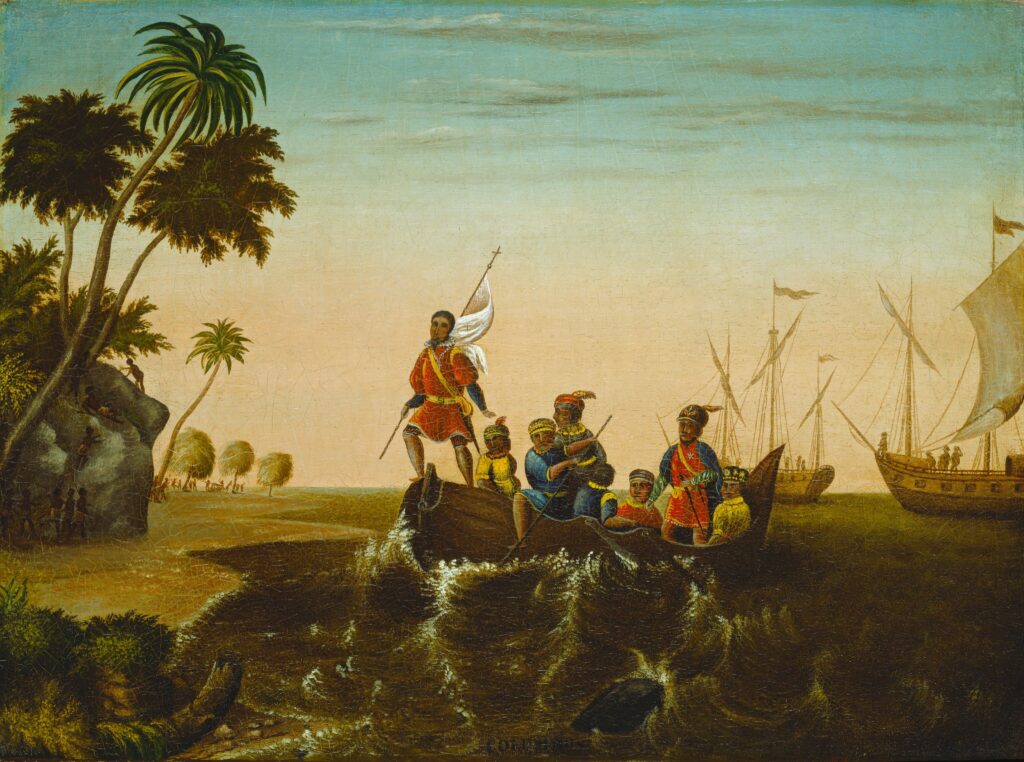
Edward Hicks, The Landing of Columbus, c. 1837. Oil on canvas. National Gallery of Art, Washington, D.C.
American folk painter Edward Hicks (1780–1849) is best remembered for his many versions of The Peaceable Kingdom, inspired by the biblical prophecy of a world in which predators and prey live together in harmony. A Quaker minister as well as an artist, Hicks brought the same religious imagination to his depiction of Christopher Columbus’s arrival in the Americas. In The Landing of Columbus, European sailors approach the shore beneath a luminous sky, their arrival presented with an almost theatrical sense of ceremony. The painting captures the nineteenth-century American tendency to regard Columbus’s voyage as the opening act of a providential national history.
Painted more than three centuries after Columbus’s first Atlantic crossing, Hicks’s work reveals as much about the young United States as it does about the events of 1492. By the 1830s, Columbus had become an emblem of courage, discovery, and the supposed destiny of European civilization in the Western Hemisphere. Hicks’s serene composition reflects this romantic understanding of exploration, transforming an encounter that would inaugurate centuries of conquest, cultural exchange, and upheaval into a moment of apparent promise. The painting offers a glimpse of how Americans once understood the origins of their civilization, and how dramatically that understanding has changed.