Christopher Columbus and the Modern Hatred of Great Men
The obvious solution would be to dispense with history altogether. Unfortunately, this would leave us with the present, which is hardly an improvement.
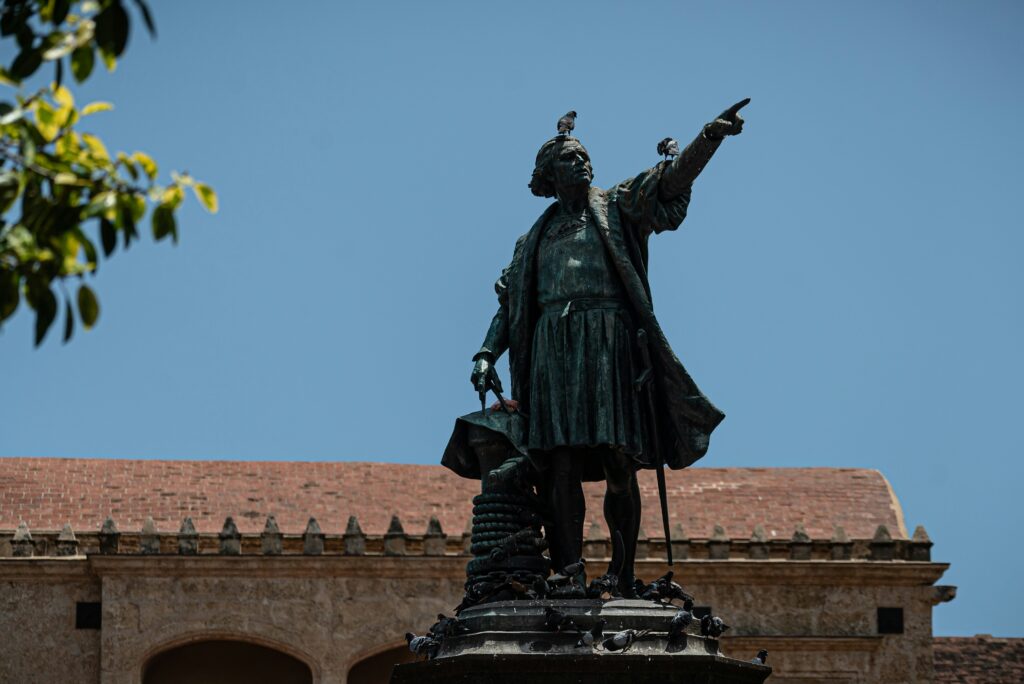
There is something wonderfully strange about the fact that Christopher Columbus, who died in 1506 believing he had reached the outskirts of Asia, is still being dragged through the American political system five centuries later. He has been accused, convicted, commemorated, canceled, restored, and canceled again. His statues have been pulled into harbors by people who could not navigate their way across one without Google Maps. Every October, the American public assembles to decide whether the Genoese navigator was a hero, a criminal, or some embarrassing combination of the two. It is a peculiar achievement for a man who never knew America existed.
This year, President Donald Trump has once again made Columbus a political cause, with a reconstructed statue arriving at the White House. His opponents have responded with the familiar catalog of atrocities: slavery, conquest, cruelty, colonialism. The accusations are serious, and many are true. But the entire exercise seems to rest on a bizarre assumption: that the purpose of history is to discover which dead people would be acceptable company at a contemporary dinner party.
By this standard, practically nobody who lived before 1995 can be considered a decent human being. Aristotle defended slavery. Plato imagined an authoritarian society ruled by philosophers, which is perhaps the least appealing form of government ever proposed. Martin Luther was an antisemite. Thomas Jefferson owned slaves. Even the enlightened men of the eighteenth century had the peculiar habit of excluding nearly everyone from their universal declarations of equality. One begins to suspect that human history was conducted almost entirely by people with unacceptable opinions.
The obvious solution would be to dispense with history altogether. Unfortunately, this would leave us with the present, which is hardly an improvement.
The real question about Columbus is considerably more interesting than whether we would approve of him today. It is whether a man can do something genuinely magnificent while also doing terrible things. Our ancestors generally understood that the answer was yes. It is only recently that we have developed the curious conviction that greatness must be a reward for moral cleanliness.
Columbus was not an especially agreeable man. He was ambitious, vain, stubborn, and frequently disastrous as an administrator. He participated in the enslavement of Indigenous people, and his rule in Hispaniola became sufficiently scandalous that the Spanish Crown had him arrested and returned home in chains. His career contained rather more cruelty and incompetence than the average Columbus Day parade is prepared to acknowledge.
It also contained one of the most consequential voyages in human history.
The popular modern correction is that Columbus did not discover America because millions of people were already living there. This is perfectly true, although it raises the question of what exactly we mean by discovery. The Americas had been inhabited for thousands of years, and Norse sailors had reached Newfoundland centuries earlier. Columbus was neither the first man to see America nor the first European to arrive there. What distinguished his voyage was that it permanently altered the relationship between the hemispheres.
Before 1492, the peoples of Europe and the Americas lived largely outside one another’s historical consciousness. Afterward, their histories became inseparable. Plants, animals, languages, religions, diseases, technologies, and people crossed the Atlantic in both directions. The resulting transformation was so enormous that historians still struggle to describe it without resorting to geological metaphors.
All this happened because a stubborn Genoese sailor convinced the Spanish monarchy to finance an expedition based partly on a spectacular miscalculation of the Earth’s circumference.
There is something deeply satisfying about this. One of the most important events in world history was the result of a man being wrong about geography with extraordinary confidence. The experts who doubted his calculations were largely correct. Asia was much farther away than he believed. Had the Americas not stood in his path, his expedition might well have ended in catastrophe. Yet Columbus’s error placed him in the peculiar category of men whose mistakes changed the world.
It is difficult to imagine a modern institution funding such a project. Columbus would have been required to produce an environmental impact assessment, establish measurable outcomes, consult affected stakeholders, and demonstrate a realistic return on investment. A committee would have reviewed his proposal, discovered the mathematical errors, and recommended a more sustainable route to India. The Atlantic would have remained undisturbed, and everyone involved would have congratulated themselves on their responsible decision-making.
Of course, Columbus also represents something rather more unsettling than the triumph of human daring. His voyage helped inaugurate centuries of European conquest, forced labor, dispossession, and demographic catastrophe. These were not incidental footnotes to the new Atlantic world. They were central to its development.
But here is where our modern moral imagination runs into trouble. We find it easy enough to imagine history as a procession of victims and villains. We find it much harder to understand how genuine human achievements can emerge from circumstances of terrible injustice, or how the same civilization can produce both extraordinary beauty and extraordinary suffering.
We would prefer history to behave like a courtroom. Evidence is presented, the accused is judged, and a verdict is delivered. The righteous are rewarded with statues, and the wicked are consigned to the municipal storage facility. Yet history is not a courtroom, and removing the defendant does nothing to undo the world he helped create.
More importantly, the demand for historical innocence is itself a rather modern luxury. We inhabit a civilization made possible by countless actions we would now condemn. Our cities were built through conquest, our wealth through exploitation, our institutions through centuries of conflict, and our technology through processes that are hardly free of suffering. We have inherited a world we did not make, and our indignation at its origins does not exempt us from benefiting from it.
The contemporary American who denounces Columbus from a smartphone assembled through a global supply chain is not necessarily wrong about Columbus. But he occupies a somewhat awkward position from which to deliver a lecture on the moral purity of historical progress.
None of this requires us to pretend that Columbus was a saint. Indeed, the insistence that our heroes must be saints is part of the problem. The old civilizations had a more complicated understanding of human greatness. Achilles was a murderer and a magnificent warrior. Odysseus was deceitful, ruthless, and resourceful. The Greeks did not admire these men because they provided suitable models for corporate ethics training. They admired them because they embodied, in monstrous and extraordinary proportions, the possibilities of human action.
The modern world has become increasingly uncomfortable with this distinction. We have replaced admiration with approval, greatness with goodness, and historical understanding with a sort of retrospective personnel review. To call someone great is now taken to mean that we endorse his conduct, share his convictions, and would trust him to supervise our children.
Columbus would undoubtedly fail such a test. So would most of the people who made the modern world possible.
There is another irony in the campaign against him. The moral principles by which we condemn European conquest are themselves deeply indebted to the history of European civilization, including traditions that developed in response to the conquest of the Americas. Sixteenth-century Spanish theologians such as Francisco de Vitoria and Bartolomé de las Casas wrestled with the rights of Indigenous peoples and the legitimacy of imperial domination. Their arguments helped shape traditions of international law and universal human dignity.
Western civilization did not simply commit great wrongs and then wait patiently for modern Americans to discover morality. It also produced some of the intellectual resources by which those wrongs could be recognized and challenged. Its history contains both the conquest and the protest against conquest, the slaveholder and the abolitionist, the imperial adventurer and the theologian asking whether his empire had any right to exist.
This makes the usual Columbus Day argument look rather childish. On one side, we are offered the spotless hero who brought civilization to a grateful hemisphere. On the other, the irredeemable monster whose name should be scraped from every public building. Both accounts flatten the past into something conveniently simple, which is perhaps why they are so attractive to people whose primary experience of history consists of arguing about it online.
A more mature civilization might acknowledge that Columbus was courageous, visionary, cruel, ambitious, and often profoundly mistaken. It might recognize that 1492 brought suffering on an almost unimaginable scale while also transforming the possibilities of human civilization. It could commemorate an extraordinary event without pretending that everyone involved behaved honorably, and mourn its victims without denying its significance.
But such an approach would require us to abandon the comforting idea that history exists to affirm our moral superiority.
The most revealing thing about our annual prosecution of Christopher Columbus is the confidence with which we assume that posterity will approve of us. We have convinced ourselves that we have finally arrived at the correct moral arrangements, that our prejudices are principles, and that future generations will look back on our age with admiration rather than horror.
Perhaps they will. But it seems unlikely. The people of the twenty-sixth century may find our treatment of animals monstrous, our environmental destruction barbaric, and our cheerful surrender of human judgment to machines incomprehensible. They may regard practices we consider harmless as unspeakable atrocities. They may even find themselves debating whether some monument to our age ought to be thrown into the nearest river.
And if they do, they might remember that Christopher Columbus sailed across an unknown ocean in three small ships, taking risks that most modern people would find intolerable, and that the world was never the same afterward.
Whether he deserves our affection is a much smaller question than whether we are still capable of recognizing what he accomplished. We do not have to love Columbus. But a civilization that can no longer distinguish greatness from innocence may eventually lose the capacity for greatness itself.