The Men Who Came to Explain the Future
This should interest Americans more than the normal Washington summit does, because AI is scrambling several categories we normally keep separate.
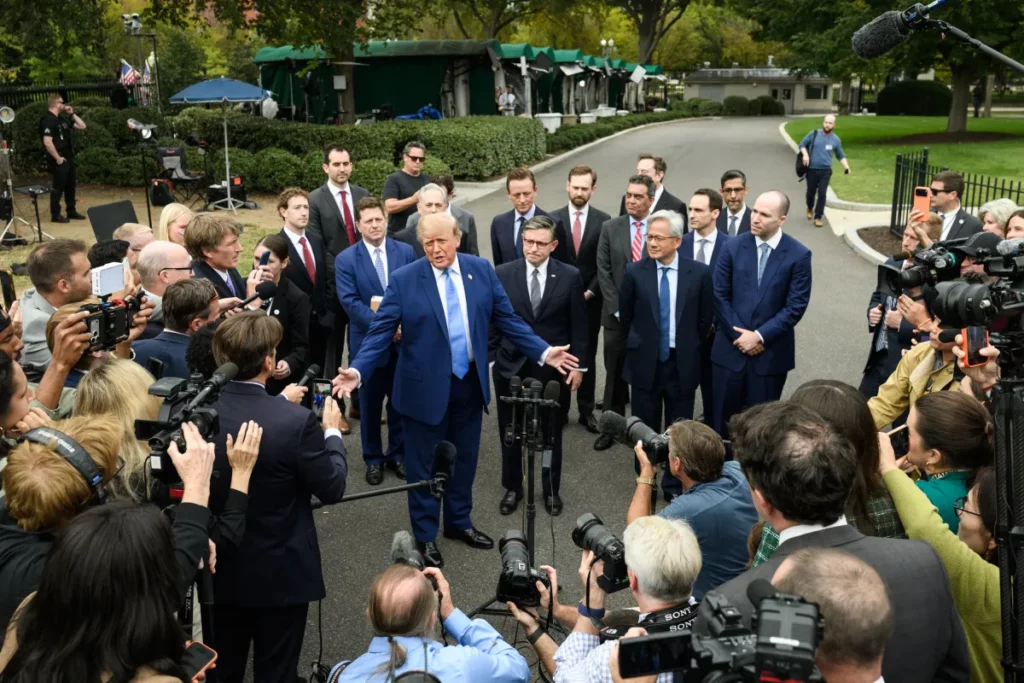
There is something almost medieval about the photographs from the White House: the sovereign at the center of the table, the great merchant princes arranged around him, each representing some province of an empire that does not quite exist yet. Elon Musk. Mark Zuckerberg. Jensen Huang. Sundar Pichai. Dario Amodei. Greg Brockman. Satya Nadella. Jeff Bezos. Thirty-one executives and government officials were expected at the September 29 gathering, convened by President Donald Trump and House Speaker Mike Johnson to discuss artificial intelligence and what, if anything, should be done about it.
The meeting ended with something called the White House Accord on Super Intelligence, a voluntary agreement among several of the largest AI companies to establish internal safeguards, submit systems to outside auditing, and create board-level mechanisms for reviewing the results. Trump called the agreement “morally binding” and compared it to a constitution. It is not a law. There are no statutory penalties for breaking it. The basic arrangement is that the companies building the most powerful machines in human history have promised the government that they will keep an eye on themselves.
This should interest Americans considerably more than the normal Washington summit does, because AI is beginning to scramble several categories we normally keep separate. A car company makes cars. A bank lends money. A newspaper publishes news. An advanced AI company is attempting to build a machine that may eventually perform substantial portions of all these activities at once. The firms represented at the White House are simultaneously becoming infrastructure companies, defense contractors, energy consumers, employers, media intermediaries, educators and perhaps, eventually, substitutes for large quantities of human labor.
That makes the familiar language of “regulating an industry” slightly inadequate. The question is closer to one Americans have encountered during the construction of railroads, electrical grids, telecommunications networks and nuclear weapons: what happens when a technology becomes important enough that the state cannot simply stand outside it?
The Trump administration’s answer has so far leaned heavily toward partnership. The president has promoted enormous investments in chips, power generation and data centers, while arguing that excessive regulation could allow China to overtake the United States. At the same White House meeting, he praised continued data-center construction despite growing local objections over electricity demand and other community effects.
There is a perfectly intelligible case for this. If artificial intelligence becomes a foundational technology of the twenty-first century, a country that deliberately slows its own development while a geopolitical competitor accelerates would be taking a serious gamble. AI already has military, scientific and economic applications, and neither Beijing nor Silicon Valley intends to stop simply because American politics has not figured out what to do with them. But there is another gamble hidden inside the first.
It is the assumption that the interests of the companies developing artificial intelligence and the interests of the American public will continue to overlap closely enough that the companies can be trusted to police the boundary themselves.
Even the people sitting around the White House table do not seem entirely convinced of this. Anthropic CEO Dario Amodei has repeatedly warned about catastrophic misuse, cyberattacks and massive labor-market disruption. Behind the scenes after the meeting, other technology executives reportedly challenged him over the intensity of those warnings. OpenAI and others have also called at various points for government oversight, even while the industry as a whole has resisted regulations it considers burdensome.
This produces one of the stranger political spectacles of our era. The men building the machine arrive in Washington to tell Washington that the machine may be dangerous. Washington asks what should be done. The men building the machine propose standards for the men building the machine. Nobody here has to be lying for the arrangement to be unstable.
The incentives are simply enormous. These firms are competing for hundreds of billions of dollars in investment, strategic advantage, engineering talent and perhaps control of an entirely new technological platform. A company that believes slowing development would be wise in the abstract may still fear that slowing while its competitors continue would be suicidal. Each laboratory is therefore trapped inside the logic of the race it is helping create.
Americans should resist the temptation to reduce this situation to the personalities involved. Zuckerberg is not the question. Musk is not the question. Trump is not even really the question.
The question is whether a democratic society is capable of governing a technology whose development is concentrated inside a tiny number of corporations possessing resources, technical knowledge and computing infrastructure that the government itself often lacks. That problem survives every election.
There are also more immediate questions, which are in some ways less cinematic and therefore easier to ignore. Who pays for the power infrastructure required by enormous data centers? What happens to towns that suddenly find themselves hosting them? What happens to workers if AI systems begin doing significant portions of white-collar work? Who is liable when autonomous systems cause damage? How much access should the government have to privately developed models? How much access should those companies have to government data?
And perhaps the oldest American question of all: when private economic power becomes public power in practice, who gets to say no?
The White House accord may turn out to be useful. Independent auditing is better than none; internal controls are better than none; forcing corporate boards to confront safety questions may expose risks that would otherwise remain buried inside engineering departments. Even some critics have treated the agreement as a meaningful first step.
But the phrase “first step” contains its own warning. A voluntary compact devised by the people developing the technology cannot settle questions that belong to the country as a whole.
The great temptation of the AI age is to believe that because the technology is difficult to understand, ordinary citizens have nothing useful to say about it. Leave the machines to the engineers; leave the engineers to the billionaires; leave the billionaires to the president. That would be an extraordinary surrender.
Americans do not need to understand transformer architecture or semiconductor fabrication to understand the political problem taking shape in front of them. They need to ask who possesses power, what incentives govern its use, what happens when something goes wrong, and whether the people making the decisions will bear the consequences.
Those are ancient questions, only the machines are new.