The Quiet Discipline of an American Champion
The painting is striking for its quiet treatment of success. Schmitt has already won, yet the moment Eakins gives us is calm and workmanlike.
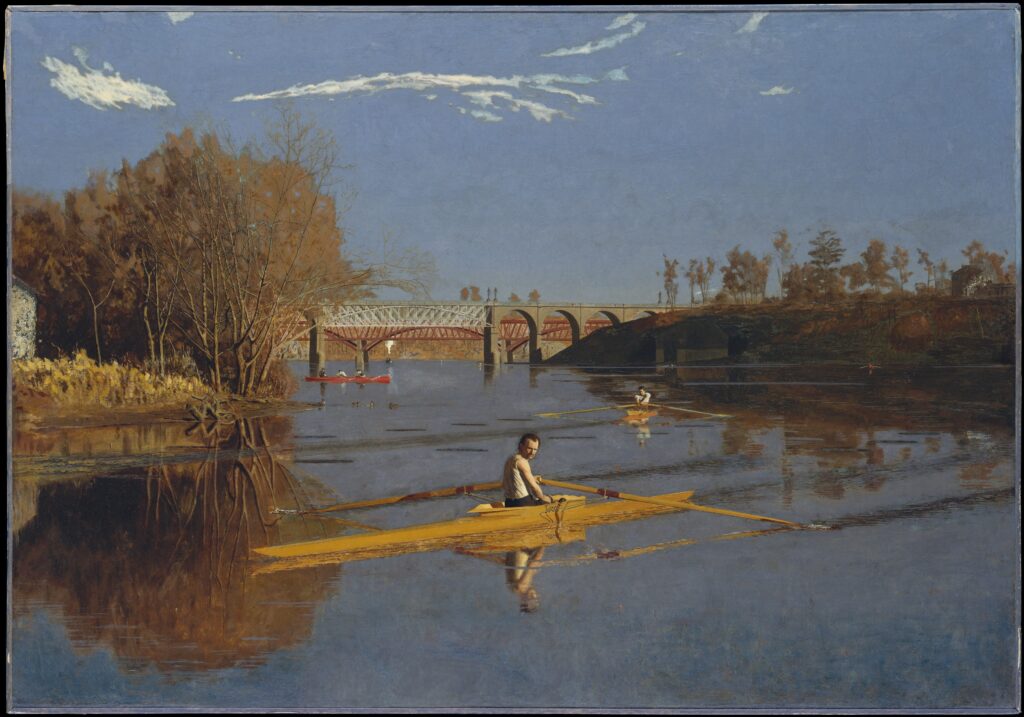
Thomas Eakins, The Champion Single Sculls, 1871.
Painted shortly after Thomas Eakins returned to Philadelphia from years of artistic study in Europe, The Champion Single Sculls marked his turn toward a distinctly American subject: the disciplined life of the modern city.he rower in the foreground is Max Schmitt, a close friend of Eakins and one of Philadelphia’s leading amateur oarsmen. The painting commemorates Schmitt’s victory in a major single-scull race on the Schuylkill River in 1870. Eakins chose a restrained moment. There is no crowd or trophy. Schmitt appears alone on the water, his body a small, controlled presence within the broad river landscape.
Eakins knew rowing intimately and painted the sport with unusual technical precision. He also placed himself in the scene: the more distant rower is Eakins, identifiable by the name painted on his boat. The detail gives the work a personal dimension and turns it into a record of friendship, shared discipline, and a particular Philadelphia world of amateur athletics that flourished in the decades after the Civil War.
The painting is striking for its quiet treatment of success. Schmitt has already won, yet the moment Eakins gives us is calm and workmanlike. The river lies still, the industrial city sits hazily in the distance, and the athlete bends again to the repetitive labor of the oar.
The Champion Single Sculls captures something central to Eakins’s vision of American life: achievement grounded in discipline. The champion remains part of the ordinary world around him. He is simply a man who has mastered a difficult thing, alone on the water, still doing the work.