The Veteran in a New Field
The Veteran in a New Field is both a national image and an intimate one: America in 1865, victorious, productive, reunited.
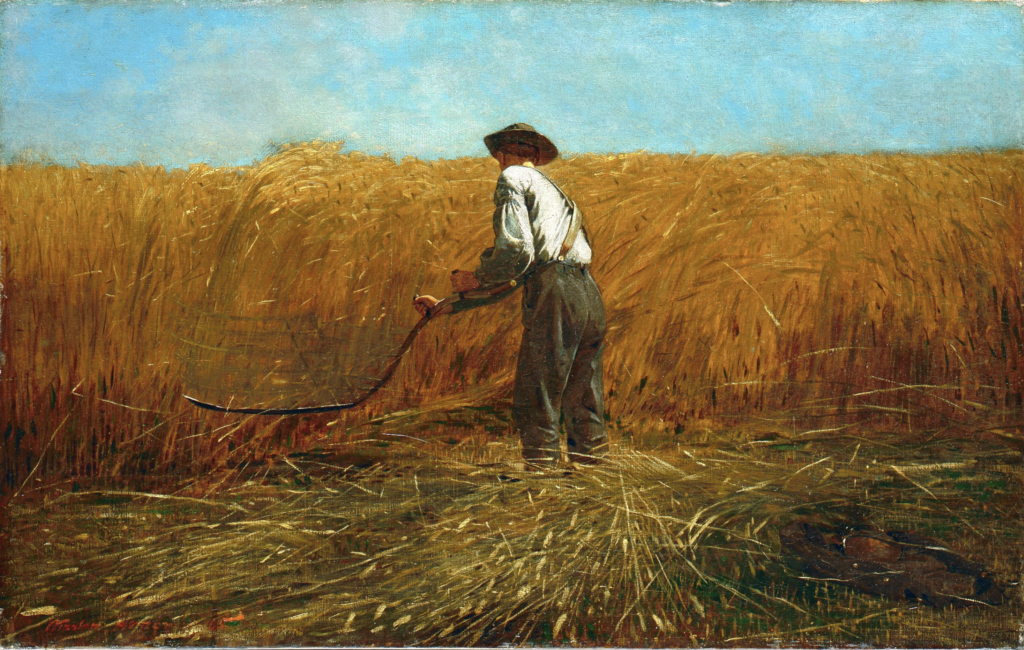
Winslow Homer painted The Veteran in a New Field in the summer of 1865, when the Civil War had only just ended. Lee had surrendered at Appomattox in April; Lincoln was assassinated five days later. Homer knew the war at unusually close range. Before becoming one of America’s great painters, he had worked as an illustrator for Harper’s Weekly and traveled with the Union Army, drawing soldiers in camp and near the front. By 1865 he had spent years making pictures of war. Then he painted this: one man, back home, cutting wheat.
The clues to the man’s past are almost hidden. In the lower corner lie a discarded Union jacket and canteen. The insignia connects them to the same Union division Homer had followed during the war. We never see the veteran’s face. He has stripped off the most visible evidence of being a soldier and returned to ordinary work—literally exchanging the battlefield for a new field. The Met connects the image to Isaiah’s promise that men will beat their swords into plowshares: war giving way to productive life.
But Homer made the image much less reassuring than that sounds. The field is enormously abundant, an obvious image of recovery and renewal, but the veteran harvests it with a single-bladed scythe. In Western art the scythe is also the instrument of the Grim Reaper. Even stranger, technical examination shows that Homer originally painted a more elaborate, modern harvesting implement and then simplified it into the stark blade we see now—making the association with death stronger. The veteran has returned from killing fields to a field of wheat, but he is still a reaper. Peace has arrived; death has not quite left the picture.
That ambiguity is what makes the painting feel so American. It is a picture of regeneration without pretending regeneration erases what came before. The soldier can take off his uniform. The country can go back to work. Wheat can grow over ground that was once soaked in blood. But neither the man nor the country simply returns to 1860. Homer himself had come back from his time with the army profoundly changed; according to a family recollection, his mother said that his closest friends hardly recognized him. The Veteran in a New Field is therefore both a national image and an intimate one: America in 1865, victorious, productive, reunited—and standing waist-deep in the memory of what it had just done to itself.