Robots Would Like a Word!
Domo arigato, Mr. Ningen!
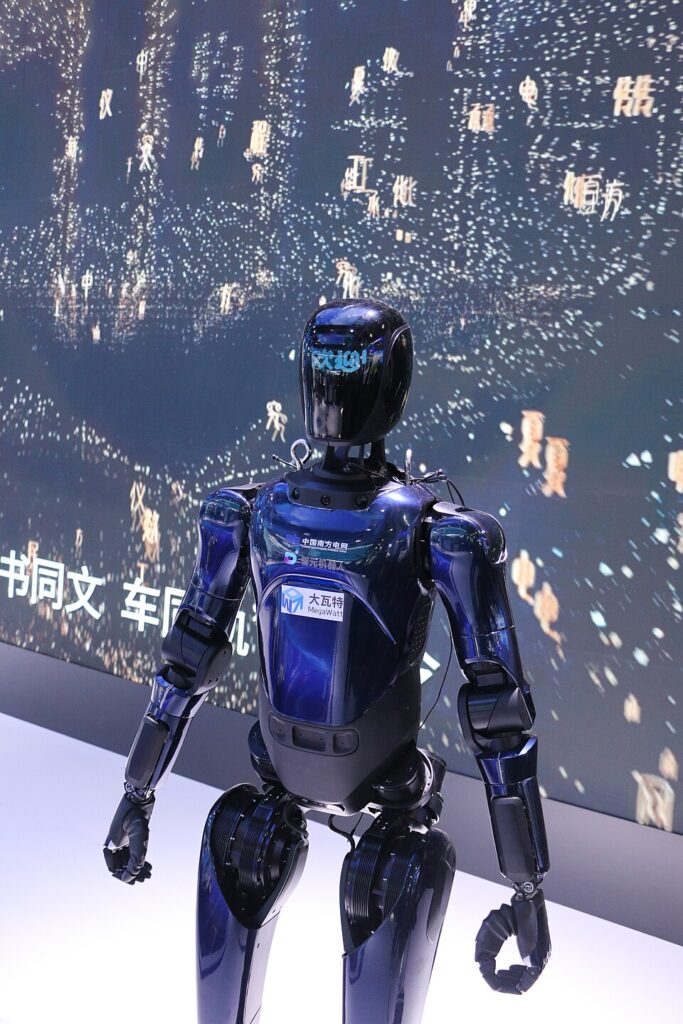
On September 7, 2026, about 30 robots showed up outside Poland’s Ministry of Digital Affairs in Warsaw to demand clearer regulation of Artificial Intelligence (AI) and automation before the technologies change the world as we know it. The group included humanoids and robot dogs waving Polish flags and blasting recorded chants from loudspeakers. Apparently, machines have joined the labor debate before joining the labor force.
Besides the entertainment value, the stunt worked: it was as though the future had arrived on the sidewalk.
For years, the argument over AI and robotics has moved through every level of politics and society. Public debate often arrives at narrow extremes: utopian promises on one side, doomsday scenarios on the other. The robot protest just made it everyone’s business.
The scene begs the question: How realistic is the expectation that robots will replace flesh-and-blood workers?
A revealing place to ask this question is Warsaw, Poland, a city where manufacturing is a kitchen-table issue. According to the World Bank’s data, manufacturing represented about 15 percent of Poland’s GDP in 2025. For comparison, U.S. manufacturing was about 11 percent of GDP in 2025. Statistics Poland reported that manufacturing accounted for 22.5 percent of average paid employment in the domestic economy in 2025. That industrial base makes the AI discussion substantive.
The Polish public opinion on AI products and services is mixed. According to Ipsos’s 2026 AI Monitor, 47 percent of Poles agreed that AI products and services have more benefits than drawbacks, eight points below Ipsos’s 32-country benchmark of 55 percent. Poland sits above the United States, where 38 percent agreed, and below China, where 85 percent agreed.
The labor anxiety is tangible among young Polish workers. A 2024 CBOS survey found that 26 percent of professionally active Poles familiar with AI feared their own work could be replaced within a few years. Among workers aged 18 to 24, the figure rose to a staggering 48 percent. Eurobarometer adds the EU workplace view: 62 percent of Europeans viewed robots and AI positively at work, yet 66 percent expected them to eliminate more jobs than they create.
That anxiety becomes easier to understand once we separate two technologies the protest deliberately put together: robots as machines, and genAI as software. The protest brought together technologies that enter workplaces in different ways. Robots require physical installation and maintenance, while generative AI can reach employees through software they already use (e.g., an internet browser). Both depend on computing infrastructure and electricity, but deploying a robot generally requires more changes to the workplace than introducing an AI assistant.
This differentiation might help explain why young graduates feel the AI revolution as a more immediate challenge to their career prospects than warehouse automation. Amazon serves as a benchmark example of how physical automation develops through years of investment. Amazon bought Kiva Systems in 2012 to modernize warehouse management and prepare for scaling up. It reported 100,000 robotic drive units by 2018, more than 520,000 by 2022, and its one millionth robot by 2025. Besides automation, the company also said that robotics added more than a million jobs globally.
Generative AI, on the other hand, reaches the desk where careers often begin. Recent models of ChatGPT, Copilot, Perplexity, and Claude can fulfil diverse tasks like writing code, translating and summarizing documents, searching for and analyzing data, and producing drafts of work junior employees were once hired to do. The 2026 U.S. Census Bureau working paper found that the decline in early-career hiring in certain industries after ChatGPT’s 2022 release is related to AI exposure—but it clarified that this decline is also attributable to monetary policy shocks through 2023.
The robot-protest brings us back to the factory floor. Its organizer, Democratism, a campaign group, was launched by robot supplier Delta Robots, whose own products raise a practical question: what would replacing a worker actually cost in dollars and zloty (Polish currency)?
Using Delta Robots as an example, the company lists an Agibot A3 humanoid at about EUR 72,635 net (about $84,500). Its robot-dog listings range from about EUR 2,500 (about $2,900) to about EUR 67,800 (about $78,650). Tesla’s Optimus gets the headlines, although Tesla has yet to publish a sales price. Elon Musk’s early predictions range from $20,000 to $30,000.
Bluntly, human labor is still “cheaper.” Statistics Poland put the average monthly gross wage in the enterprise sector in 2025 at PLN 8,934 (about $2,408). Add employer contributions to this, and one average employee costs roughly PLN 128,664 a year (about $34,677). On that simple math, an Agibot A3 equals about 2.4 years of one average worker’s employer cost. Agility Robotics’ investor materials describe Digit v5 at about $200,000 upfront, with deployment, software updates, maintenance, and repairs, bringing five-year spending near $400,000.
That makes full human replacement quite costly. Smaller businesses account for a substantial share of employment on both sides of the Atlantic. In the EU, small and medium-sized employers (SMEs) represent 99.8 percent of businesses and account for roughly 67 percent of employment in the business economy, according to the European Commission’s 2025/2026 SME report. In the U.S., 99.9percent of businesses are classified as small businesses (which include the EU’s “medium-sized” business category, with companies under 500 employees), which, according to the Small Business Administration’s February 2026 report, employ 45.9 percent of private sector employees (62.3 million workers). Although these firms dominate employment, they usually have less capital and less tolerance for long payback periods than large-scale operators such as Amazon. This also means that for a smaller manufacturer, a robot that takes years to pay for itself—and replaces well-known human resources—is a risky bet. Not to mention that the market is rapidly changing; newer and cheaper models may arrive before the first machine has earned back its cost.
Smaller firms also lag behind larger businesses in AI use. EU data shows that in 2025, AI technologies were used by 55 percent of large enterprises, compared with 19 percent of SMEs. A similar gap appears in the U.S. The Census Bureau analysis covering December 2025 through May 2026 reported that AI use was among 37 percent of firms with at least 250 employees, compared with fewer than 20 percent of firms with four or fewer employees. Although the surveys differ in coverage and timing, both show greater AI adoption among larger businesses.
Public debate about automation often overlooks another practical limitation: robots like the ones at Amazon’s warehouses are trained for engineered environments where work can be broken into repeatable subtasks (e.g., moving inventory, assembling products, etc.). Employers without warehouses, and certainly most households, need different kinds of help. For example, to do different types of chores. On a personal note, as a dog owner myself, I can barely imagine household uses for quadrupeds. They are not cute, inanimate, and have no personality. Why would anyone want them in their living room? I can imagine useful roles for them at dangerous sites, like oil refineries or power plants, where they can inspect areas even after disasters without risking human casualties. On the other hand, a humanoid may eventually handle more flexible physical and household work, yet price will be the determining factor in their popularity. Overall, a robot may become attractive when the task is repetitive or dangerous enough, the hours are long enough, and the employer has enough scale to absorb the setup costs.
After the cost math, the lesson is clear: in free economies, companies will continue to modernize and decide which tasks to automate. Public panic will do little to stop that process.
For policymakers and universities, that means a shared responsibility to get the facts right. Policymakers should explain to citizens where automation is already happening and where the evidence for large-scale transition remains weak. We need a revival of evidence-based policymaking, meaning that ideology and emotions should be tested against facts and evidence—evidence not manufactured to serve policy outcomes.
Universities have a huge responsibility training the next generation of experts, providing them with the knowledge base of their professions, and teaching them how to think. It is up to colleges and universities to instill in students how to best apply that knowledge both in the old and the new AI-infused world. That means asking better questions, analyzing data, understanding technological change, and, being equipped with all these skills, resisting fearmongering. The golden mean still applies: novices need enough AI training to meet employer expectations and enough disciplinary knowledge to use the machine wisely. For all of us, the lesson is simple. Every expert was once a beginner, and AI economies still need beginners.