Sodom and Gomorrah Make Bail
Sanctuary policies grant illegal aliens legal protections that American citizens themselves do not enjoy. The Constitution has a name for it: nullification.
Philadelphia, a city that enjoys historically high crime rates compared to the national average, is continuing on with its brilliant track record. The Police Department serving the “City of Brotherly Love” has taken to releasing illegal aliens and foreign nationals for crimes that would land Americans in jail for a long, long time.
For an example, the Philadelphia Police Department has refused to honor federal immigration detainers for an illegal alien from Guatemala arrested on charges of aggravated assault, strangulation, reckless endangering, and criminal mischief; a twice-deported Honduran national arrested for assault and stalking; a Dominican national arrested for possession with intent to distribute heroin and fentanyl; and a second Dominican facing charges of assault and reckless endangerment. Each was released back onto the streets of a city whose own citizens, charged with comparable conduct, would have been processed, held, and prosecuted as a matter of course. In Philadelphia, identical behavior now produces opposite outcomes that favor illegal aliens over American citizens.
That documentary record was assembled by the House Judiciary Committee in oversight letters delivered Monday to District Attorney Larry Krasner, Police Commissioner Kevin Bethel, and Sheriff Rochelle Bilal. Chairman Jim Jordan and Subcommittee Chairman Tom McClintock want the underlying communications, the policy memoranda, the case files. They are documenting an arrangement that has been operating in plain sight for years: a District Attorney’s office that instructs its prosecutors to weigh deportation consequences when charging illegal aliens, even in cases involving murder or crimes against minors; a sheriff’s office that obstructs federal arrests at the city’s own courthouse; a police department that has declined simple ICE detainers as a matter of standing policy.
What the committee describes is the working logic of a two-tiered republic, maintained openly, in which the legal protections owed to illegal aliens systematically exceed those extended to the citizens whose taxes pay for the courthouses where the alien is not held.
What the Detainers Reveal
The animating premise of Philadelphia’s regime, articulated by Krasner himself, is that “low-level and nonviolent crimes should not lead to deportation.” A separate Krasner directive instructs prosecutors to weigh the potential deportation and immigration consequences of charging decisions even in serious cases. Sheriff Bilal’s office requires federal warrants to be filed with the clerk of court 48 hours before the alien’s court appearance, then bars federal arrests until after transfer to county prison; in practice, these provisions function less as procedural reforms than as ladders kicked out from beneath federal officers.
What this produces is a system under which the same conduct yields opposite outcomes, with the difference indexed solely to whether the accused is a citizen of the country whose laws he has broken. The native of Northeast Philadelphia arrested on a fentanyl distribution charge sits in the Curran-Fromhold Correctional Facility. The man charged with the same offense who happens to be in the country illegally walks out, often with a court date he will not keep. Philadelphia’s coercive apparatus, in other words, applies more rigorously to those who possess the constitutional standing to demand its forbearance.
The Connecticut Tally
Connecticut has run the experiment longer, and the numbers are now legible. According to the Justice Department’s complaint filed in federal court in April, Connecticut has honored fewer than 20 percent of the more than 3,000 civil immigration detainers issued in the state since 2020. Four out of five federal requests, in other words, have been refused. The refusal is the policy.
The cases have names. Christian Espinosa-Sarango, an Ecuadorian national charged in December 2025 with sexual assault, illegal sexual contact with a child, and enticing minors with a computer in North Haven, was the subject of an ICE detainer lodged four days later. State authorities, citing the Trust Act, declined to honor it. He was released into the community, and federal officers were obliged to track him down at large in February, breaking out his car window when he refused lawful orders. Sanjay Sivan Walsh, a Jamaican national twice convicted of second-degree sexual assault in 2023, was likewise released by the Connecticut Department of Correction in defiance of a federal detainer; ICE arrested him in August 2025. In a single August 2025 sweep, federal officers apprehended 65 criminal aliens previously released under the Trust Act, including a sex offender from Ecuador, a Salvadoran national with cocaine, weapons, and child cruelty convictions, and a Guatemalan with a sexual assault conviction and three drunk-driving convictions to his name.
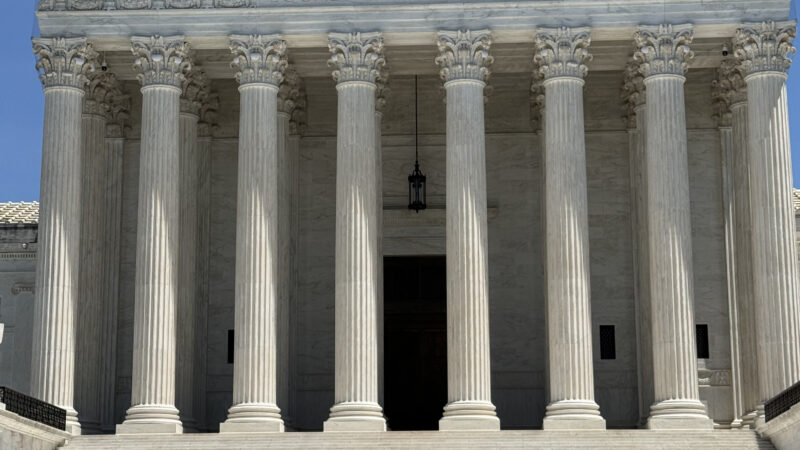
On May 4, with these numbers in the record and a federal lawsuit pending, Governor Ned Lamont signed Senate Bill 397 on the steps of the Connecticut Supreme Court. The new statute restricts federal arrests near schools, hospitals, and houses of worship without a judicial warrant; permits residents to sue federal officers in state court; and prohibits federal agents from concealing their identities except in narrow medical or emergency circumstances. Attorney General William Tong, addressing the gathered Democratic officials, declared from the steps that “we are sovereign in this state.”
The word is the giveaway. A state inside the federal Union is sovereign in some respects and not in others. It is not sovereign with respect to coining money, declaring war, or enforcing the immigration laws of the United States. To say otherwise is to say something the Constitution does not permit.
The Federalism Inversion
Senator Richard Blumenthal, standing alongside Tong, invoked the recent fatal ICE shootings in Minneapolis and told the crowd that what happened there could happen in Connecticut. The framing is conscious. The Lamont administration is treating ICE the way the antebellum state of South Carolina once treated federal customs officers: as visitors whose presence requires permission and whose authority can be conditioned on local terms.
The historical parallel is exact. John C. Calhoun theorized this same logic into a doctrine called nullification, and Andrew Jackson, with the Supremacy Clause as his shield, denounced it as incompatible with the Union itself. The contemporary version speaks the language of compassion rather than tariffs, but the constitutional structure of the claim is identical: a state authority asserting the right to suspend the operation of federal law within its own borders, on its own terms, by its own determination.
The constitutional answer has not changed since 1832. The Supremacy Clause, in operation since 1788, settles the question. Immigration is a federal subject. Detainers are issued under federal statute. State or local statutes that obstruct the exercise of those authorities sit in plain conflict with Article VI.
The Justice Department’s April lawsuit makes the argument plainly. Connecticut’s Trust Act, the complaint alleges, rejects the means Congress authorized to enforce federal immigration law and obstructs the federal government’s preeminent authority over immigration matters. The case extends an active campaign of similar suits the Department has brought against Minnesota, Boston, New York City, Los Angeles, New York State, Colorado, Illinois, Rochester, and several New Jersey cities. The pattern is national, and so is the answer the Department is asking the courts to give. Either federal law governs federal subjects, or it does not.
When Universities Sound the Alarm
The cultural confirmation arrived in early May from Eugene, Oregon. Beginning May 5, the University of Oregon is using its UO Alert emergency notification system to warn students and staff of the presence of federal immigration officers on campus. The system is the same one used to warn the campus of active shooters, fires, and what its own protocol describes as “imminent threats to health and/or safety.”
The university’s logic, articulated by Associate Vice President for Student Life Jimmy Howard in an April 30 email, is that the alerts will be triggered only after a designated team confirms ICE activity within minutes. The team includes representatives from the Office of the General Counsel, campus police, and Safety and Risk Services. The triggering equivalence, however, has already been made. The same tone of voice that warns of a gunman in Johnson Hall will now warn of an immigration officer outside the cafeteria. President Karl Scholz’s administration has accepted, by policy, that federal law enforcement engaged in lawful work belongs in the same category as an active shooter.
The University of Oregon did not invent the framing. Governor Tina Kotek’s administration imposed it. House Bill 4079, the Safeguarding Students and Families Act, was signed at the end of March and requires every public school and public university in Oregon to develop an ICE alert system by September 30. The University of Oregon simply moved early, in response to demands from a coalition that includes MEChA and the Young Democratic Socialists of America. The students have been instructed, by their state, that the men who enforce the immigration laws of the United States are something to flee. That instruction is now a written component of public higher education in Oregon.
The Citizen Pays More
The financial dimension of the same inversion arrived in federal court in early May. The Justice Department filed suit against New Jersey over a 2013 statute that grants illegal aliens in-state tuition rates at the state’s public colleges and universities. The disparity is concrete. At Rutgers University, a New Jersey resident pays $14,933 a year in tuition; an American citizen from any other state pays $35,758. At Montclair State, the New Jersey resident pays $15,678; the citizen from Pennsylvania, Ohio, or Texas pays $26,394. New Jersey law, the complaint alleges, extends the lower rate to illegal aliens who establish residency in the state, while denying it to American citizens who reside lawfully in any of the other 49.
The federal statute Congress wrote to prevent this arrangement, 8 U.S.C. § 1623, prohibits states from offering postsecondary education benefits to illegal aliens that are not equally available to U.S. citizens regardless of where in the country those citizens live. Congress passed the language in 1996 precisely to forestall the inversion New Jersey has now run for more than a decade. Assistant Attorney General Brett Shumate, whose name has appeared in the Department’s filings before, framed the suit in the only terms the facts allow: a system in which American students are “treated like second-class citizens in their own country.”
From Philadelphia to Hartford to New Brunswick, the operating premise is the same. The illegal alien is the favored category. The American citizen, whether in his neighborhood or in his college’s tuition office, is the residual.
Whose Country Is This
Strip the policies of their euphemisms and what remains is a single, repeating premise: the federal government does not possess the legitimate authority to enforce its immigration laws inside states whose officials prefer otherwise. Connecticut declares the federal warrant insufficient. Philadelphia declares the federal detainer impertinent. Oregon declares the federal officer a threat. Each declaration is offered, in its way, as a defense of constitutional values. None of it is. Constitutionalism has a name for what they are doing, and the name is nullification.
The deeper inversion is moral. A polity confers the highest protections on its own. The Athenian polis distinguished sharply between the citizen, the metic, and the foreigner. Roman citizenship was the most prized civic possession in the ancient world precisely because it carried legal protections that others did not enjoy. The American republic, founded on a different and superior premise, extends due process to all persons under its jurisdiction; but the differential between citizen and noncitizen has always been part of what made citizenship mean anything at all. Sanctuary policy collapses that distinction in one direction only, granting the illegal alien charged with a crime a tier of legal solicitude denied to the citizen charged with the same. The result is a system that has forgotten what it is for.
What the Cases Actually Show
The defenders of sanctuary insist that their statutes are public-safety measures, that immigrant communities will not cooperate with police if they fear deportation, that “trust” requires distance. The premise is plausible only at a distance. Up close, what the policies produce is the systematic release of named, charged, often previously convicted individuals into the same neighborhoods whose residents the policies are notionally meant to protect. A pedophile from Ecuador. A twice-convicted sex offender from Jamaica. A Honduran charged with stalking. A Dominican distributing fentanyl. Connecticut’s sanctuary regime offered no protection to the child Espinosa-Sarango is charged with abusing. The Krasner directive will offer none to the next victim of the next twice-deported assailant Philadelphia returns to the street.
By extending procedural protections to illegal aliens that exceed those granted to the citizen, sub-federal jurisdictions establish a working principle of legal nonequivalence: the illegal alien receives, by virtue of that status, more solicitude from the state than the citizen receives by virtue of birth. The implications run beyond immigration. A government willing to treat its own citizens as a residual category, last in the queue, is a government that has begun to understand citizenship itself as a problem.
The Question Before the Country
That is the question the federal lawsuits and the House Judiciary letters are forcing into the open. The deeper issue is whether the American republic still operates as a single legal order or has become, by accumulation, a federation of opt-outs in which national law applies where the locals permit it and not otherwise.
The answer the Trump administration is offering, through the Justice Department’s litigation campaign and the Judiciary Committee’s expanding inquiry, is the answer the Constitution requires: federal law governs federal subjects, the Supremacy Clause means what it says, and the citizen of the United States is owed the equal protection of his own laws. The answer Lamont, Krasner, and Kotek are offering, in their different registers, is the answer of nullification, dressed in the language of compassion.
The compassion, in any case, runs in only one direction. There is no comparable solicitude for the American citizens whose neighborhoods receive the released, whose hospitals treat the consequences, whose courts adjudicate the next charge, whose taxes underwrite each step of the system that has decided their citizenship is the lesser claim. The Connecticut child whom Espinosa-Sarango is charged with abusing did not benefit from the Trust Act. The Philadelphia neighborhoods to which Krasner has returned the twice-deported, the assailant, and the trafficker have not been made safer by the directive that returned them. The students at the University of Oregon will not be protected from anything by an alert system that treats federal officers as the threat.
A republic cannot endure permanently half sovereign and half opt-out, half operating under one law and half pretending the law does not run. The next chapter of this story will be written in federal court. Whether the country it produces still resembles the one its citizens recognize will depend on how plainly the courts are willing to say what the architects of sanctuary have already, in their own words, conceded.