Congressional Incumbents Are Losing Their Alibi
A new Napolitan survey finds 68% would replace the entire Congress, and congressional incumbents have lost their home-district advantage with voters.

The standing alibi of American incumbency has always been the local exception: voters loathe Congress in the aggregate while forgiving the member who answers their mail. A new Napolitan News Service survey of 1,000 registered voters, conducted by Scott Rasmussen, suggests the alibi is expiring.
Start with the topline. Asked whether they would keep or replace the entire Congress if the question were on the ballot today, 68% of voters chose replacement and 13% chose retention, a net of minus 55. When the same question was asked in October 2022, replacement stood at 61%. Contempt for the institution has deepened seven points in under four years and now runs better than five to one.
The sharper movement is closer to home. Asked whether their own representative is the best person for the job, 25% said yes and 38% said no, a net of minus 13. In April 2025 the same question ran six points positive; in July 2022, plus two. The home-district indulgence that sustained generations of incumbents flipped from asset to liability in 14 months.
The collateral findings are no kinder. Forty-eight percent of voters disapprove of their own representative’s performance against 34% who approve, and 9% concede they do not know who represents them. Forty-seven percent rate it very or somewhat likely that their own member trades votes for cash, against 30% who call it unlikely; that suspicion, a net of plus six in October 2022, has nearly tripled to plus 17. And 54% say a group of citizens selected at random, one from each congressional district, would do a better job than the Congress now seated, a margin of plus 35 that has widened five points since April 2025.
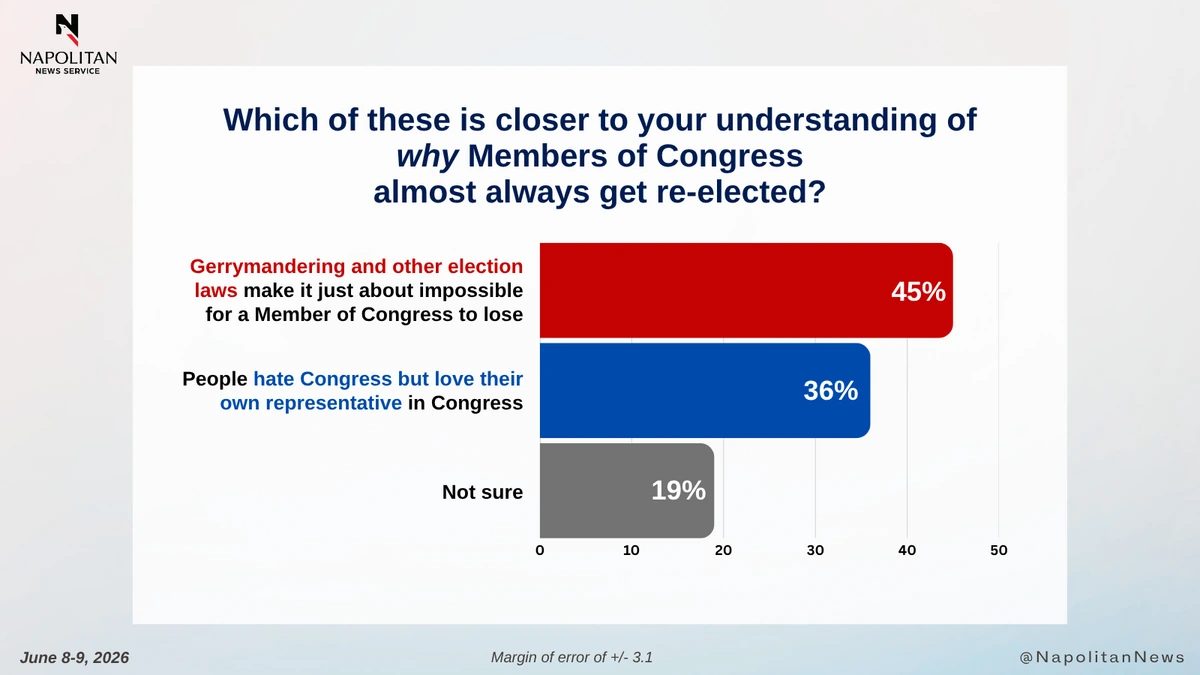
The survey then asked voters to explain a puzzle it framed directly: how do 94% of incumbents win re-election from an institution this despised? Offered two accounts, a 45% plurality chose the structural one, that gerrymandering and allied election laws have made it nearly impossible for a member to lose. Only 36% endorsed the older folk theory that “people hate Congress but love their own representative.” Democrats blame the rules by 55% to 33%; Republicans split, with 42% holding to the folk theory and 37% pointing to the maps. In the open-ended version, 21% cited voter behavior, 13% the absence of alternatives, 12% systemic corruption, and 10% the built-in advantages of office.
Read together, the numbers describe an electorate that has stopped blaming itself. Voters no longer profess affection for the members they keep returning to Washington; a plurality now locates the cause in rules built to make removal impossible. Whether that diagnosis is accurate is a separate question; that voters hold it is the finding. The belief is more corrosive than ordinary disapproval because it converts frustration into fatalism: nearly half the country suspects its own representative of selling votes while doubting the ballot box can do anything about it. The survey’s margin of error is 3.1 points. The margin of institutional credibility looks considerably thinner.