The Hate Map’s Ledger
The Department of Justice has filed the case that fifteen years of conservative reporting already made. The record is older than the indictment, and the cost has not yet been counted.
Start with the count. Eleven.
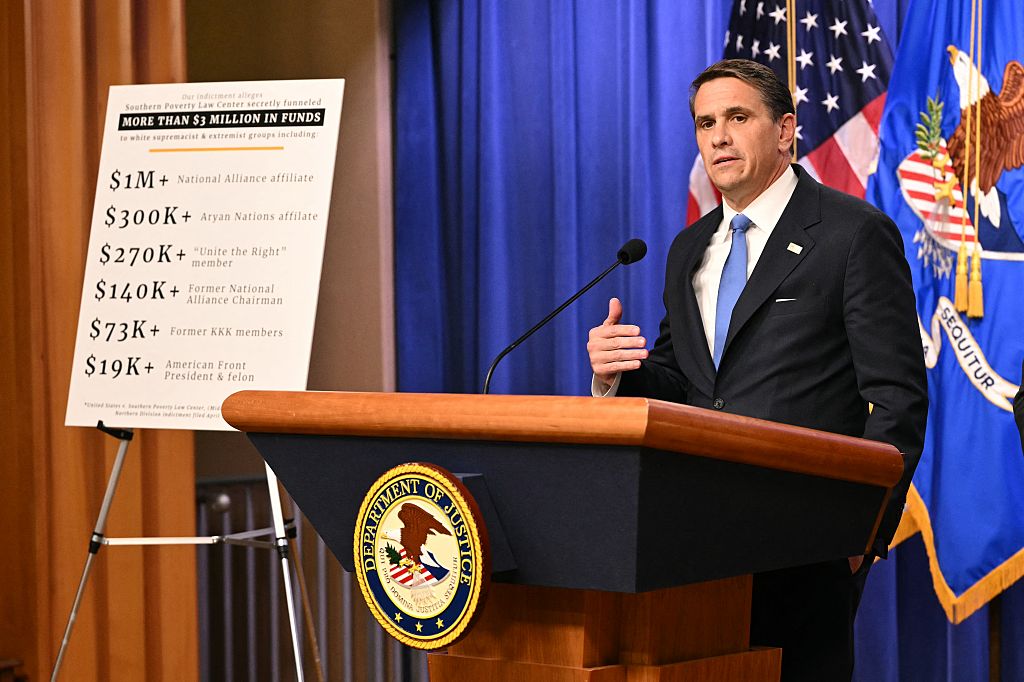
On April 21, 2026, a federal grand jury in Montgomery, Alabama returned an eleven-count indictment against the Southern Poverty Law Center. Six counts of wire fraud. Four counts of false statements to a federally insured bank. One count of conspiracy to commit concealment money laundering. The U.S. Attorney’s Office for the Middle District of Alabama filed two separate forfeiture actions to recover the proceeds.
The central allegation, for anyone who has ever written a check to the organization: between 2014 and 2023, the SPLC secretly funneled more than $3 million in donated funds to individuals associated with violent extremist groups including the Ku Klux Klan, Aryan Nations, and the National Socialist Party of America. Per the indictment, SPLC opened bank accounts in the names of at least five fictitious entities with no bona fide employees and no legitimate business purpose, in order to hide the flow of money. One paid informant received more than $1 million between 2014 and 2023 while affiliated with the neo-Nazi National Alliance. Another, allegedly paid more than $270,000 across eight years, participated in the online leadership chat that planned the 2017 Unite the Right rally in Charlottesville, attended the rally at SPLC’s direction, and coordinated transportation for other attendees.
Acting Attorney General Todd Blanche, at the Justice Department press conference announcing the charges:
The SPLC is a nonprofit entity that purports to fight white supremacy and racial hatred by reporting on extremist groups and conducting research to inform law enforcement groups with the goal of dismantling these groups. The SPLC was not dismantling these groups. It was instead manufacturing the extremism it purports to oppose by paying sources to stoke racial hatred.
Read that quote twice. That is the Acting Attorney General of the United States, with a grand jury behind him, describing what the Southern Poverty Law Center has been for the last decade.
None of it is news to anyone who was paying attention.
The Map Has a Body Count
The SPLC hate map predates the indictment. So does its body count.
On August 15, 2012, a man named Floyd Lee Corkins II walked into the Family Research Council’s headquarters in Washington, D.C. carrying a 9mm pistol, extra ammunition clips, a box of rounds, and a bag of Chick-fil-A sandwiches that prosecutors later said he planned to smear on the faces of his victims. He shot FRC security guard Leo Johnson in the arm. Johnson, wounded, disarmed him. That is the only reason the day is not remembered as a mass shooting at a Christian nonprofit in the nation’s capital. Corkins pleaded guilty to committing an act of terrorism while armed and was sentenced to 25 years in federal prison.
On video, to the FBI, Corkins explained how he had selected his target:
Southern Poverty Law lists anti-gay groups. I found them online, did a little research, went to the website, stuff like that.
A second list of targets was recovered from him. It included the Traditional Values Coalition, also on the SPLC hate map.
Thirteen years later, the Family Research Council is still on that map.
On May 3, 2015, two ISIS-pledged jihadists named Elton Simpson and Nadir Soofi drove from Phoenix to the Curtis Culwell Center in Garland, Texas, wearing body armor and carrying three rifles, three handguns, and 1,500 rounds of ammunition. Their target was a Muhammad cartoon contest hosted by Pamela Geller’s American Freedom Defense Initiative, an organization the Southern Poverty Law Center had spent years labeling an anti-Muslim hate group. The attackers fired on unarmed Garland Independent School District security officer Bruce Joiner, 58, hitting him in the ankle. Garland Police Officer Gregory Stevens, armed only with a service pistol, returned fire and wounded both. SWAT officers finished the job. ISIS publicly claimed responsibility within 48 hours. It was the first attack on U.S. soil for which the Islamic State took credit.
Twelve hours after the attack, the press did what the press always does. Every major outlet cited SPLC’s designation of Geller’s organization as a hate group and proceeded to treat her as the problem.
Geller was the target of the attack. She was not the cause of it. Simpson and Soofi had selected an American event featuring cartoons because a religion that criminalizes those cartoons told them to. SPLC’s contribution was to have pre-painted Geller’s organization as morally indistinguishable from the Klan, so that when two armed jihadists actually tried to kill her, the ideological framing was already in place in every reporter’s inbox.
On June 14, 2017, a 66-year-old man named James Hodgkinson opened fire on a congressional Republican baseball practice at Eugene Simpson Stadium Park in Alexandria, Virginia. He fired at least 70 rounds from a 9mm pistol and an SKS rifle. House Majority Whip Steve Scalise was shot in the hip, suffered critical injuries, and nearly died. Capitol Police agents returned fire and killed Hodgkinson. Inside his van, the FBI recovered a handwritten list of six House Freedom Caucus Republicans with their Capitol Hill office room numbers written next to each name: Representatives Scott DesJarlais, Trent Franks, Jeff Duncan, Jim Jordan, Mo Brooks, and Morgan Griffith.
SPLC did not tell Hodgkinson to shoot anyone. What SPLC did, beginning with a December 2014 Hatewatch article by Mark Potok titled “Steve Scalise’s denials are not believable,” was spend years painting Scalise as a white supremacist sympathizer through its own publications and the liberal press ecosystem that treats SPLC’s characterizations as fact.
When an angry man with a rifle and a list of names showed up at the Republican baseball practice, the relevant question was not whether SPLC had pulled the trigger. It was who had told him which congressmen to point it at.
On September 10, 2025, Charlie Kirk was assassinated at Utah Valley University. He was 31 years old and the father of two. Four months earlier, in May 2025, SPLC had added Turning Point USA to its hate map. In its 2024 Year in Hate and Extremism report, the organization featured Turning Point as a “case study of the hard right.” Before his death, Kirk warned on Fox News that the hate map designation would put his organization “in the crosshairs.” He cited the 2012 FRC shooting by name as the precedent.
Kirk’s assassin, Tyler Robinson, did not cite SPLC. That distinction matters. Do not let anyone blur it.
What matters more is that Kirk cited SPLC himself, on camera, as a proximate danger to his life. He was shot months later. In early October 2025, FBI Director Kash Patel terminated all federal ties with the organization and described SPLC as a “partisan smear machine” whose hate map “has been used to defame mainstream Americans and even inspired violence.”
That is the Director of the Federal Bureau of Investigation. Not a blogger. Not a columnist. The Director of the Bureau that, until Kirk’s death, had formally listed SPLC as a resource on its hate crime web page.
Read the Map Again
The hate map is not a civil rights document. It is an accountability document. Start reading it as one.
Per the SPLC’s own 2024 Year in Hate and Extremism report, the organization documented 1,371 hate and antigovernment extremist groups in the United States last year. The useful breakdown is the one the report would rather readers glide past. Of the 533 groups the SPLC formally classifies as hate groups in 2024, only 118 are white nationalist, 61 are neo-Nazi, 14 are Ku Klux Klan, 10 are racist skinhead, and four are neo-Confederate. That is 207 groups, a little over a third of the hate-group total, that fit the category the average donor has in mind when writing a check to an organization named after a civil rights lawsuit.
The remaining two-thirds are where the real work gets done. Ninety-six groups are classified as “anti-LGBTQ.” Forty-one are “Christian identity.” Thirty-one are “anti-Muslim.” Sixteen are “male supremacy.” Seventeen are “anti-immigrant.” Eight, as of 2024, are listed under a new SPLC category titled “radical traditional Catholicism.”
The organizations currently on the map, alongside active Klan chapters and neo-Nazi cells, include:
The Alliance Defending Freedom, a Christian legal organization that has won multiple cases before the U.S. Supreme Court. The Family Research Council, still listed thirteen years after a domestic terrorist used the map to target it. Focus on the Family. The American Family Association. Liberty Counsel. Pacific Justice Institute. Moms for Liberty, a school-board advocacy group of mothers. Gays Against Groomers, an organization of gay and lesbian adults opposed to the sexualization of minors. Parents Defending Education. Do No Harm, a physicians’ association that opposes the medicalization of children. The David Horowitz Freedom Center. Turning Point USA. The Center for Immigration Studies. The Federation for American Immigration Reform. NumbersUSA. The Dustin Inman Society, a Georgia group with legal immigrants on its board that opposes illegal immigration.
Normal Americans, of course, understand the difference between a Klan chapter and a law firm that argued 303 Creative v. Elenis before the Supreme Court. The SPLC does not. That is not an oversight. That is the product.
The commercial consequences are real. A private corporate-donation platform called Benevity, used by hundreds of companies to process employee-matching contributions to nonprofits, uses the SPLC hate map as a gatekeeper. Organizations SPLC labels are blocked from receiving those matched donations. The hate map is not a label. It is a financial choke point, privately enforced against groups the United States government cannot constitutionally defund.
The asymmetry cuts the other way too. In 2016, SPLC added White Lives Matter to its hate map. Asked in the same news cycle why Black Lives Matter was not on the list, the SPLC’s published answer was that it had “heard nothing remotely comparable” from the founders of BLM to what it heard from white-separatist groups. One is entitled to that view. One is not entitled to that view and also to the privilege of posing as a neutral, evidence-based watchdog.
Defamation by Subscription
The hate map is the visible product. The defamation racket is the business model.
On June 18, 2018, SPLC paid the British counter-extremism activist Maajid Nawaz and the Quilliam Foundation $3.375 million in settlement and issued a formal video apology. SPLC had included Nawaz and Quilliam in its 2016 publication “A Journalist’s Manual: Field Guide to Anti-Muslim Extremists,” alongside actual Islamists, and labeled them causes of “hate-based violence.” Nawaz is a former Islamist who renounced extremism and founded Quilliam in London to oppose it. Quilliam worked with human rights advocates affiliated with the United Nations.
SPLC’s own insurance carrier paid the settlement.
That is the detail that tells you what kind of business is actually being run. A defamation settlement covered by malpractice insurance is not an apology. It is a recurring operational cost.
The pattern long predates Nawaz. Ayaan Hirsi Ali, a Somali-born survivor of female genital mutilation and a prominent critic of Islamist violence, was named as an anti-Muslim extremist in the same 2016 field guide. Dr. Ben Carson was added to SPLC’s Extremist Watch List in October 2014 and quietly removed four months later after public backlash. The Traditional Values Coalition was on Floyd Corkins’s second target list in 2012. Pamela Geller’s AFDI was on the hate map when ISIS-pledged gunmen tried to shoot up her event in 2015. Turning Point USA was added four months before its founder was shot in the neck.
The other lawsuits have mostly failed, for a structural reason. Under New York Times Co. v. Sullivan (1964), a defamation plaintiff who qualifies as a public figure must prove actual malice, meaning the defendant published the statement knowing it to be false or with reckless disregard for whether it was true. That standard was written to protect civil-rights-era journalism from state-court juries in the Deep South. It now serves primarily to protect a $500 million Alabama-based nonprofit from its smeared targets.
In January 2019, the Center for Immigration Studies filed a RICO lawsuit against SPLC President Richard Cohen and Hatewatch director Heidi Beirich. Judge Amy Berman Jackson of the U.S. District Court for the District of Columbia dismissed it in September 2019 for failure to state a RICO claim.
One case got further than the others. The Dustin Inman Society, a Georgia group named for a 16-year-old boy killed by an illegal alien driver and led by the late D.A. King, sued SPLC after being added to the hate map in February 2018. The society’s board includes legal immigrants. King’s adopted sister is herself a legal immigrant. The case was especially strong because the SPLC had told the Associated Press in 2011 that it did not consider the society a hate group, then reversed course in 2018 within days of the society registering as a lobbyist against pro-enforcement immigration bills in Georgia. Judge W. Keith Watkins of the Middle District of Alabama denied SPLC’s motion to dismiss in April 2023. The case moved to discovery. It was then transferred to Judge Corey L. Maze of the Northern District of Alabama, who dismissed most of the claims in January 2026 on statute-of-limitations and actual-malice grounds.
King’s estate appealed to the Eleventh Circuit on April 17, 2026. The DOJ returned the indictment four days later.
Inside the Federal Agencies
The pipeline between the SPLC and the United States government was documented in public view more than a decade ago. It has only gotten deeper since.
The story begins on April 7, 2009, when the Obama Department of Homeland Security distributed an internal intelligence report written by a senior analyst named Daryl Johnson titled “Rightwing Extremism: Current Economic and Political Climate Fueling Resurgence in Radicalization and Recruitment.” The report warned that “rightwing extremists” might target returning Iraq and Afghanistan veterans for recruitment and cited Timothy McVeigh as the archetype. After public outcry from the American Legion and veterans’ groups, DHS Secretary Janet Napolitano apologized for the veteran references, and the report was quietly withdrawn. The Southern Poverty Law Center publicly defended it, noting in a subsequent interview with Johnson himself that the findings were “in line with similar findings by the Southern Poverty Law Center.” Johnson’s domestic-terrorism unit was later disbanded. The category work did not go away. It simply migrated.
In February 2015, DHS produced a new intelligence assessment, this time focused on “sovereign citizen” extremists. It was marked For Official Use Only, which was supposed to mean for law enforcement, not for publication. It was leaked to CNN, which then ran “DHS intelligence report warns of domestic right-wing terror threat,” complete with a map of 24 alleged incidents of sovereign-citizen violence since 2010 and an assertion that federal and local law enforcement viewed the domestic right-wing threat as equal to or in some cases greater than the threat from ISIS.
That was February 2015. ISIS was in the process of establishing a caliphate across Syria and Iraq. Three months later, its pledged soldiers would attempt to shoot up a cartoon contest in Garland, Texas.
CNN’s on-the-record authority on the domestic sovereign-citizen threat was Mark Potok of the Southern Poverty Law Center. Potok claimed there were as many as 300,000 Americans involved in sovereign-citizen extremism, with 100,000 forming the core of the movement. Neither figure was sourced to anything beyond his estimate. When other reporters asked DHS and CNN for the underlying document, DHS declined to release it. CNN said it was not a public document. The public could read CNN’s characterization, and the SPLC’s framing, and nothing else.
That is the operation in miniature: a classified-ish government threat assessment, an activist nonprofit laundering the narrative on television, and a refusal to let anyone else see the underlying paper.
Eight months later, the next step arrived in public. An October 2015 dispatch at Politically Short documented Assistant Attorney General John P. Carlin announcing the creation of a new Domestic Terrorism Counsel position inside the Department of Justice, at an event co-sponsored by George Washington University’s program on extremism and the Southern Poverty Law Center. In his remarks, Carlin referred to the organization as “our SPLC colleagues.” The SPLC’s own 2014 Annual Report celebrated the arrangement openly. The investigative team had “trained thousands of law enforcement officials” and had “successfully pushed the federal government to reinstate a high-level task force on domestic terrorism.” In 2013 alone, per the report, SPLC provided training sessions to more than 5,000 law enforcement officers. Judicial Watch had already obtained FOIA emails from 2012 showing SPLC co-founder Morris Dees personally conducting a “diversity training event” for Department of Justice staff.
The operational payoff came inside the FBI, in January 2023. The FBI’s Richmond Field Office produced an internal memorandum identifying “radical traditionalist Catholics” as a category of “racially or ethnically motivated violent extremists” deserving of investigative attention. When the memo leaked, FBI Director Christopher Wray publicly described it as an isolated document produced by a single field office.
That was not true.
After Director Kash Patel took office in 2025 and cooperated with congressional oversight, the Senate Judiciary Committee and the House Judiciary Committee obtained over 1,300 additional pages of documents that had been withheld under Wray. The record was clearer than almost anyone had assumed. At least thirteen FBI documents, plus five attachments, used the “radical traditionalist Catholic” terminology. All cited the Southern Poverty Law Center as the source for the category. The Richmond memo was distributed to more than a thousand FBI employees before the whistleblower exposed it. The FBI’s Buffalo field office responded with concern about SPLC-identified “hate groups” located in its area of responsibility. FBI Headquarters drafted a second, nationwide memorandum on the same subject. It was shelved only because the first one leaked.
One FBI agent wrote to a colleague in an email later reproduced in the Senate report:
[O]ur overreliance on the SPLC for hate designation is . . . problematic.
Patel has since formally admonished the employees involved and adjusted the FBI’s source-recruitment structure to prevent the placement of sources inside houses of worship. None of that was initiated because the SPLC was charged with anything. All of it was initiated because the SPLC’s hate designations had become the connective tissue between a private Alabama nonprofit and the national-security bureaucracy of the United States government.
The Offshore Balance Sheet
The money tells the same story.
An April 2019 Politically Short piece documented a letter Senator Tom Cotton of Arkansas had just sent to the IRS Commissioner calling for an investigation into whether the SPLC should retain its 501(c)(3) classification. The core Cotton finding was already damning in 2019:
The SPLC’s defining characteristic is to fundraise off of defamation. This business model has paid well. The SPLC has accrued more than $500 million in assets. According to the group’s most recent financial statement, it holds $121 million offshore in non-U.S. equity funds. The SPLC uses these assets to pay its executives lavish salaries far higher than the comparable household average.
The Cayman Islands specifics were publicly available if anyone wanted to look. Per IRS Form 8865 and Form 926 filings reviewed by the Washington Free Beacon, SPLC transferred $960,000 in cash to Tiger Global Private Investment Partners IX, L.P. in the Cayman Islands on November 24, 2014. Another $102,007 went to BPV-III Cayman X Limited on December 24 of the same year. Another $157,574 a week after that. On March 1, 2015, SPLC sent $2.2 million in cash to AQR Managed Futures Offshore Fund Ltd., and on the same day, a second $2.2 million to AQR Style Premia Offshore Fund Ltd., both registered to the same Grand Cayman address. The Daily Signal reported in July 2025 that SPLC still carried more than $30 million in offshore accounts.
The executive compensation, drawn from SPLC’s own Form 990 filings, was its own indictment. Morris Dees, Chief Trial Counsel: $303,936 in 2008, $375,181 by 2017. Richard Cohen, President and CEO: $299,598 in 2008, $364,799 by 2017. Rhonda Brownstein, Legal Director: $146,048 in 2008, $222,606 by 2017. Wendy Via, Chief of Development and Communications: $117,000 in 2008, $244,922 by 2017. Total legal services spending by the “law center” during the same period: approximately $61,000 a year.
Not bad for working at a poverty law center.
The House Turns on Itself
The internal collapse of 2019 told the same story from the inside.
On March 14, 2019, SPLC fired Morris Dees. Internal emails obtained by the Alabama Political Reporter revealed the firing followed allegations of sexual harassment by Dees and a broader pattern of gender and racial discrimination inside the organization. The catalyst was a resignation letter from Meredith Horton, SPLC’s highest-ranking Black woman attorney, describing the hardships faced by women and employees of color. Roughly two dozen SPLC employees signed a subsequent letter to management stating that “allegations of mistreatment, sexual harassment, gender discrimination, and racism threaten the moral authority of this organization and our integrity along with it.” One former employee described the internal culture as defined by “the unchecked power of lavishly compensated white men at the top.”
Within a week of Dees’s firing, SPLC President Richard Cohen resigned. Legal director Rhonda Brownstein resigned. In December 2019, SPLC staff voted to unionize, 142 to 45. The hate watchdog had a civil rights problem with its own employees, and those employees said so on the record.
The Bill
The through-line is now a federal filing.
For fifteen years, a small number of conservative researchers and reporters documented the Southern Poverty Law Center as a litigation-based fundraising operation that raised money by manufacturing accusations, parked the proceeds offshore, and paid its executives accordingly. For fifteen years, they were treated, by the liberal press and by the polite parts of the conservative establishment, as cranks. The hate map was treated as a reference work. Hatewatch was cited by major newspapers. SPLC’s training materials sat inside the FBI, the DOJ, and the U.S. military. Its executives sat on panels with Assistant Attorneys General and were referred to, from the podium, as “our colleagues.” Its hate designations were used by a federal field office to draft intelligence memoranda on the religious practice of American Catholics.
Now a federal grand jury in the same state where the SPLC was founded has returned an eleven-count indictment alleging that the organization labeled Christians, conservatives, and counter-jihad activists as Klansmen while, between 2014 and 2023, paying the actual Klansmen.
The counts are not figurative. The count is eleven.
The cost of the operation will not appear on the indictment. It appears somewhere else. On a security guard shot in the arm outside the Family Research Council in Washington in 2012. On a school-district security officer shot in the ankle outside a cartoon contest in Garland, Texas, in 2015, while the Islamic State claimed credit from across the world. On a House Majority Whip shot outside a baseball diamond in Alexandria in 2017. On a Catholic priest in Richmond, Virginia, interviewed by the FBI in January 2023 because his religion had been categorized by a private Alabama nonprofit as a domestic-extremism risk. On a 31-year-old father of two assassinated at a campus in Orem, Utah, in 2025, months after the SPLC placed his organization on its hate map and he predicted, on camera, that the designation would put him in the crosshairs.
The one thing every one of these victims has in common is that they were not, in fact, white supremacists or Klansmen. The Klansmen were on the SPLC payroll.